

Key Takeaways
Option A
Motorway
The highest-grade road - strictly controlled access and the fastest legal speeds.
Best for: Long-distance, high-speed travel between major cities or regions, with no junctions, cyclists, or pedestrians.
Option B
Dual Carriageway
A fast, divided road - but with fewer restrictions and more entry points.
Best for: Faster inter-town travel where at-grade junctions, cyclists, and local traffic may still be present.
If you want to cover long distances quickly with minimal interruptions
Motorway
Motorways are engineered for uninterrupted high-speed travel, with no at-grade crossings or local junctions to slow you down.
If you are a learner driver or supervising one
Dual Carriageway
Learners are legally banned from motorways without a qualified driving instructor in a dual-controlled vehicle, so dual carriageways offer the next best high-speed practice environment.
If you are cycling or travelling on a low-powered moped
Dual Carriageway
Motorways are legally off-limits to cyclists, pedestrians, and vehicles under 50cc - dual carriageways do not carry those restrictions.
If you need to exit frequently for deliveries or local stops
Dual Carriageway
Dual carriageways often have more frequent exits and at-grade junctions, making them more practical for routes with multiple stops.
Why Drivers Confuse These Two Road Types
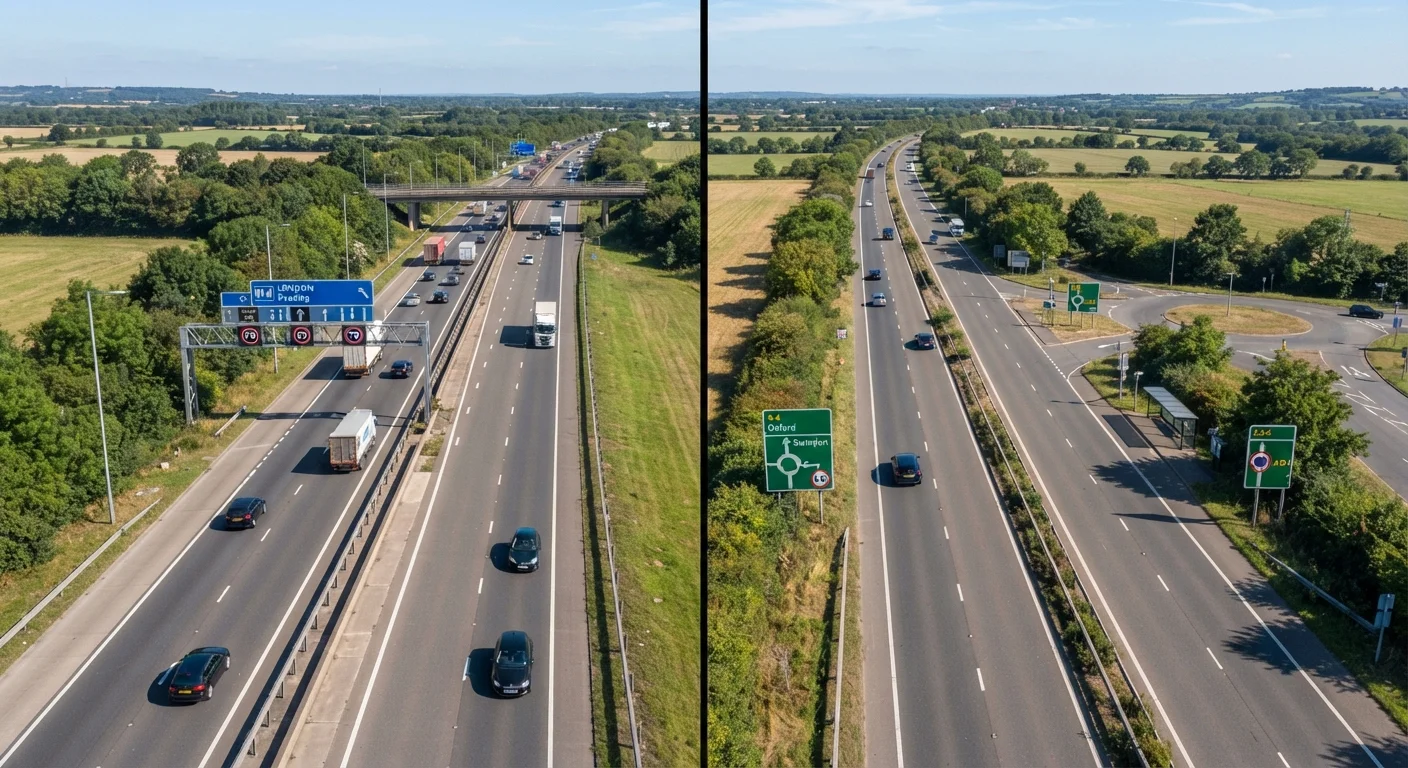
Both road types have two lanes running in each direction, with a central reservation separating opposing traffic. At a glance - especially at speed - they can feel identical. But the legal and safety differences are significant enough that every driver should know them.
The simplest way to tell them apart is the signage. Motorway signs are blue with white text, and the road is designated with an 'M' number (M1, M25). Dual carriageway signs are green, like most A-roads. If you see a blue sign, you are on or approaching a motorway. If it's green, you're likely on a dual carriageway - even if it looks very similar.
For a broader look at signs that trip up experienced drivers, see our guide to commonly misread road signs.
| Criterion | Motorway | Dual Carriageway |
|---|---|---|
| Sign colour | Blue with white text | Green with white text |
| Road designation | M-number (e.g. M1) | A-number (e.g. A1(M) or A14) |
| Learner drivers allowed | Only with approved instructor | Yes |
| Cyclists / pedestrians allowed | No - prohibited by law | Yes |
| Speed limit (cars) | 70 mph national limit | 70 mph national limit |
| Junction type | Slip roads only | Slip roads, roundabouts, traffic lights |
| Hard shoulder | Usually present (check for smart motorway) | Not standard |
| Low-powered vehicles (<50cc) | Prohibited | Permitted |
Access, Junctions, and Who Can Use Each Road
This is where the differences become legally important. Motorways are restricted access roads. By law, the following are prohibited from using them:
- Learner drivers (unless accompanied by an approved driving instructor in a dual-controlled car)
- Cyclists and pedestrians
- Motorcycles under 50cc and vehicles incapable of exceeding 25 mph
- Agricultural vehicles
Dual carriageways carry none of those blanket restrictions. Cyclists, learners, and low-powered vehicles can all legally use them, which means you need to be more alert to slower or unexpected road users - especially at night or in poor visibility.
Motorway junctions use slip roads designed for vehicles to accelerate or decelerate without impeding through traffic. Dual carriageways may have roundabouts, traffic lights, or simple give-way junctions where vehicles join directly - sometimes with limited run-up distance. That difference in junction design has a direct impact on how you approach joining and leaving each road type.
70 mph
National speed limit on both road types
The same limit applies to cars on motorways and dual carriageways, though variable limits on smart motorways can reduce this.
~33%
Share of road fatalities on motorways and dual carriageways
UK Department for Transport data consistently shows these high-speed road types account for a significant portion of fatal collisions despite carrying less traffic than urban roads.
Speed Limits, Lane Discipline, and Hard Shoulders
The national speed limit of 70 mph applies to both motorways and dual carriageways for cars and motorcycles in good conditions. Lower limits apply for larger vehicles - lorries and buses are limited to 60 mph on both road types. Always check posted signs, as variable limits are increasingly common on smart motorways.
Remember that the posted limit is a legal ceiling, not a target. Speed limits and genuinely safe speeds are not the same thing - conditions, visibility, and traffic flow all affect what's appropriate.
Lane discipline rules are the same: keep left unless overtaking, and return to the left lane once you've passed. But the consequences of poor lane discipline are more severe at motorway speeds, where closing distances are much shorter.
Hard shoulders are a standard feature on traditional motorways, giving a refuge in a breakdown. Dual carriageways typically do not have them. If your car develops a problem on a dual carriageway, your options are more limited - making it more likely you'd need to stop on a live lane or find a nearby layby. For a breakdown on either type of high-speed road, knowing the right steps could protect your life.
Practical Tips for Driving Confidently on Both
Understanding the road type you're on changes how you should drive, not just what rules apply.
- Before joining a motorway: Use the slip road to match the speed of traffic before merging. Do not stop at the end of the slip road unless traffic is stationary.
- On a dual carriageway: Watch for vehicles joining from side roads or roundabouts - they may not have enough space to accelerate fully before entering your lane.
- Exiting: Signal early, move to the left lane well in advance of your junction, and avoid last-minute lane changes.
- If you're a new driver: Build confidence on dual carriageways first. They expose you to higher speeds and divided traffic without the full demands of motorway driving. When you're ready, our guide to driving on motorways for the first time covers what to expect.
What About 'A(M)' Roads?
Some roads carry a designation like A1(M), which signals an A-road that has been upgraded to motorway standard. These carry full motorway rules - including the ban on cyclists and learners - even though they started life as an A-road. Look for the blue signs; if they're there, motorway rules apply regardless of the letter in the designation.