

Key Takeaways
Start here
What Makes Motorways Different
Core skill
Joining the Motorway: Getting the Merge Right
Build confidence
Lane Discipline and Overtaking
Stay in control
Keeping Up with Traffic and Managing Speed
Complete the journey
Leaving the Motorway
Before you set off
Before You Go: Prep That Actually Helps
What Makes Motorways Different
Motorways are not just faster roads - they operate by a different set of rules and demand a different kind of attention. Traffic moves quickly and consistently, there are no traffic lights or roundabouts to break the flow, and junctions are spaced far apart. That combination is what makes them feel unfamiliar the first time.
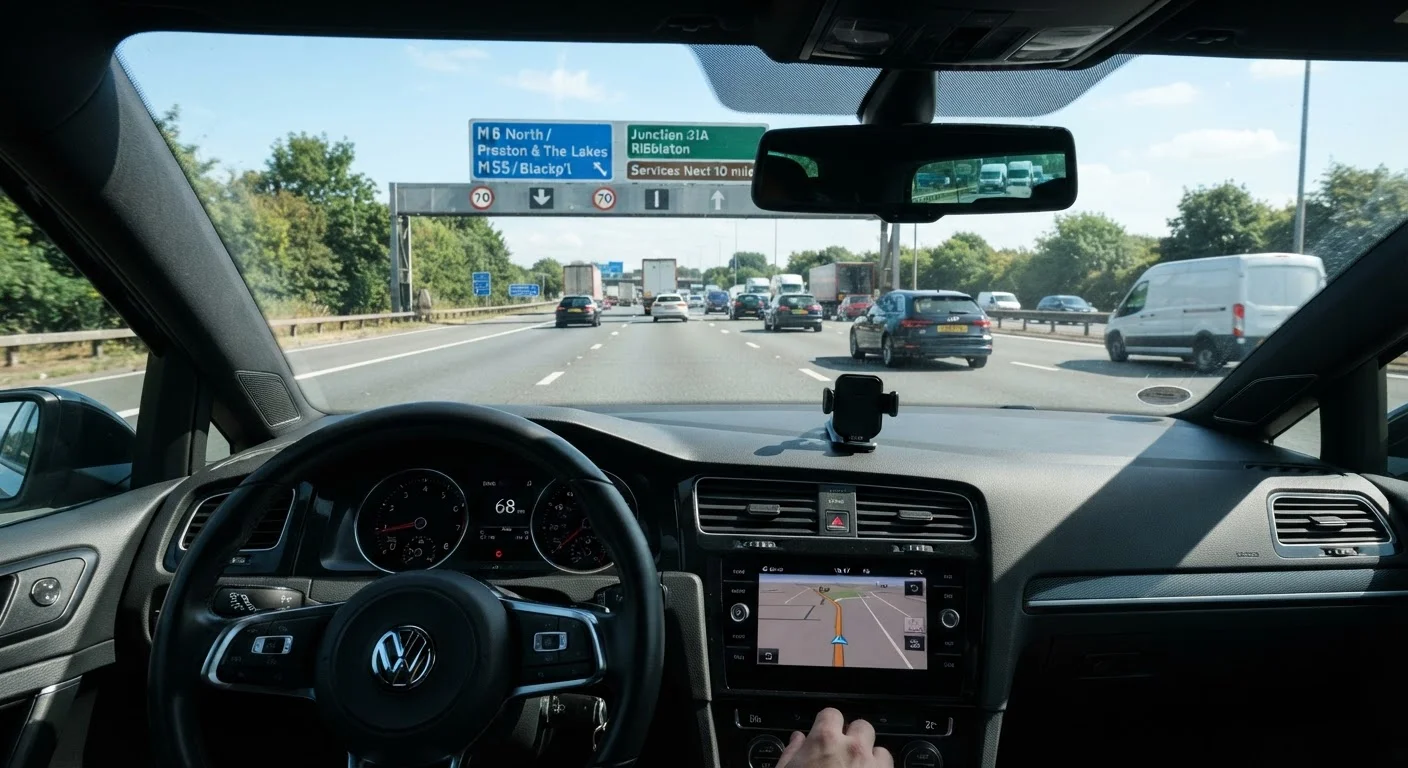
The key differences from an ordinary A-road include: no pedestrians, cyclists, or learner drivers (unless the rules in your region have changed); a national speed limit of 70 mph in the UK; lane markings that have specific, enforceable meanings; and overhead gantry signs that carry legal force when lit. See our guide to motorways versus dual carriageways if you are unsure which type of road you are on.
Slip road
The short joining or leaving lane that connects ordinary roads to a motorway. Sometimes called an acceleration or deceleration lane depending on direction of travel.
Lane discipline
The practice of using lanes according to their intended purpose - keeping left except when overtaking - rather than staying in whichever lane feels comfortable.
Gantry sign
An overhead structure spanning the motorway that displays variable speed limits, lane closures (red X), or hazard warnings. When lit, these signs are legally enforceable.
Stopping distance
The total distance a vehicle travels from the moment a driver sees a hazard to the moment the car stops. It includes thinking distance plus braking distance, and grows rapidly with speed.
Hard shoulder
A paved strip running along the left edge of a motorway, reserved for genuine emergencies and breakdowns. On smart motorways, it may be in use as a running lane when signed.
Undertaking
Passing another vehicle by moving into a lane to its left. This is generally illegal on UK motorways except when traffic in all lanes is slow-moving.
Joining the Motorway: Getting the Merge Right
The slip road (also called the acceleration lane) is your runway. Its entire purpose is to let you build speed so you can slot into moving traffic without forcing anyone to brake. Use the full length of it.
Watch the gap in the left lane as you accelerate. Signal early, check your mirror and blind spot, and aim to match the speed of traffic before crossing the solid white line. If the gap is not there yet, adjust your speed - but do not come to a stop at the end of the slip road unless traffic is completely stationary. Merging at 40 mph into a 70 mph lane is one of the most common mistakes new motorway drivers make.
If the gap is not there, adjust early
Rather than committing to a merge and hoping a gap appears, read the traffic further ahead while still on the slip road. Easing off slightly to let a cluster of vehicles pass - then accelerating into the space behind them - is smoother and safer than forcing your way in at the last moment.
Lane Discipline and Overtaking
The left lane is the default lane - always. Move to the middle lane only to overtake a slower vehicle, then return to the left. The right lane is for overtaking only; in normal conditions you should not cruise there even if traffic is light.
When overtaking, check mirrors, signal, move out smoothly, pass at a steady pace, signal left, and return once you can see the vehicle you passed in your rear-view mirror. Avoid sitting alongside another vehicle for extended periods - it puts you in someone's blind spot and limits your own escape routes.
Undertaking - passing on the left - is generally prohibited and dangerous. The only exception in UK law is when traffic in all lanes is moving slowly in a queue.
Keeping Up with Traffic and Managing Speed
One of the most disorienting things about a first motorway trip is how quickly everything feels. At 65 mph you are covering about 95 feet every second. That means the gap between you and the car ahead shrinks far faster than it does on a 30 mph street.
Use the two-second rule as a baseline in dry conditions: pick a fixed point - a bridge, a line on the road - and count two seconds after the vehicle ahead passes it. If you reach the same point before finishing your count, you are too close. In rain or poor visibility, double the gap.
Watch for brake lights further ahead, not just the car directly in front. Early awareness gives you time to ease off the accelerator gradually rather than braking hard. Smooth deceleration is safer and keeps traffic flowing. For longer journeys, managing fatigue is a real concern - tiredness impairs reaction time significantly at motorway speeds.
Speed feels slower than it is at motorway pace
After 20-30 minutes at 70 mph, your brain adapts to that speed and slower speeds begin to feel normal. This is called speed adaptation and it makes slip roads and junctions after a long motorway run genuinely hazardous. Always check your speedometer when leaving the motorway rather than relying on how fast you feel you are going.
Leaving the Motorway
Motorway exits are signposted in advance - typically at one mile, half a mile, and then at the exit itself. Start counting down the marker posts (small numbered posts on the left verge) when you see the half-mile board, and move into the left lane well before the exit.
Signal as you reach the countdown markers and ease off the accelerator on the slip road - your speed will feel lower than it actually is after a long motorway stretch. Check your speedometer rather than relying on instinct; many drivers carry motorway speeds into roundabouts or sharp bends at the end of slip roads. If you miss the exit, continue to the next junction. Never reverse on a motorway under any circumstances.
Before You Go: Prep That Actually Helps
A breakdown on a motorway is stressful and genuinely dangerous. A few checks before setting off reduce that risk significantly. Run through tyres (pressure and condition), fuel, engine oil, and lights - a full pre-journey checklist is covered in our pre-long-drive vehicle check.
Plan your route before you leave so you know which junction number you need - searching for a junction name while travelling at 70 mph is a serious distraction. If something goes wrong while you are on the road, our motorway breakdown guide walks through exactly what to do. And if you are still building general confidence as a new driver, the first car ownership primer covers the broader responsibilities that come with getting on the road.