

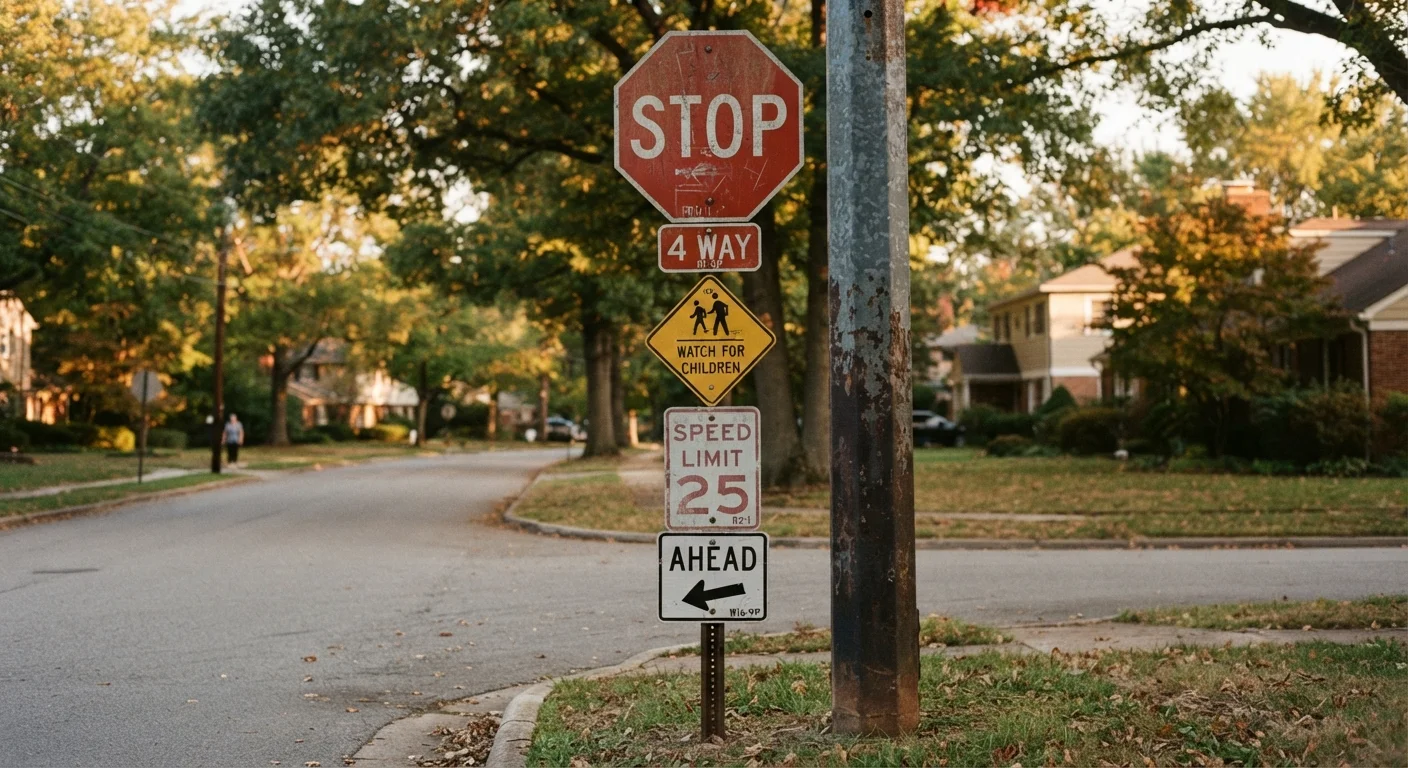
| Sign shape: Stop | Octagon (8-sided), red with white border (MUTCD (Manual on Uniform Traffic Control Devices)) |
| Sign shape: Yield | Downward-pointing triangle, red and white (MUTCD) |
| Sign shape: Warning | Diamond, yellow or orange background (MUTCD) |
| Sign shape: Regulatory (other) | Rectangle, typically white background with black text (MUTCD) |
| Flashing red light = | Full stop required, treat as stop sign (Standard US traffic law) |
| Flashing yellow light = | Slow down, proceed with caution - no stop required (Standard US traffic law) |
Signs That Trip Up Even Experienced Drivers
Most drivers feel confident they know the road signs around them - until a tricky situation reveals a gap. Research by traffic safety organizations consistently finds that a significant share of licensed drivers misinterpret common signs, sometimes in ways that create real hazards. These aren't obscure signs buried in a manual. They're the ones you pass every day.
| Sign shape: Stop | Octagon (8-sided), red with white border (MUTCD (Manual on Uniform Traffic Control Devices)) |
| Sign shape: Yield | Downward-pointing triangle, red and white (MUTCD) |
| Sign shape: Warning | Diamond, yellow or orange background (MUTCD) |
| Sign shape: Regulatory (other) | Rectangle, typically white background with black text (MUTCD) |
| Flashing red light = | Full stop required, treat as stop sign (Standard US traffic law) |
| Flashing yellow light = | Slow down, proceed with caution - no stop required (Standard US traffic law) |
Understanding these signs more precisely can help you make faster, safer decisions, especially in unfamiliar areas or at higher speeds. If roundabouts are another area of confusion, our guide to roundabout rules covers the most common lane and priority mistakes.
The Signs Most Often Misread
Here are the signs drivers most frequently get wrong, and what each one actually requires of you.
Yield Sign
Many drivers treat a yield sign as a rolling suggestion - slow down, glance around, keep moving. But a yield sign legally requires you to give the right of way to any traffic that would conflict with your path. If traffic is present and close enough to cause a conflict, you must stop completely. It is not a courtesy sign; it carries the same legal weight as a stop sign in those situations.
"Do Not Enter" vs. "Wrong Way"
These two signs work as a pair, but drivers often see only one. The Do Not Enter sign (a white horizontal bar on a red background) faces you at the entry point of a one-way road you're about to enter incorrectly. The Wrong Way sign appears further down the road as a second warning if you've already gone past the first. Seeing one means stop and reverse course immediately - not slow down and assess.
Flashing Yellow vs. Flashing Red Traffic Lights
A flashing red light means treat the intersection exactly like a stop sign: come to a full stop, yield to cross traffic and pedestrians, then proceed when clear. A flashing yellow means proceed with caution - no stop required, but you must slow down and check for hazards. The two are regularly confused, which can cause dangerous hesitation or, worse, failure to stop.
Speed Limit Signs: Minimum vs. Maximum
Most drivers know a posted speed limit is a maximum. Fewer pay attention to minimum speed signs - a speed figure displayed inside a circle (white on black, sometimes posted on highways). Driving below that speed can be just as dangerous as speeding, especially on fast-moving roads, and is typically illegal.
Pedestrian Crossing vs. School Zone Signs
The pedestrian crossing sign (a diamond with a walking figure) warns you that a crosswalk ahead may have foot traffic. It does not mean a child-specific zone or reduced speed limit on its own. School zone signs are separate, typically include specific speed limits and time restrictions, and are often accompanied by flashing lights during active hours. Treating one as the other can result in either failing to slow down enough - or slowing unnecessarily in a way that surprises other drivers.
Yield
A traffic control instruction requiring a driver to give the right of way to other traffic or pedestrians. A full stop is required whenever a conflict would otherwise occur.
Right of Way
The legal entitlement of a vehicle, cyclist, or pedestrian to proceed in a given situation before others. Yielding means giving this entitlement to someone else.
Regulatory Sign
A sign that communicates a legal requirement drivers must follow, such as a stop sign, yield sign, or speed limit. Ignoring these can result in traffic violations.
Warning Sign
A sign that alerts drivers to a potential hazard or change in road conditions ahead. These are typically diamond-shaped and yellow in the US.
Minimum Speed
The lowest legal travel speed on a given road, sometimes posted separately from the maximum speed limit. Driving below this figure can be dangerous and is often illegal.
Keeping up with your vehicle's other warning systems matters too. See our guide to dashboard warning lights for a plain-English breakdown of what your car is trying to tell you.
Why Getting These Right Matters
Misreading a sign rarely ends in disaster - most of the time, other drivers and the road environment compensate. But that creates a false sense of security. The situations where sign misreads become genuinely dangerous are precisely those where conditions are already difficult: low light, unfamiliar routes, heavy traffic, or adverse weather.
1 in 5
Drivers who misidentify common signs
Traffic safety studies have repeatedly found meaningful proportions of licensed drivers struggle to correctly interpret standard regulatory signs.
~20%
Of crashes linked to driver error involving traffic controls
According to the NHTSA, a substantial share of collisions involve some form of failure to obey or correctly interpret traffic control devices.
A quick personal check is worthwhile: if any of the signs above gave you pause, consider reviewing your state's official driver handbook. Rules and sign designs can vary slightly by state, and a refresh is far easier than dealing with the consequences of a preventable mistake. If high-speed or multi-lane road navigation feels uncertain, our explainer on motorways and dual carriageways may also help clarify the rules that apply on faster roads.