

Key Takeaways
Why Roundabouts Still Catch Out Confident Drivers
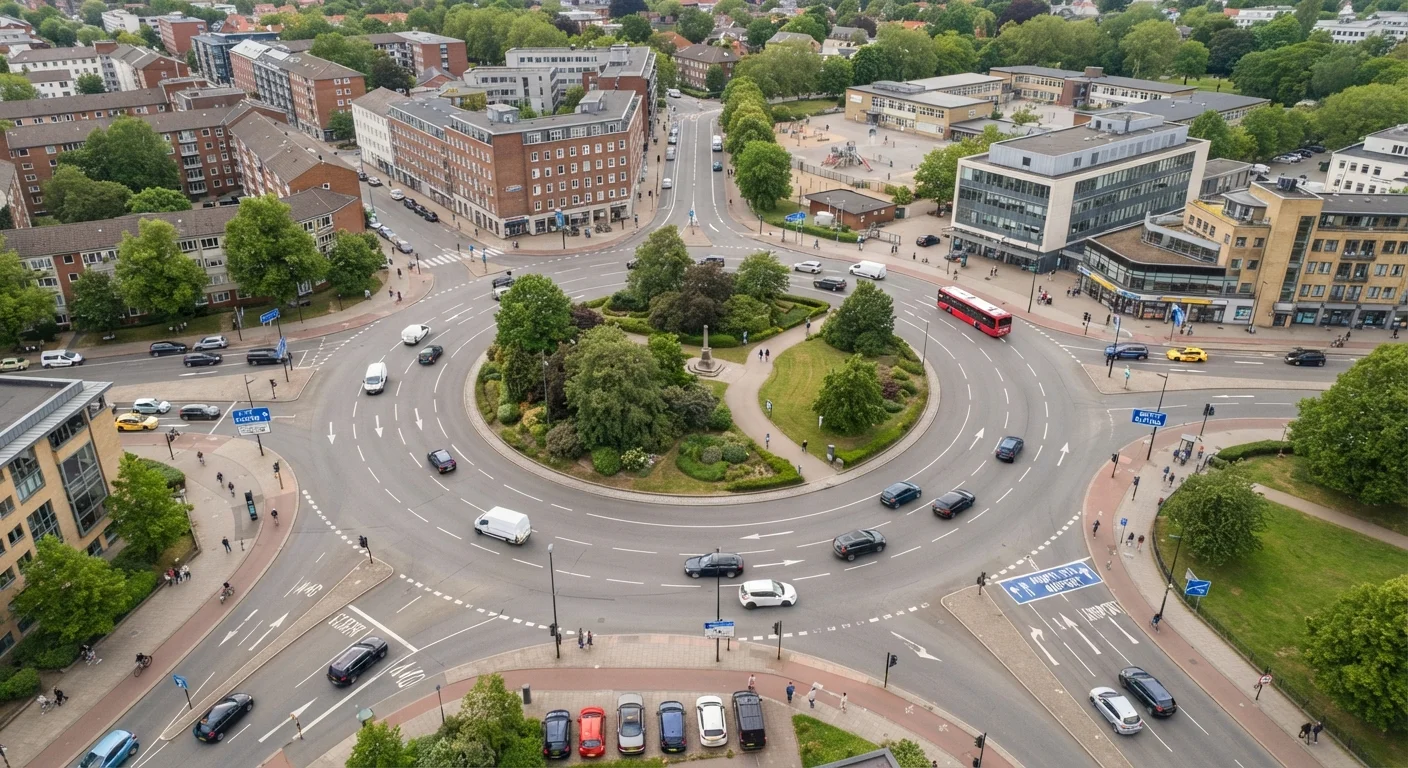
Roundabouts should, in theory, be one of the smoother junction types to navigate. Traffic flows in one direction, there are no traffic lights to miss, and collisions tend to be lower-speed than at standard intersections. And yet they remain a consistent source of near-misses, confusion, and minor crashes — even among drivers who've held a licence for decades.
The problem isn't usually a lack of awareness that rules exist. It's that habits formed over years of driving can quietly drift away from what the rules actually say. Roundabouts expose those gaps fast. If you're brushing up or just want to make sure your instincts are still accurate, road sign awareness is a good companion topic — roundabout signage is often misread too.
Failing to give way to traffic already on the roundabout.
Why it happens: Drivers entering from a busy approach sometimes assume they can slot into a gap without fully stopping, especially when the roundabout looks clear at a glance.
Choosing the wrong lane before entering a multi-lane roundabout.
Why it happens: Drivers often pick a lane based on which queue is shorter rather than which lane leads to their intended exit, then find themselves boxed in mid-roundabout.
Not signalling — or signalling incorrectly — when exiting.
Why it happens: Many drivers were never taught the exit signal clearly, or they assume a roundabout doesn't require the same signalling discipline as a standard junction.
Changing lanes while already on the roundabout.
Why it happens: A driver who entered in the wrong lane or misjudged the exit tries to correct mid-circuit, often without adequate mirror or blind spot checks.
Braking unnecessarily or hesitating once inside the roundabout.
Why it happens: Uncertainty about the exit or anxiety about other vehicles leads some drivers to slow sharply once they're already circulating, creating a concertina effect behind them.
Treating a two-lane roundabout like a single-lane one.
Why it happens: On smaller or quieter roundabouts with two lanes, drivers sometimes drift across the central line or ignore markings, assuming the extra space is just a buffer.
The Mistakes That Cause the Most Problems
Most roundabout errors fall into a handful of predictable patterns. Understanding why they happen makes them easier to catch in yourself before they become a hazard for everyone around you.
~40%
Of roundabout crashes involve a failure to yield
Research consistently shows that the most common collision type at roundabouts involves a driver entering without giving way to circulating traffic.
3–5×
Fewer fatal crashes than signalised intersections
Studies by traffic safety researchers, including work by the Insurance Institute for Highway Safety, indicate roundabouts substantially reduce severe injury crashes compared with traditional junctions.
Improving your roundabout habits is part of a broader approach to anticipating problems before they develop. The principles covered in defensive driving apply directly here — roundabouts reward drivers who read the situation early and commit to clear, predictable movements.
Also worth noting: poor spacing and hesitation at roundabouts can contribute to the same rear-end collision risk as tailgating on open roads. The same awareness of the vehicle behind you matters in both contexts.
Don't Wave Other Drivers In
Gesturing for a waiting driver to enter the roundabout ahead of you might feel polite, but it creates unpredictability for everyone around you. Drivers behind you may not expect you to slow, and the driver you're waving in can't be certain what you mean. Stick to the established priority rules — they work precisely because they're consistent.