

| Red light urgency | Stop driving soon - potential safety or mechanical risk |
| Amber/yellow light urgency | Schedule a service visit - not usually an immediate emergency |
| Flashing check engine light | Reduce speed and get to a mechanic promptly |
| Tire pressure spec location | Driver's door jamb sticker - not the tire sidewall |
| Free code reading | Many auto parts stores read diagnostic codes at no charge |
| TPMS requirement (US) | Mandatory on most new passenger vehicles since 2008 (NHTSA) |
Why Warning Lights Confuse So Many Drivers
Your dashboard can light up like a pinball machine, and most drivers have no idea what half those symbols mean. Some people ignore them entirely. Others panic and pull over immediately for something that could have waited until Monday morning. Neither approach serves you well.
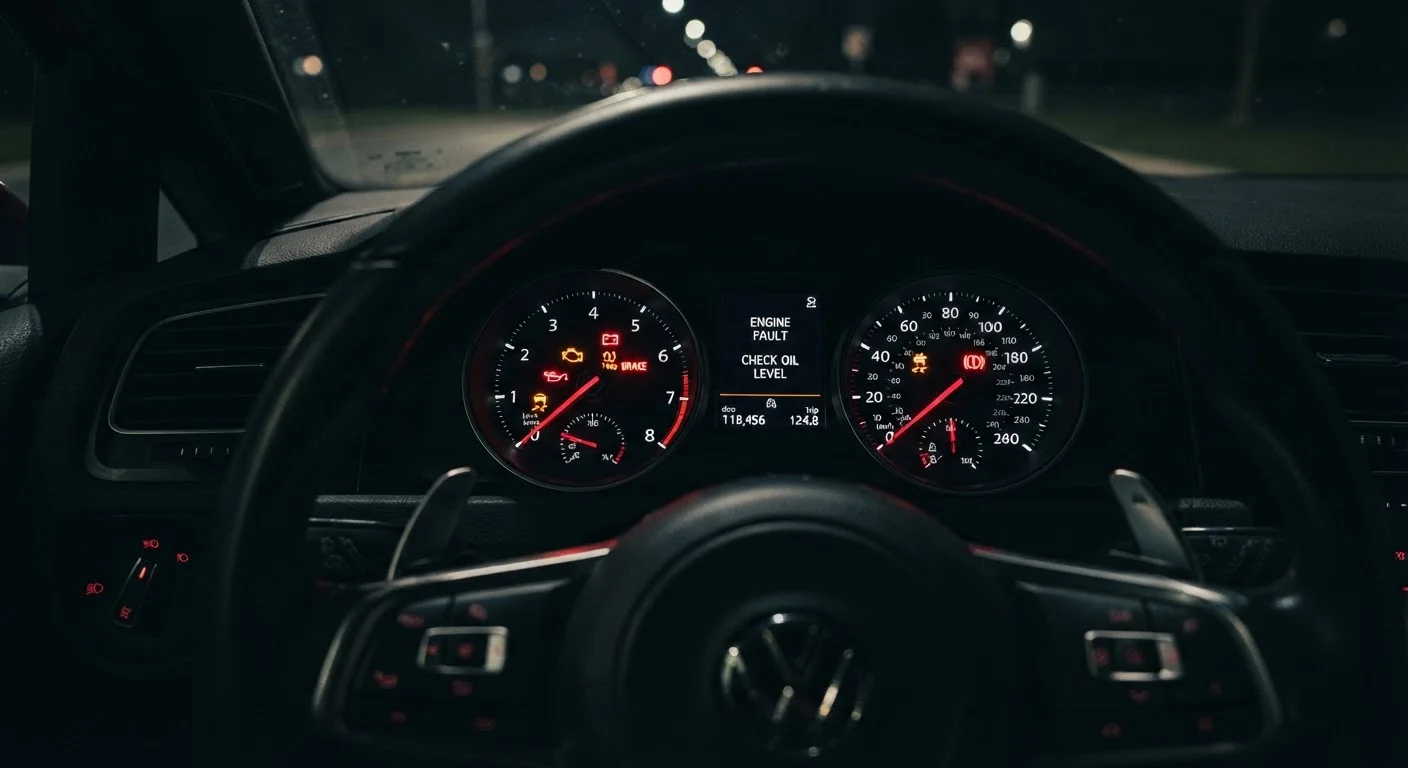
Warning lights fall into two broad categories: urgent alerts that mean stop driving soon, and advisory notices that mean schedule a service visit. The color is your first clue - red generally signals a serious or safety-critical issue, amber or yellow signals something that needs attention but isn't usually an emergency, and blue or green are informational (think headlights on or high beams active).
Your owner's manual has a full list specific to your vehicle. If you haven't opened it lately, our guide to reading your owner's manual explains where to find that section and how to use it.
TPMS
Tire Pressure Monitoring System - a sensor-based system that alerts you when tire pressure falls outside a safe range. Most vehicles sold in the US after 2008 are required to have it.
Diagnostic trouble code (DTC)
A standardized code stored by your car's computer when it detects a problem. A mechanic or code reader retrieves these codes to identify what triggered a warning light.
Catalytic converter
An emissions control device in your exhaust system that converts harmful gases into less harmful ones. Engine misfires can overheat and damage it quickly.
Alternator
A generator driven by your engine that keeps the battery charged and powers electrical systems while the car is running. A failing alternator causes the battery warning light to illuminate.
Oil pressure
The force at which oil circulates through your engine to lubricate moving parts. Low oil pressure - whether from low oil level or a pump problem - can destroy engine components within minutes.
The Warning Lights Drivers See Most Often
Here's a plain-language breakdown of the most common dashboard symbols and what they're actually asking you to do.
| Red light urgency | Stop driving soon - potential safety or mechanical risk |
| Amber/yellow light urgency | Schedule a service visit - not usually an immediate emergency |
| Flashing check engine light | Reduce speed and get to a mechanic promptly |
| Tire pressure spec location | Driver's door jamb sticker - not the tire sidewall |
| Free code reading | Many auto parts stores read diagnostic codes at no charge |
| TPMS requirement (US) | Mandatory on most new passenger vehicles since 2008 (NHTSA) |
Check Engine Light
This is the one that causes the most anxiety - and the most confusion. The check engine light (a small engine outline) can be triggered by anything from a loose gas cap to a failing catalytic converter. If it's steady, the issue is worth investigating soon but isn't usually a stop-right-now emergency. If it's flashing, that typically signals a misfire that can damage your catalytic converter - reduce speed and get to a mechanic promptly. An auto parts store can read the diagnostic code for free, which gives you a starting point.
Oil Pressure Warning
This light - usually a small oil can icon - means your engine isn't getting adequate oil pressure. Pull over safely as soon as you can and shut off the engine. Running an engine with low oil pressure can cause serious, expensive damage in a matter of minutes. Check your oil level; if it's fine and the light stays on, you need a mechanic before driving further.
Battery / Charging System
A battery icon means the car's electrical system isn't charging properly. Your battery, alternator, or related wiring could be at fault. The car may keep running on battery reserve for a short time, but don't push it - turn off non-essential electronics and head straight to a shop.
Tire Pressure (TPMS)
The TPMS light (a cross-section of a tire with an exclamation point) lights up when one or more tires are significantly under- or over-inflated. Check pressure at a gas station and inflate to the spec listed on the sticker inside your driver's door - not the number printed on the tire sidewall. Cold weather commonly drops tire pressure enough to trigger this light.
Brake System Warning
If this light appears and your parking brake is fully released, take it seriously. It could indicate low brake fluid or a fault in the braking system. For a deeper look at what's happening mechanically, see our guide to how your brakes work. Don't delay getting it checked.
Temperature Warning
A thermometer icon means your engine is overheating. Pull over, turn off the engine, and let it cool - do not open the radiator cap while the engine is hot. Continuing to drive an overheating engine is one of the fastest ways to turn a manageable repair into an engine replacement.
When to Act Immediately vs. When to Schedule a Visit
A useful mental rule: red lights mean stop soon, yellow lights mean plan a visit. That said, even amber lights shouldn't be ignored for weeks. Many are early warnings that become expensive problems if left alone.
~1 in 4
Vehicles on the road with the check engine light on
Car Care Council estimates roughly one-quarter of vehicles are being driven with an active check engine light at any given time.
Minutes
Time before low oil pressure causes engine damage
Automotive engineers and mechanics consistently note that running an engine with critically low oil pressure can cause irreversible damage in a very short time.
If a light comes on and you're unsure what it means, pull up your owner's manual or search the symbol along with your car's make and model. Avoid the temptation to assume everything is fine just because the car feels normal - some issues don't affect drivability until real damage has already occurred.
Also worth knowing: after a repair, some lights reset automatically, while others require a mechanic's scan tool to clear. If a light returns shortly after being cleared without a repair, the underlying problem hasn't been fixed.
Staying on top of routine maintenance is the best way to avoid many warning lights in the first place. Check out our article on common car maintenance myths to separate good habits from outdated ones.
This article provides general automotive information for educational purposes. For diagnosis and repairs specific to your vehicle, consult a qualified mechanic.