

Key Takeaways
Why the Owner's Manual Is the Right Starting Point
Most drivers know their car needs regular maintenance - they're just not sure exactly what, or when. Service reminder stickers, shop suggestions, and general advice online all offer guidance, but none of it is specific to your vehicle. Your owner's manual is. It was written by the engineers who designed your car, using your engine, your transmission fluid, and your operating conditions as the baseline.
If you're new to managing a vehicle, getting familiar with ownership basics first will help you put the maintenance schedule in context. For drivers who want a broader view of what routine upkeep actually involves, a first-year maintenance roadmap is a useful companion read.
The maintenance schedule section of your manual is not long or complicated - but it does use specific language that can feel opaque if you haven't read one before. The steps below walk you through how to find it, read it, and actually use it.
What you will need
What You'll Need Before You Start
Owner's Manual
Contains the official maintenance schedule and definitions for your specific vehicle.
Notepad or Notes App
Used to record upcoming service milestones and intervals for easy reference.
Manufacturer's Website or App
A backup source for maintenance schedules if the physical manual is missing.
Once you have your manual in hand, set aside 15 to 30 minutes in a quiet spot. You don't need any mechanical knowledge to do this - just the ability to read a table and note some numbers.
Locate the maintenance schedule section
Open your owner's manual and look at the table of contents. The maintenance section is usually labeled "Scheduled Maintenance," "Service Intervals," or simply "Maintenance." It's often toward the back third of the manual. If your manual has an index, search for "maintenance schedule" or "service intervals."
Identify the two schedule types
Most manuals list two tracks: Normal and Severe (sometimes called "Special Operating Conditions"). Normal applies to typical highway and city driving. Severe applies if you regularly tow heavy loads, drive mostly short trips under five miles, operate in extreme heat or cold, or sit in frequent stop-and-go traffic. Read both descriptions carefully - many drivers unknowingly qualify for the severe schedule without realizing it.
Read the interval columns
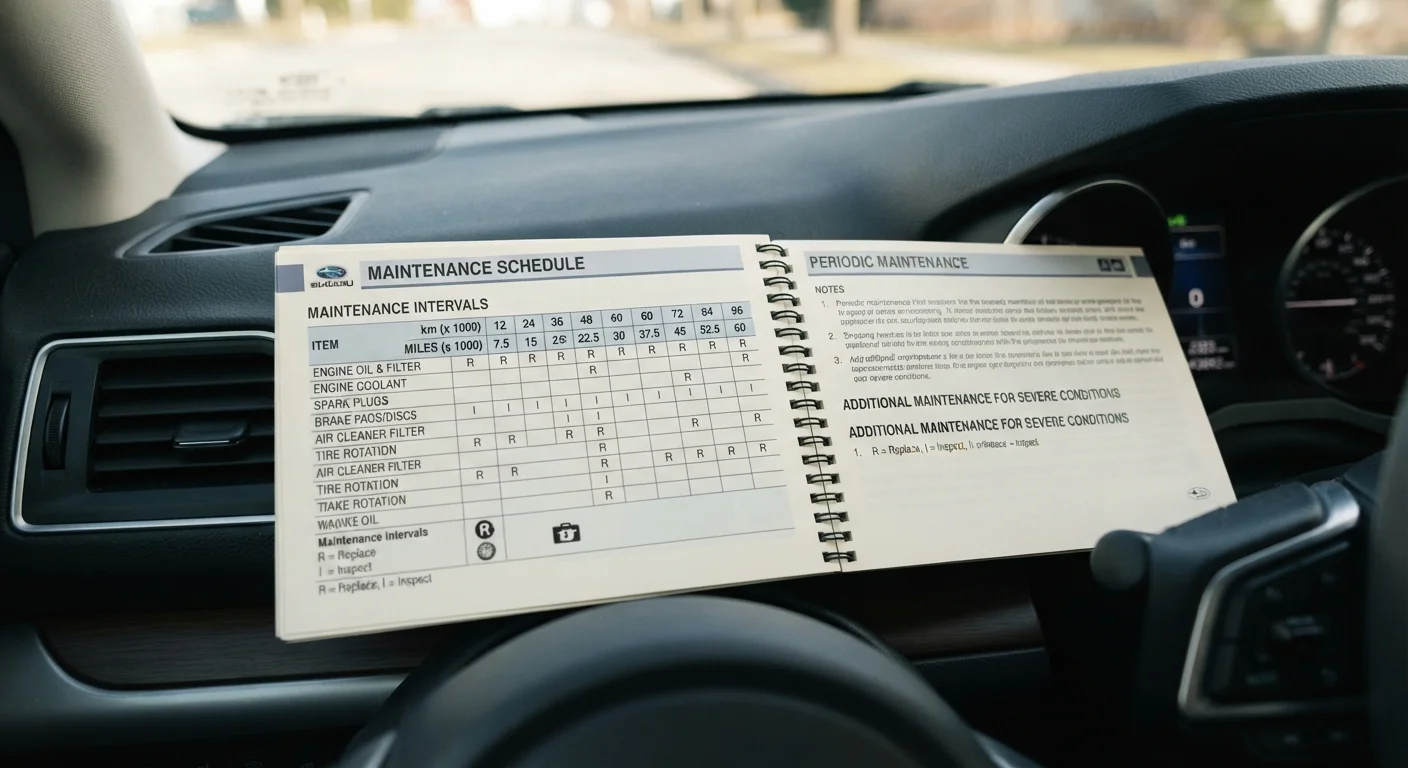
The schedule is laid out as a grid. Rows list specific services - oil change, tire rotation, air filter replacement, brake fluid, spark plugs, and so on. Columns show intervals in miles (e.g., every 5,000 or 30,000 miles) and sometimes in months (e.g., every 12 months). The rule is simple: service is due at whichever threshold arrives first. A car driven very little still needs some services on a time basis, not just mileage.
Decode the service abbreviations
Manuals use shorthand. Common examples: R = Replace, I = Inspect, L = Lubricate. "Inspect" means a mechanic visually checks the component and replaces it only if worn - it does not automatically mean replacement. If you see a footnote number next to a service item, find the corresponding footnote; it often explains a condition or exception that changes when or how the service applies.
Compare the schedule to any shop recommendations
When a shop recommends a service, pull up your manual's schedule and cross-reference it. If the recommendation aligns with your interval, it's straightforward. If a shop suggests a service significantly earlier than the manual indicates, ask them to explain why - wear patterns, a specific inspection finding, or your driving conditions may justify it. You're entitled to that explanation. The manual is your baseline, not a ceiling.
Putting Your Schedule to Work
Reading the schedule once is useful. Using it consistently is what actually protects your car. After you've identified your upcoming service milestones, keep a simple note somewhere accessible - your phone, the glove box, or a small notebook. When a shop visit comes up, check your manual before you go.
Photograph the Key Pages
Take a photo of the maintenance schedule pages with your phone and save them to an album. This way you always have the intervals handy - even if the manual is buried in the glovebox during a shop visit. It takes under a minute and saves a lot of back-and-forth.
It's also worth knowing that some services drivers assume are universal - like oil changes every 3,000 miles - may not apply to your car at all. Persistent maintenance myths cost drivers real money, and your manual is one of the clearest ways to cut through them.
For high-mileage vehicles, the schedule may shift as the car ages. Maintenance needs change past 100,000 miles, and it's worth reviewing the manual again at that point. And if a warning light ever appears on your dash between scheduled visits, understanding what it means helps you decide whether it's urgent or can wait for your next scheduled appointment.
Time Intervals Apply Even With Low Mileage
If your car sits for long stretches or you drive very few miles, some services are still due on a time basis - typically every 12 months regardless of mileage. Brake fluid, coolant, and certain belts degrade with age, not just use. Check the 'months' column in your schedule just as carefully as the mileage column.