

Key Takeaways
Soil Health
Soil health refers to how well your garden soil functions as a living system — supporting plant roots, retaining moisture, cycling nutrients, and hosting the microorganisms that plants depend on. Healthy soil isn't just dirt; it's a complex mix of minerals, organic matter, water, air, and billions of living creatures. When these elements are in balance, plants grow stronger with fewer inputs.
Soil scientists often measure health through indicators such as aggregate stability, microbial biomass carbon, and cation exchange capacity — all of which affect a soil's ability to hold and release nutrients.
What Soil Is Actually Made Of
When you dig into your garden bed, you're not just moving dirt — you're disturbing a layered ecosystem. Soil has four basic components: mineral particles (sand, silt, and clay), organic matter (decomposed plant and animal material), water, and air. Ideal garden soil contains roughly 45% minerals, 25% water, 25% air, and 5% organic matter by volume, though real-world soils rarely hit those numbers perfectly.
The ratio of sand, silt, and clay determines your soil's texture, which affects how it drains, how it holds nutrients, and how easy it is to work with. Sandy soil has large particles with big gaps between them — water rushes through quickly, taking nutrients with it. Clay soil has tiny, tightly packed particles that hold moisture but can become compacted and poorly aerated. Loam — a balanced blend of sand, silt, and clay — is what most gardeners are aiming for.
1 billion+
Microorganisms in a teaspoon of healthy soil
Soil ecologists estimate that a single teaspoon of healthy garden soil can contain more than one billion bacteria alone, along with fungi, protozoa, and other organisms.
5%
Organic matter in ideal garden soil
Soil scientists consider around 5% organic matter by volume a healthy target for productive garden beds, though many residential soils fall well below this level.
6.0–7.0
Optimal pH range for most vegetables
University extension programs consistently recommend this pH range as the window where the broadest range of vegetable nutrients remain plant-available.
Understanding Soil pH
Soil pH measures how acidic or alkaline your soil is on a scale from 0 to 14, with 7 being neutral. This number matters enormously because it controls which nutrients are chemically available for plant roots to absorb. A plant growing in soil with the wrong pH can be surrounded by fertilizer and still show signs of nutrient deficiency — the nutrients are there, but locked in forms the plant can't use.
Most common garden plants, including vegetables, lawns, and ornamental shrubs, thrive in a pH range of 6.0 to 7.0. Below 6.0, nutrients like phosphorus become less available. Above 7.5, iron and manganese can become scarce. You can raise pH (make it more alkaline) by adding ground limestone, or lower it (make it more acidic) with elemental sulfur — but always test first. Home soil test kits are widely available at garden centers, and many county cooperative extension offices offer inexpensive lab testing that gives more detailed results.
Test Before You Amend
Never add lime, sulfur, or large amounts of fertilizer based on guesswork. A soil test takes the uncertainty out of the process and prevents you from making pH or nutrient imbalances worse. Many cooperative extension services offer testing for a modest fee, and results typically include specific amendment recommendations for your region.
Why Organic Matter Is Your Soil's Best Friend
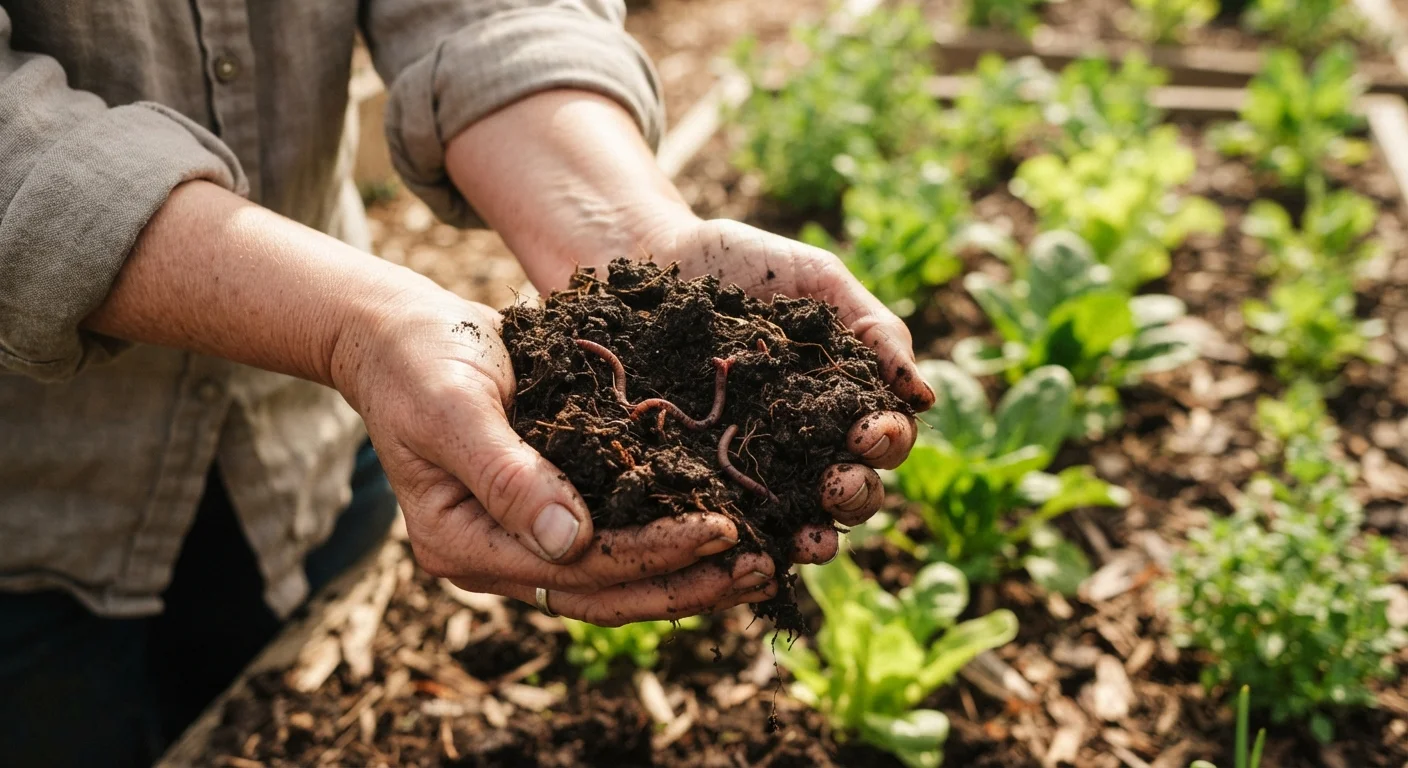
Organic matter — decomposed leaves, grass clippings, food scraps, and other formerly living material — is the component that ties everything together. It improves water retention in sandy soils, loosens compacted clay soils, provides slow-release nutrients, and feeds the bacteria, fungi, and earthworms that keep the whole system functioning.
Adding compost is the most practical way to increase organic matter. Even modest additions made annually build soil structure over time. For a deeper dive into making your own, see our guide on composting at home — it walks you through what to include and how to speed up the process.
Mulching the surface of your beds with organic materials like bark or straw also contributes as it slowly breaks down. Our article on organic vs. inorganic mulch explains how to choose the right type for your specific goals.
How Soil Affects Watering — and Vice Versa
Soil texture and structure directly determine how water behaves in your garden. Sandy soil drains so fast that plants can dry out within a day of watering. Clay soil retains water but can become waterlogged, cutting off the oxygen roots need. Both extremes stress plants, and both can be mistaken for pests or disease problems when the real issue is simply the soil beneath.
Understanding your soil type helps you water smarter — watering deeply but less frequently for sandy soils, and allowing more time between waterings for clay-heavy beds. Poorly understood soil is one reason garden watering goes wrong so often. When you know what your soil can hold, your irrigation decisions become much more intentional.
“Feeding the soil rather than the plant is the foundation of sustainable gardening. When the soil ecosystem is functioning well, plants take care of themselves far more than most gardeners expect.”
— Eliot Coleman, Organic farming advocate and author of widely referenced market gardening guides