

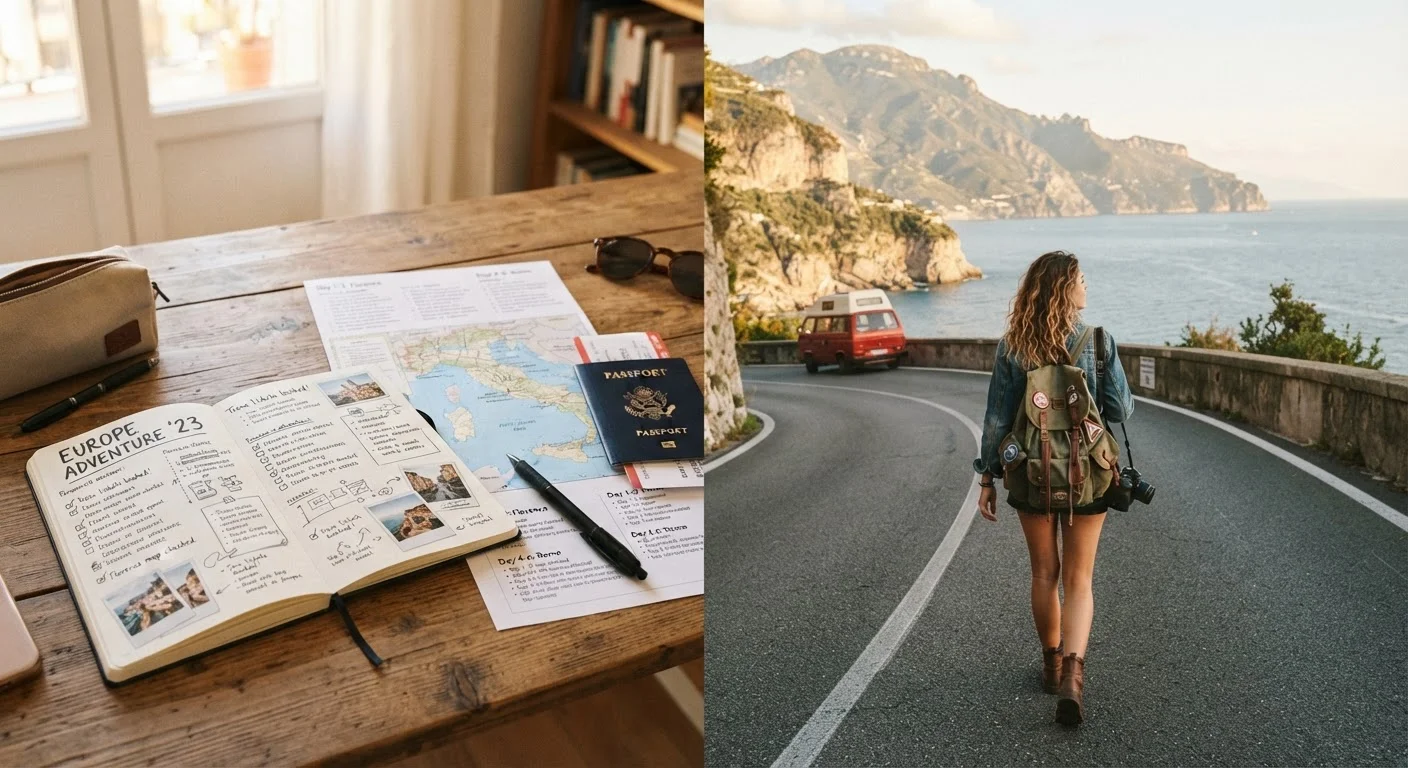
Key Takeaways
Our Verdict
Organised planning and spontaneous travel are not competing philosophies — they are tools that work best in different contexts. Planning ahead pays off for popular, complex, or time-sensitive destinations, while a looser approach suits slower, off-peak, or open-ended journeys. The most practical strategy is a hybrid: lock down the logistics that are hardest to recover from and leave breathing room everywhere else.
| Best for | Recommended |
|---|---|
| First-time visitors to high-demand destinations | Organised Planning |
| Group travel with mixed preferences and schedules | Organised Planning |
| Solo travellers with flexible budgets and open calendars | Spontaneous Travel |
| Most travellers on most trips | A Hybrid of Both |
What Each Approach Actually Means
Organised planning means researching and booking key elements — flights, accommodation, major attractions — before you leave home. A structured itinerary assigns activities to specific days and times, reducing on-the-ground decision-making. For a deeper look at how this process unfolds step by step, see our guide to the anatomy of a well-planned trip.
Spontaneous travel, by contrast, involves arriving with minimal commitments: perhaps only a flight and a first night's accommodation confirmed. Daily decisions about where to go, eat, or sleep are made in the moment. This is less about being disorganised and more about deliberately preserving optionality.
In practice, most real trips live somewhere between these poles. Understanding what each approach demands — and where each pays off — is more useful than picking a side.
Where Organised Planning Has the Clear Edge
Certain situations make advance planning close to mandatory rather than merely advisable:
- High-demand destinations. Iconic sites — national parks with timed-entry permits, popular museums, or peak-season resort towns — often sell out weeks or months ahead. Showing up without reservations can mean missing the main reason you came. Our guide to destinations that reward careful research covers exactly these scenarios.
- Complex multi-leg itineraries. When a trip involves several cities, connecting flights, or rail passes, a loose approach can quickly cascade into missed connections and expensive last-minute fixes.
- Group travel. Coordinating schedules, preferences, and budgets across multiple people requires a shared framework. Group travel planning works best when the non-negotiables are settled early.
- Limited time. A long weekend in a new city leaves little margin to figure things out as you go.
| Organised Planning | Spontaneous Travel | |
|---|---|---|
| Booking lead time | Weeks to months ahead | Same day to a few days ahead |
| Cost predictability | High — locked-in rates | Variable — often higher last-minute |
| Flexibility on the ground | Lower — commitments already made | High — adapt as you go |
| Stress profile | Lower during travel, higher pre-trip | Lower pre-trip, higher during travel |
| Works best for | Groups, peak season, complex routes | Solo, off-peak, slower-paced destinations |
| Risk if things go wrong | Cancellation fees, rigid schedule | No availability, last-minute price surges |
Where Spontaneity Genuinely Earns Its Reputation
Spontaneous travel is not simply disorganised travel — at its best, it's a deliberate choice to stay responsive to what a place actually offers rather than what you expected before you arrived.
It tends to work well when:
- You're travelling solo or with a single, flexible companion. Solo travel and group travel differ significantly in how much flexibility is actually achievable.
- You're visiting during shoulder or off-peak periods, when accommodation and transport options are plentiful. Travelling in peak season vs. shoulder months has a direct effect on how viable spontaneity is.
- You have a financial buffer for last-minute pricing, which is typically higher for flights and accommodation booked on arrival.
- Your destination is somewhere slower-paced — rural regions, smaller towns, or countries with abundant inventory.
Build In a Buffer Day
Regardless of how spontaneous your travel style is, try to avoid scheduling anything important on your final full day. A buffer day absorbs delays, gives you time to revisit a favourite spot, and removes the anxiety of rushing. It's one of the habits consistent travellers use to reduce trip stress.
The Hybrid Approach Most Travellers Actually Use
Experienced travellers rarely commit fully to either extreme. A practical middle path looks like this: lock down the hard-to-recover logistics and leave the rest open.
Concretely, that means booking flights, the first and last nights' accommodation, and any capacity-limited experiences (tours, tickets, border crossings) in advance — then leaving daily activities, restaurant choices, and mid-trip accommodation largely unscheduled. This approach is sometimes called a loose itinerary or anchor planning.
Our article on building a travel itinerary without overloading every day walks through how to structure days that have enough shape to feel purposeful without crowding out spontaneity. And if you want a comprehensive framework regardless of which style suits you, The Complete Framework for Planning Any Trip covers everything from destination research to contingency planning.
60%+
Travellers who book accommodation in advance
Industry surveys consistently find that the majority of leisure travellers secure lodging before departure, particularly for peak-season trips.
2–3x
Last-minute accommodation price premium
Hotel pricing research indicates that same-day bookings during busy periods can cost significantly more than equivalent rooms booked weeks ahead.
Matching Your Style to Your Destination
Travel style should adapt to the destination, not the other way around. Some places are simply more forgiving of loose planning than others.
Cruise itineraries, for example, are highly structured by nature — the ship sets the schedule. Our guide to choosing a cruise itinerary can help you find a format that balances structure with your personal preferences. Cities dealing with overtourism — like Venice or popular national parks — increasingly require advance bookings as a practical matter, not just a personal preference. See our explainer on overtourism and how destinations are responding for context on why planning ahead has become more important at certain places.
For broader destination inspiration regardless of planning style, the Destinations hub and Travel Tips hub are good starting points for research.