

Key Takeaways
Overtourism
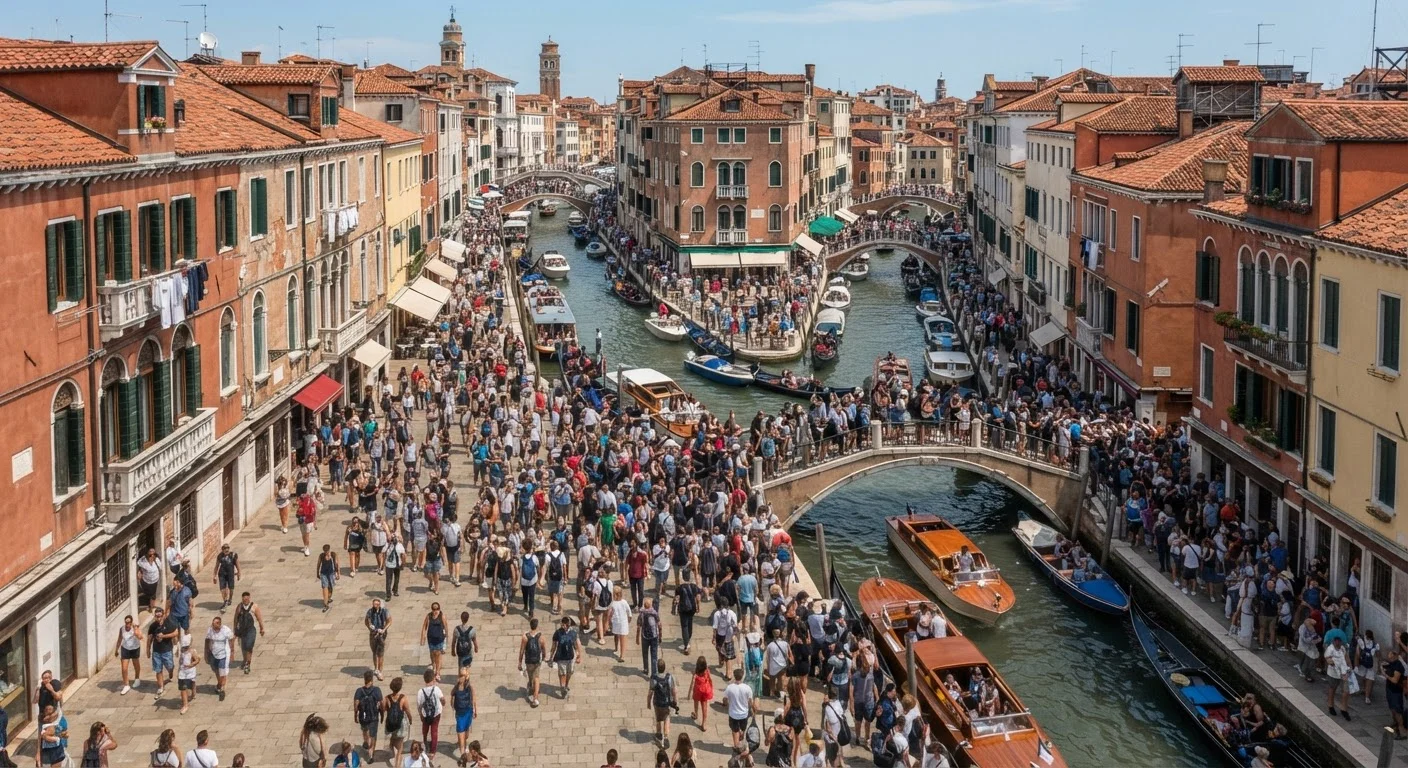
Overtourism occurs when the number of visitors to a destination exceeds what that place can comfortably support — straining infrastructure, degrading the environment, disrupting local communities, and diminishing the experience for travelers themselves. It is not simply about crowds; it's about a mismatch between visitor volume and a place's capacity to absorb that volume without lasting harm.
The United Nations World Tourism Organization (UNWTO) has described overtourism as the impact of tourism on a destination, or parts thereof, that excessively influences perceived quality of life of citizens and/or quality of visitors experiences.
What Overtourism Actually Means
Tourism has long been framed as an unambiguous good — a source of economic growth for destinations and meaningful experiences for travelers. Overtourism complicates that framing. It describes the point at which visitor numbers, concentrated in a specific place and time, begin to inflict real costs: on local residents who can no longer afford housing, on ecosystems that cannot recover between visits, on heritage structures absorbing more foot traffic than they were built to handle.
The term entered mainstream travel conversation during the mid-2010s, but the pressures it describes are not new. What changed was scale — lower airfares, the rise of short-term rental platforms, and the amplifying power of social media combined to send surges of visitors to places that had not built infrastructure to match.
Understanding the concept matters because it reframes how travelers think about popular destinations. A long queue at a famous site is not just an inconvenience; it may be a signal of systemic strain. Knowing what you're looking at helps you make more informed choices about where, when, and how you travel. See trip planning essentials for practical strategies to organize smarter travel from the start.
The Causes Behind the Crowds
No single factor creates overtourism. It typically results from overlapping pressures converging on a place that wasn't designed to absorb them at volume.
1.4 billion
International tourist arrivals globally in 2019
The UNWTO reported approximately 1.4 billion international tourist arrivals in 2019 before pandemic-related disruptions, a figure that represented a near-doubling compared to two decades earlier.
~30 million
Annual visitors to Venice vs. 250,000 residents
Venice's historic center is estimated to host tens of millions of visitors annually while its permanent resident population has shrunk dramatically over decades, illustrating the population-to-visitor imbalance at the heart of overtourism debates.
5,000/day
Visitor cap at Machu Picchu
Peru's Ministry of Culture has set daily visitor limits at Machu Picchu — figures that have been adjusted over time — as part of ongoing efforts to protect the site's physical integrity and visitor experience.
- Cruise ship scheduling: Large cruise ships can deposit several thousand passengers into a small port for six to eight hours, all targeting the same handful of famous sites simultaneously, then leave — contributing little to local economies beyond the port authority's fees.
- Social media concentration: A single widely shared photo can funnel enormous interest toward one specific viewpoint, beach, or alley, regardless of whether that spot has any capacity infrastructure around it.
- Seasonal clustering: The majority of visitors to many destinations arrive within a two-to-three month window, overwhelming services that operate year-round on thin margins.
- Short-term rentals: The conversion of residential housing to tourist accommodation has reduced housing supply for local residents in neighborhoods adjacent to attractions, driving up rents and displacing communities.
These causes interact. A destination that goes viral in July, is served by multiple cruise ships weekly, and has lost a third of its residential housing to short-term rentals faces compounded pressure that destination managers can't solve with a single policy lever.
Destinations Actively Navigating the Problem
Several well-known destinations have moved from acknowledging overtourism to actively managing it — with varying degrees of success.
Venice, Italy introduced a day-tripper entry fee for peak-season visits to the historic center, a first for a major European city. The city has also debated capping the number of cruise ships permitted to enter the lagoon.
Dubrovnik, Croatia imposed daily visitor caps inside the old city walls after UNESCO raised concerns about the site's integrity. Local authorities have also worked to limit cruise ship arrivals on specific days.
Machu Picchu, Peru uses a timed-entry reservation system that requires visitors to choose a specific entry window and trail circuit in advance. Spontaneous walk-up visits are no longer possible during peak periods.
Amsterdam, Netherlands has taken an unusual approach by actively discouraging certain types of tourists — running campaigns aimed at visitors associated with disruptive behavior, and restricting the opening of new hotels in the city center.
Each approach reflects local priorities and politics. None has fully resolved the underlying tension between economic dependence on tourism revenue and the quality of life for residents. For destinations with UNESCO designation specifically, responsible tourism at heritage sites outlines what thoughtful engagement looks like on the ground.
What This Means for How You Plan Your Trip
Overtourism doesn't mean you shouldn't visit famous places. It means visiting more deliberately — and that's worth doing for your own experience as much as for the destination's sake.
Research Before You Book — Not After
Check whether your target destination has visitor caps, required reservations, or entry fees before finalizing plans. For some sites, walk-up access during peak periods is simply no longer available. Destinations that reward careful research explores how thorough pre-trip groundwork pays off — especially for places under visitor pressure.
A few practical adjustments make a meaningful difference:
- Travel in the shoulder season. Visiting in May rather than August, or October rather than July, typically means fewer crowds, lower prices, and a place that feels more like itself.
- Book timed entry in advance. For sites that require reservations — Machu Picchu, the Alhambra in Granada, the Vatican Museums — booking well ahead is not optional during peak periods. It's also how you contribute to manageable visitor flow rather than walk-up congestion.
- Consider nearby alternatives. If a famous destination is overwhelmed, the towns and sites within an hour's reach often offer similar character with far fewer visitors and stronger economic benefit to less-touristed communities.
- Stay longer in fewer places. A slower trip that gives you time to settle into neighborhoods, eat at local restaurants, and return to the same square twice is better for you and generates more distributed economic benefit than a rapid multi-city sprint.
Building a realistic daily itinerary that leaves room for flexibility makes this kind of thoughtful travel easier to execute. And if you're weighing a structured versus open-ended approach, understanding your travel style can help you find the right balance for the destinations you're considering.