

Key Takeaways
Why Ingredient Lists Feel Confusing
Food ingredient lists aren't written to be reader-friendly — they're written to meet federal labeling requirements. The result is a dense block of text that mixes familiar words like "oats" and "salt" with strings like "sodium stearoyl lactylate" or "maltodextrin." Most people either ignore the list entirely or feel vaguely suspicious without knowing exactly what to look for.
The good news: there's a simple structure underneath all that text. Once you understand three core rules — ordering by weight, recognizing aliases for common additives, and identifying what actually belongs versus what's functional filler — you can scan a label in under a minute and come away with genuinely useful information.
For a complementary view of what the numbered panel next to the ingredient list is telling you, see our breakdown of the Nutrition Facts label.
What you will need
How to Read an Ingredient List Step by Step
Follow these steps each time you pick up a packaged product. With practice, the process becomes automatic.
Find the ingredient list and orient yourself
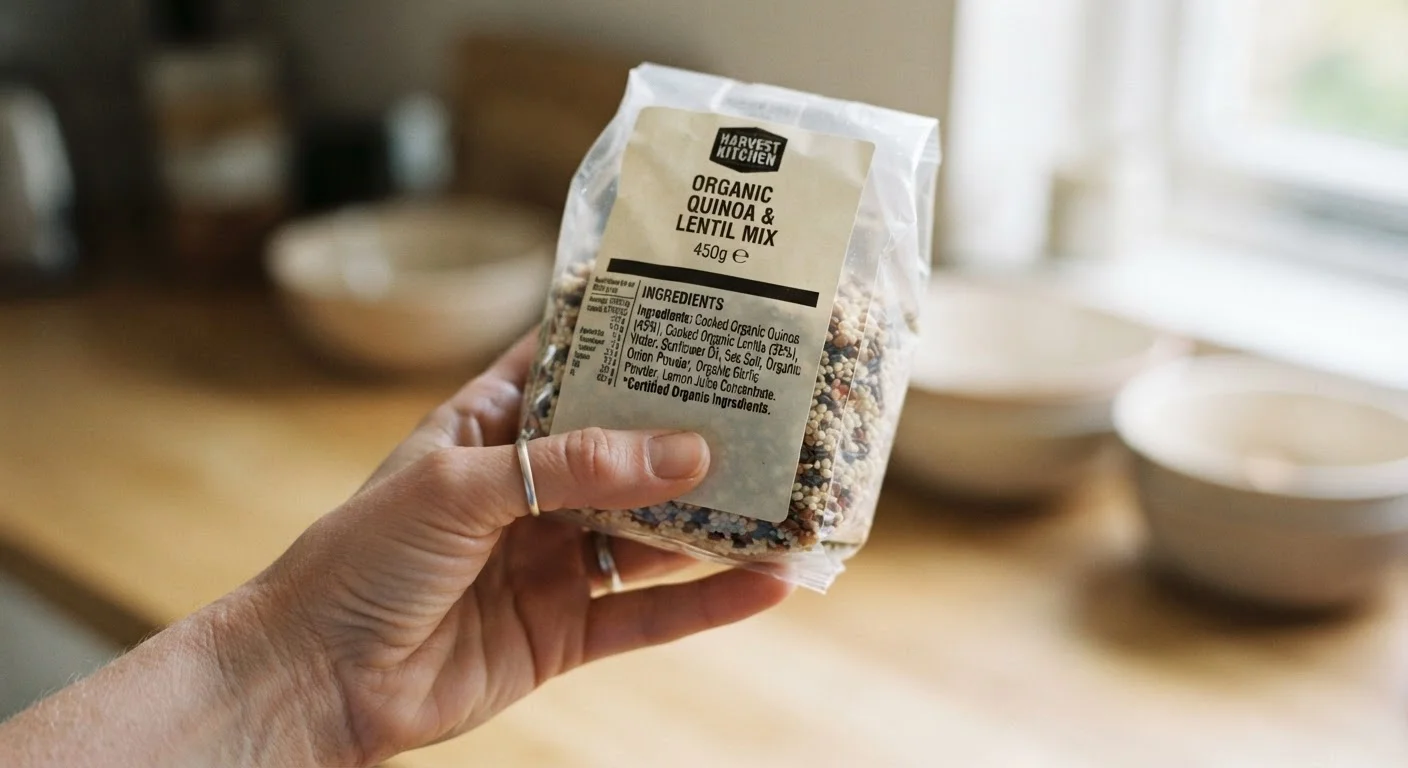
Locate the ingredient list — it's usually on the back or side panel, near or below the Nutrition Facts box. By law, the heading "Ingredients:" must introduce the list. If the product has very few ingredients (like a bag of plain almonds), the list may be short enough to read in seconds. For more complex products, give yourself a moment before diving in.
Read the first three ingredients carefully
Under FDA rules, ingredients must be listed in descending order by weight — the heaviest ingredient comes first. The first three ingredients collectively represent the largest portion of what you're eating. If a cereal's first ingredient is sugar, or a "multigrain" bread leads with enriched white flour, that tells you something meaningful about the product's actual composition regardless of front-of-package claims.
Identify added sugars and their aliases
Scan the full list for sugar in any of its forms. Manufacturers sometimes use multiple types of sweetener — for example, both corn syrup and dextrose — which keeps each one lower on the list individually, even though their combined contribution may be significant. Count how many distinct sweeteners appear, not just whether "sugar" is present.
Note sodium-contributing ingredients
Sodium shows up not just as table salt but as a long list of sodium-containing compounds used for preservation, flavor enhancement, and texture. Common examples include sodium benzoate, monosodium glutamate, and sodium nitrate. If multiple sodium compounds appear, the product's overall sodium content may be higher than a quick glance at "salt" alone would suggest — always confirm by checking the milligrams on the Nutrition Facts panel.
Look for allergen declarations
After the main ingredient list, check for a "Contains" statement or allergen callouts embedded within the list itself (often bolded). The FDA's major eight allergens — milk, eggs, fish, shellfish, tree nuts, peanuts, wheat, and soybeans — must be declared. If sesame is relevant to you, note that it was added as a ninth major allergen and must now also be declared on U.S. labels.
Evaluate what you've found in context
Step back and consider the whole picture: What are the dominant ingredients? How many types of sweetener or sodium compound appear? Are there whole-food ingredients toward the top of the list? No single ingredient makes a food healthy or unhealthy — frequency, quantity, and your overall dietary pattern matter more than any one item. Use this reading alongside the Nutrition Facts panel for the most complete picture.
A Useful Rule of Thumb
If an ingredient you can't pronounce appears in the first three items, that substance makes up a significant portion of the product. That's not automatically a reason to avoid the food, but it is useful information for making an informed choice. Use this observation alongside the full Nutrition Facts panel for context.
This Is Education, Not Medical Advice
The information in this article is general nutritional education and is not intended as personalized medical or dietary advice. If you have food allergies, intolerances, a chronic health condition, or specific dietary needs, consult a qualified healthcare provider or registered dietitian before making significant changes to your diet.
Common Aliases Worth Knowing
Many shoppers are surprised to learn that sugar alone travels under more than 60 names on ingredient labels. Recognizing the most common aliases prevents you from being caught off guard.
- Added sugars: high-fructose corn syrup, dextrose, maltose, cane juice, evaporated cane juice, agave nectar, brown rice syrup, fruit juice concentrate
- Sodium: monosodium glutamate (MSG), sodium benzoate, sodium nitrate, disodium phosphate, baking soda (sodium bicarbonate)
- Fats and emulsifiers: partially hydrogenated oils (a source of trans fat), interesterified fats, soy lecithin, mono- and diglycerides
- Preservatives: BHA, BHT, TBHQ, sodium benzoate, potassium sorbate
Spotting these doesn't mean a product is unsafe — many are permitted by the FDA and used in small quantities. It does mean you're reading the label with full information rather than assumptions. For context on how vitamins and minerals are sometimes listed, see our vitamins and minerals reference.
Allergen Declarations Can Be Easy to Miss
The FDA requires that the eight major allergens — milk, eggs, fish, shellfish, tree nuts, peanuts, wheat, and soybeans — be declared on food labels, either within the ingredient list or in a separate "Contains" statement. However, advisory statements like "may contain traces of..." are voluntary and not regulated. If you or someone in your household has a serious allergy, read every label every time, and when in doubt, contact the manufacturer directly.
Putting It Into Practice While Shopping
The most useful habit is comparison: pick up two similar products — say, two brands of whole-grain bread — and read both ingredient lists side by side. You'll often find meaningful differences in what's listed first, how many types of sweetener appear, and whether the "whole grain" claim is backed up by whole wheat flour appearing as the very first ingredient.
Keep in mind that a long ingredient list isn't inherently worse than a short one. A loaf of bread with 15 ingredients, most of which are whole grains, seeds, and vitamins, may be nutritionally stronger than a three-ingredient cracker that leads with refined white flour. The goal is informed reading, not a rigid rule about list length.
Pair this skill with broader shopping habits covered in our grocery shopping nutrition guide, and you'll have a practical framework for the entire store. If you find your overall meal strategy still feels off, common meal planning pitfalls is worth a read.
This article is for general informational and educational purposes only and does not constitute medical or dietary advice. Speak with a registered dietitian or qualified healthcare provider for guidance tailored to your individual health needs.