

Key Takeaways
Child Car Seat Safety Rating
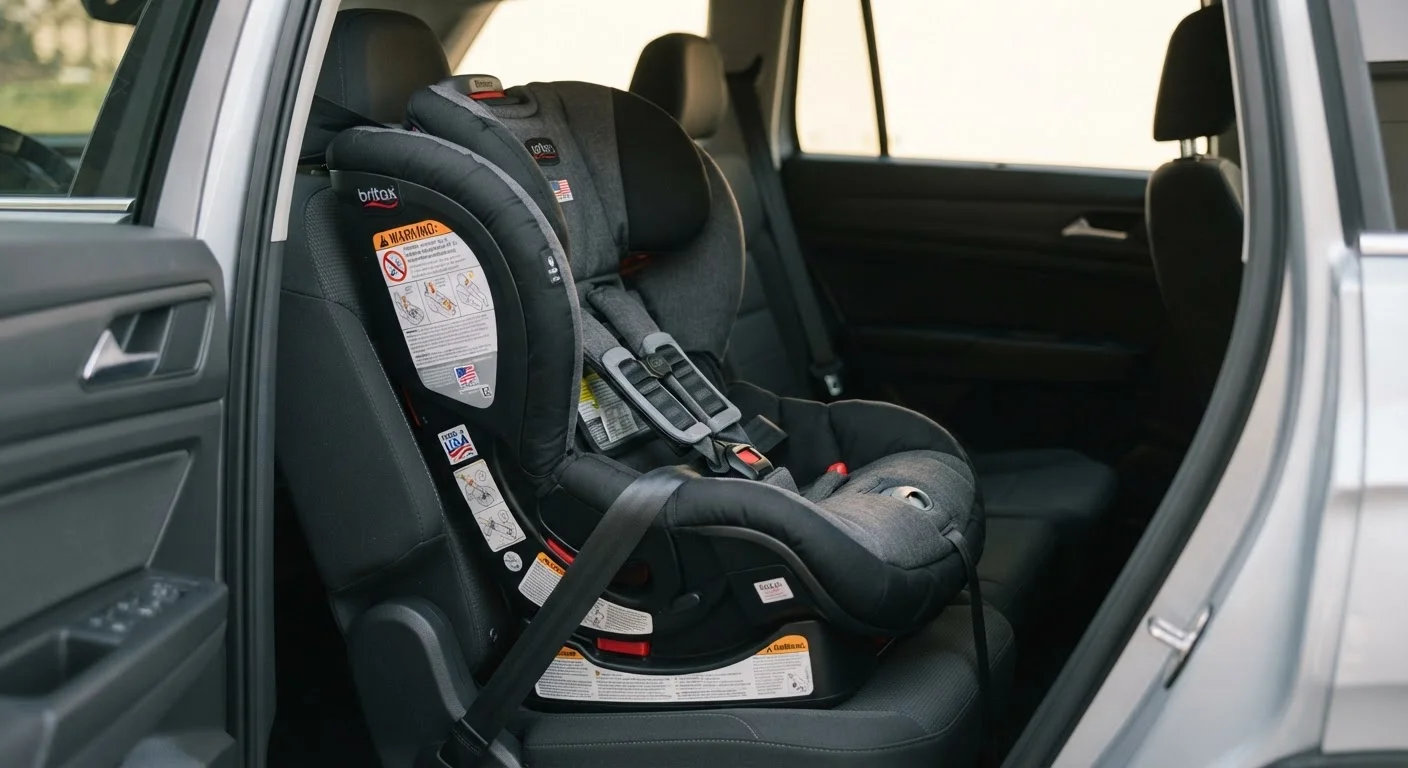
A child car seat safety rating is an evaluation of how well a car seat protects a child in a crash, based on standardized tests conducted by government agencies and independent organizations. These ratings assess factors like crash force absorption, harness performance, and ease of correct installation. Labels on the seat itself communicate weight and height limits, expiration dates, and federal compliance information.
In the United States, all child car seats must meet Federal Motor Vehicle Safety Standard (FMVSS) No. 213, which sets minimum performance requirements. Independent organizations like the Insurance Institute for Highway Safety (IIHS) conduct additional ease-of-use and crash tests beyond the federal baseline.
What the Labels on Your Child's Car Seat Are Actually Telling You
When you turn a car seat over or look at its side, you'll find a cluster of labels that can feel overwhelming. Here's what each one actually communicates:
- Weight and height limits: These are engineering limits, not suggestions. They define the range within which the seat's harness and shell are tested to perform. A child who has outgrown a seat's upper limit — even by a pound — should move to the next stage seat.
- Manufacture date and expiration: Plastics and foams weaken over years of temperature cycling inside cars. The manufacture date (not a purchase date) is your reference point. Most seats expire 6 to 10 years from that date.
- Federal compliance label: A statement that the seat meets FMVSS No. 213 means it passed federally mandated crash tests. This is the legal minimum every seat sold in the US must clear.
- Model and lot number: These are used if the seat is ever subject to a safety recall. Register your seat with the manufacturer so you receive recall notices automatically.
One label parents sometimes overlook: the installation instruction label near the belt path. It shows exactly which vehicle anchors to use and whether the seat should be installed with the vehicle's seat belt, the LATCH system, or both.
How Safety Ratings Work — Federal Standards vs. Independent Tests
There are two distinct systems parents encounter when researching car seats, and they measure different things.
Federal standards (FMVSS 213) set the baseline. Every seat sold legally in the US must pass these tests before it ever reaches a store shelf. The tests simulate frontal crashes and evaluate whether the harness holds a crash-test dummy within defined limits. Meeting this standard is required — not optional.
Independent evaluations — most notably from the Insurance Institute for Highway Safety (IIHS) — go beyond the minimum. The IIHS tests ease of installation, clarity of instructions, and fit across vehicle types. Their findings often reveal that two seats meeting the same federal standard can differ significantly in how easy they are to install correctly.
~46%
Car seats used incorrectly in the US
According to NHTSA data, nearly half of child car seats are not used correctly, including installation errors and harness misuse.
71%
Reduction in fatal injury risk for infants
NHTSA estimates that car seats reduce the risk of fatal injury by approximately 71% for infants compared to riding unrestrained.
6–10 years
Typical car seat lifespan from manufacture
Most manufacturers set expiration dates of 6 to 10 years from the date of manufacture, after which structural integrity may be compromised.
Why does ease of installation matter for safety? Because an incorrectly installed seat — harness too loose, seat belt routed wrong, recline angle off — can dramatically reduce protection in a crash, regardless of how well the seat itself performed in a lab. This is the real-world gap that independent ratings help address. For broader context on how preventive and reactive safety systems work together in vehicles, see how passive and active car safety features differ.
Understanding the Four Stages and When Labels Change
Car seat stages aren't arbitrary — each is designed around the crash physics relevant to a child's size and developmental stage.
- Rear-facing infant seats: Designed for newborns and young infants, with lower weight limits (typically up to 35–40 lbs depending on the model). The rear-facing position allows crash forces to spread across the back, head, and neck simultaneously.
- Rear-facing convertible seats: These accommodate larger children while still rear-facing, often up to 40–50 lbs rear-facing. Pediatric health organizations generally recommend staying rear-facing until a child reaches their seat's maximum limit.
- Forward-facing seats with harness: Once a child exceeds their rear-facing limit, a forward-facing seat with a five-point harness is the next step. Labels will specify the harness weight range and the maximum height at the top of the child's ears relative to the seat shell.
- Booster seats: These position the vehicle's own seat belt correctly across a child's body. Labels specify both the weight range and whether the child must be able to sit with their back flat against the vehicle seat for the full trip.
Use the Pinch Test for Harness Fit
After buckling your child in, try to pinch the harness webbing at their collarbone. If you can gather any slack between your fingers, the straps need to be tightened. A properly snug harness lies flat against the chest and cannot be pinched. This quick check takes seconds and should become part of every buckle routine.
Transitioning too early — before a child has outgrown their current seat's limits — removes protection that the current seat was specifically designed to provide. The label's limits, not a child's age, should drive the decision.
Practical Steps After You Read the Labels
Understanding labels is only half of the equation. Here are the concrete actions that translate label knowledge into real-world safety:
- Check the install after every trip, not just the first. Seats shift. A one-inch rule — the seat shouldn't move more than an inch at the belt path — is your quick checkpoint.
- Verify your child still fits. Check shoulder strap slots against shoulder height, ear tops against seat shell height, and current weight against the label's limit at every developmental checkup.
- Register the seat. Recalls happen. Registration ensures you hear about them directly from the manufacturer.
- Use a certified child passenger safety technician (CPST). Many fire stations, hospitals, and community health organizations offer free car seat inspection events. A CPST can identify installation errors that aren't obvious to even attentive parents.
Safe driving habits and vehicle condition are also part of the equation. If your dashboard warning lights have been catching your attention, our guide on what dashboard warning lights actually mean can help you address those concerns alongside seat safety.
This article is for general informational and educational purposes only. For guidance specific to your child's health, size, or medical needs, consult your child's pediatrician or a certified child passenger safety technician.