

Key Takeaways
Social Skills in Early Childhood
Social skills in early childhood refer to the abilities children develop to interact positively with others — sharing, taking turns, communicating needs, reading emotions, and forming friendships. These skills don't arrive fully formed; they unfold gradually through play, relationships, and everyday experiences between birth and around age eight. They are foundational to a child's emotional health, academic readiness, and long-term wellbeing.
Developmental researchers often distinguish between prosocial behavior (helping, sharing, cooperating) and social competence (the broader ability to navigate relationships successfully). Both are shaped by temperament, attachment, and environment.
The Building Blocks: How Social Play Develops by Age
Children don't wake up one day knowing how to share, negotiate, or comfort a friend. These abilities emerge gradually through a recognizable sequence that developmental researchers have documented for decades. Understanding where your child is in that sequence can ease a lot of parental worry.
In the first year, babies are already social learners — making eye contact, imitating expressions, and responding to voices. Toddlers around ages one to two engage in solitary play, exploring the world on their own terms. By two to three years, most children move into parallel play, happily playing alongside peers without much direct exchange. This is normal and healthy, not a red flag.
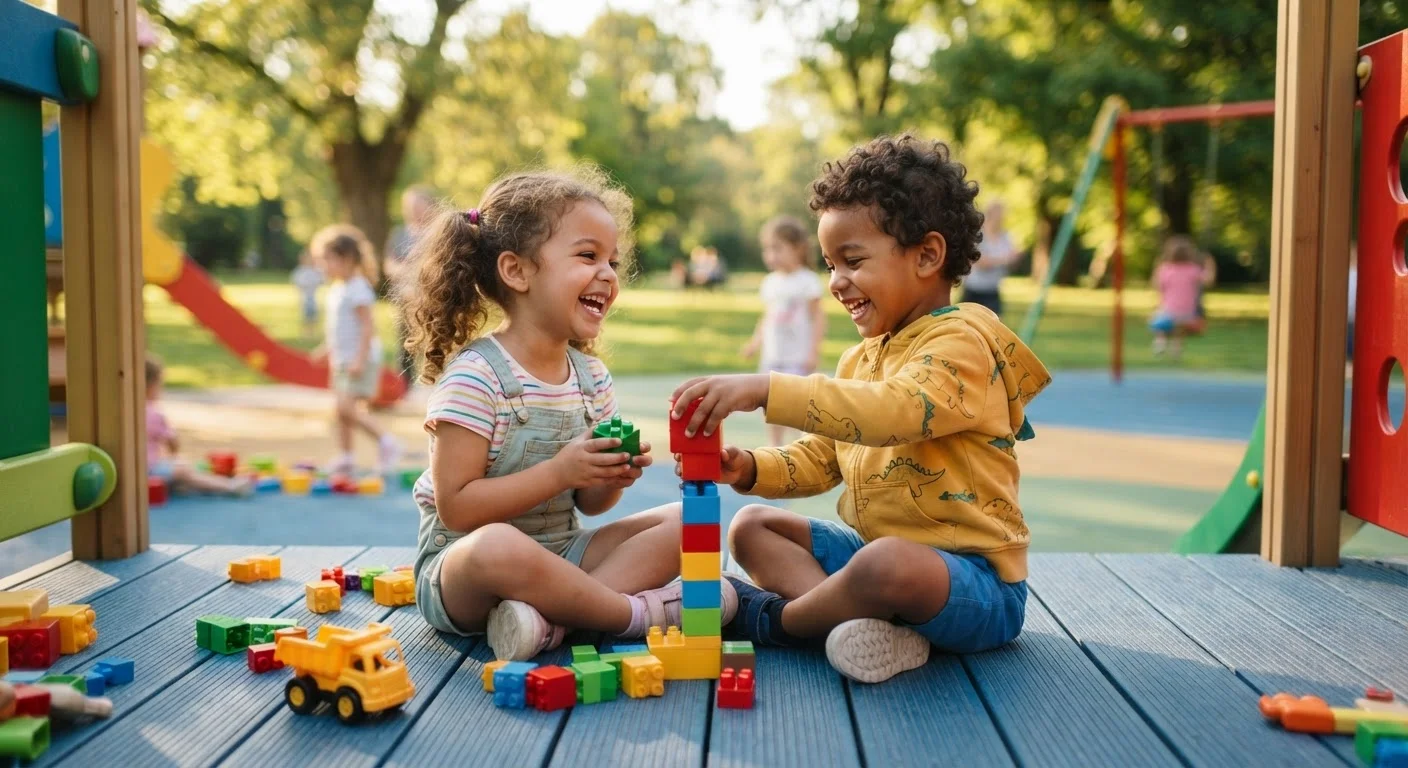
Between ages three and four, associative play emerges: children start talking to each other, borrowing each other's toys, and loosely joining activities — but without sustained coordination. By four to six years, many children are ready for cooperative play, working together toward shared goals like building a fort or acting out a story. This is when genuine friendships begin to take root.
Research on the first five years shows that social-emotional development during this window lays groundwork for everything from school readiness to mental health resilience.
Ages 3–5
Window when cooperative play typically begins
Child development frameworks, including those from the CDC, identify this as the key period for transitioning from parallel to cooperative peer play.
~75%
Of children's waking time spent in social contexts by age 4
Research in developmental psychology highlights that by preschool age, the majority of a child's day involves some form of peer or caregiver interaction.
Ages 4–6
When genuine, reciprocal friendships typically form
According to child development literature, mutual friendship preference and sustained peer bonds generally emerge during the preschool and kindergarten years.
What Children Are Actually Learning Through Play
When children play together, the developmental work happening beneath the surface is remarkable. Negotiating who gets the red crayon teaches turn-taking and delay of gratification. Pretend play — acting out family dinners or superhero rescues — builds perspective-taking, the ability to imagine what someone else is thinking or feeling. This is a precursor to empathy.
Disagreements and minor conflicts are not failures of socialization; they are the curriculum. When a four-year-old insists the dinosaur belongs to her and another child pushes back, they are practicing negotiation, emotional regulation, and problem-solving in real time. Supportive adult guidance — rather than immediate intervention — helps children work through these moments and build confidence.
Play-based learning is not simply recreation. For young children, it is the primary vehicle through which social understanding develops. Structured activities have a place, but unstructured peer play — especially outdoors — gives children the space to practice reading social cues, managing frustration, and celebrating shared success.
Let Children Work Through Small Conflicts
When a minor dispute breaks out between young children — over a toy, a turn, or a role in pretend play — resist the urge to immediately intervene and fix it. Give children a moment to try to resolve it themselves. Step in calmly if frustration escalates, but let the process unfold. These small struggles are where negotiation and empathy skills actually get built.
How Caregivers Shape Social Development
Children don't develop social skills in isolation — they learn from watching and interacting with the adults closest to them. How caregivers respond to a child's emotions sends powerful messages about how feelings should be handled and how other people deserve to be treated.
Naming emotions — "You look frustrated that it didn't work" — helps children build the emotional vocabulary they need to communicate needs rather than act them out physically. Consistent, warm responsiveness from caregivers supports the secure attachment that research consistently links to better peer relationships later. Talking with children about big emotions in developmentally appropriate ways is one of the most effective things families can do.
Language development and social development are also deeply intertwined. A child who can express herself verbally is better equipped to navigate social situations without resorting to grabbing or hitting. Language development and social growth reinforce each other throughout the early years.
Every Child's Timeline Is Different
The developmental stages described here reflect general patterns observed across many children — they are not a rigid checklist. Temperament, family context, prior peer experience, and neurodevelopmental differences all influence how and when social skills emerge. If your child's trajectory looks different, that alone is not cause for alarm, but it is always worth raising with your pediatrician.
This article is for general informational and educational purposes only. If you have concerns about your child's social development, please consult your child's pediatrician or a qualified developmental professional for personalized guidance.