

Key Takeaways
Play-Based Learning
Play-based learning is an approach to early childhood education where children develop cognitive, social, emotional, and physical skills through self-directed, exploratory play. Rather than sitting through formal instruction, children learn by doing — building, pretending, experimenting, and creating. The process is child-led, meaning children follow their own curiosity, with caring adults nearby to support and extend what emerges naturally.
Developmental researchers distinguish between free play (entirely child-directed), guided play (child-led with subtle adult scaffolding toward a learning goal), and structured play (adult-designed activities with clear objectives). All three have a place, though free and guided play are most associated with developmental benefits in early childhood.
Why Play Isn't the Opposite of Learning
Many parents grow up with a mental image of "real learning" that involves desks, worksheets, and structured lessons. Play, by contrast, looks like fun — and fun can feel like time that could be better spent. This perception is one of the most persistent mismatches between popular belief and developmental science.
According to child development researchers, play is the mechanism through which young children make sense of the world. When a toddler stacks blocks and watches them fall, she is conducting an informal experiment in physics and cause-and-effect. When a four-year-old acts out a grocery store with a friend, he is practicing turn-taking, negotiation, vocabulary, and narrative — all at once.
The first five years of a child's life represent a period of rapid brain development that is especially sensitive to experiential, self-directed learning. Formal instruction that works well for an eight-year-old can actually be counterproductive for a three-year-old whose brain is still building the very architecture needed to benefit from it.
“Play is the work of childhood. Through play, children learn about the world and themselves, developing the cognitive, social, and emotional skills that will serve them throughout their lives.”
— Fred Rogers, Educator, child development advocate, and creator of Mister Rogers' Neighborhood
What the Research Actually Shows
Decades of developmental research support play-based approaches for early childhood. Studies have linked rich play environments to stronger executive function — the cluster of mental skills that includes working memory, attention control, and cognitive flexibility. These skills are among the best predictors of long-term academic and life outcomes.
75%
Of brain development occurs after birth
Child development researchers note that the vast majority of synaptic connections form during early childhood, making experiential learning particularly impactful in the first years of life.
30 million
Word gap by age three
Research published in the 1990s by Hart and Risley estimated a gap of roughly 30 million words heard between children from language-rich versus language-sparse home environments — a gap play and conversation help address.
3–5 years
Prime window for executive function development
According to the Harvard Center on the Developing Child, the preschool years represent a sensitive period for developing executive function skills, which play-based experiences are especially well-suited to build.
Play also drives language development. Children acquire vocabulary faster in play contexts than in many direct-instruction settings because words arise naturally in meaningful situations. If you want to understand more about how language unfolds alongside play, our overview of language development from first words to full sentences explores this connection in depth.
Social development is another major benefit. Play — particularly cooperative, pretend, and rough-and-tumble play — is one of the primary ways children learn to read social cues, manage conflict, and build empathy. You can explore how this unfolds across the preschool years in our article on social skills in early childhood.
Types of Play and What Each Builds
Not all play looks the same, and each type contributes something distinct to a child's development.
- Pretend and symbolic play — Builds language, narrative thinking, and emotional regulation. When children act out scenarios, they practice perspective-taking and sequencing.
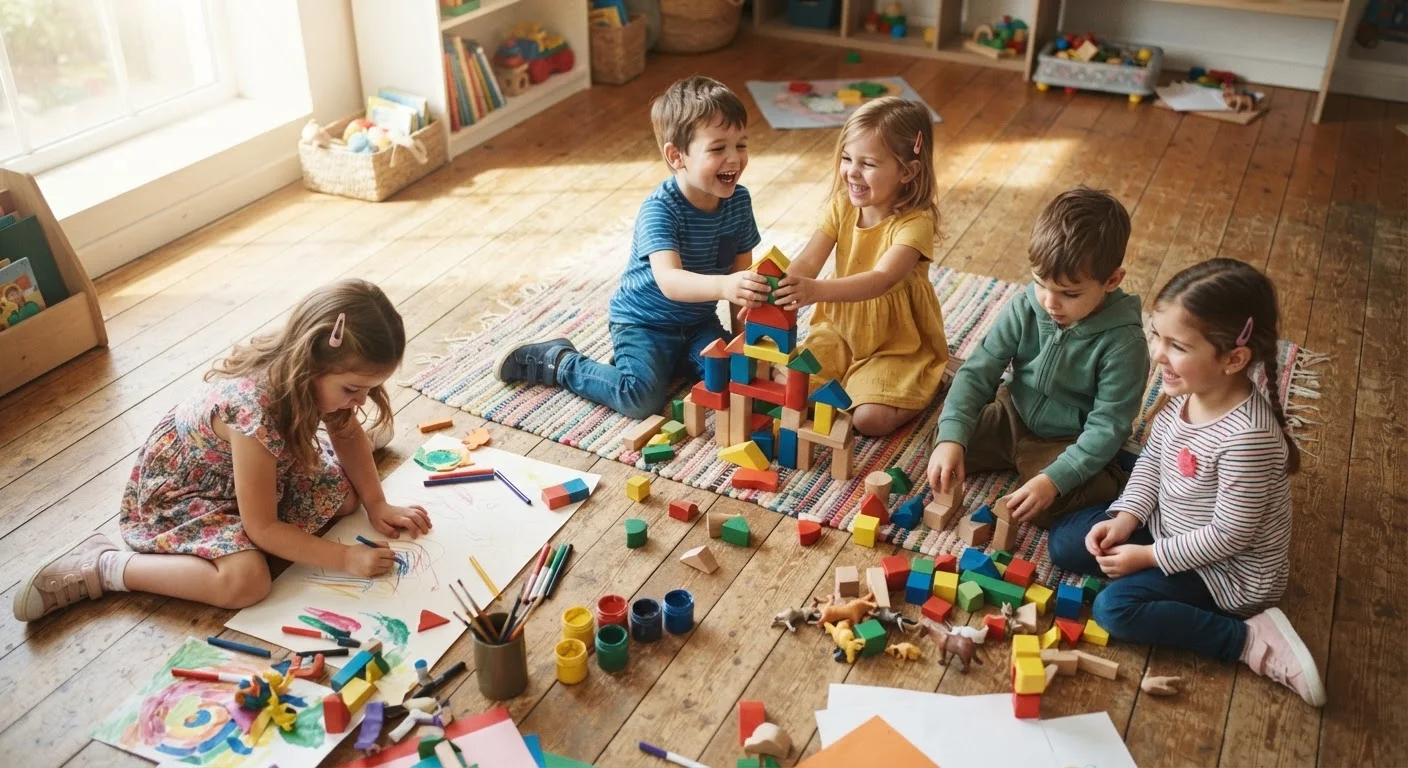
- Constructive play — Building with blocks, clay, or loose parts develops spatial reasoning, planning, and persistence.
- Physical or active play — Running, climbing, and rough-and-tumble play build gross motor skills, risk assessment, and body awareness.
- Exploratory play — Pouring water, mixing materials, or sorting objects builds early scientific thinking and sensory processing.
- Social and cooperative play — Games, role play with peers, and collaborative building develop negotiation, empathy, and communication.
Understanding which milestones are typical at each age can help parents recognize when play is doing exactly what it should — and when milestones may be misread.
How Adults Can Support — Without Taking Over
The adult's role in play-based learning is subtler than many parents expect. It is less about organizing activities and more about creating conditions where play can flourish.
Follow Your Child's Lead
When joining your child at play, try observing before participating. Ask open-ended questions like "What are you making?" rather than directing the outcome. Children benefit most when adults act as curious companions rather than instructors during play time.
Practically, this means offering open-ended materials — blocks, art supplies, sand, dress-up clothes — that invite imagination rather than prescribing a single outcome. It means protecting stretches of unscheduled time so children aren't moving constantly from one adult-directed activity to the next. And it means resisting the urge to solve problems for children the moment frustration appears; that productive struggle is often where the deepest learning happens.
For families navigating questions about screen time, over-scheduling, or pressure to begin academics early, it helps to know that many widely circulated beliefs about what children need don't always hold up under scrutiny. Our piece on widely held beliefs about child development examines some of those assumptions honestly.
More resources on practical parenting guidance are available to help you navigate every stage with confidence.
This article is for general informational and educational purposes only. For concerns about your child's individual development, please consult a qualified pediatrician or child development specialist.