

Key Takeaways
How Language Development Unfolds: The Big Picture
Language is one of the most remarkable things a young child does, and it begins far earlier than most parents expect. Well before a baby says her first word, she is already building the neural architecture for communication — tuning into the rhythms of speech, learning the social rules of conversation, and finding her own voice through cries, coos, and laughter.
Understanding the typical arc of language acquisition can help parents feel less anxious about normal variation and more alert to patterns that genuinely deserve attention. This guide walks through each major stage, from the pre-language months through fluent conversational speech, and explains what's happening beneath the surface at every step. For a broader look at how language fits into overall growth, see what child development research tells us about the first five years.
This article is for general educational purposes only and is not a substitute for professional medical or clinical advice. If you have concerns about your child's development, speak with your pediatrician or a licensed speech-language pathologist.
~300 million
Neurons in a newborn's brain dedicated to language processing
Developmental neuroscience research shows that even at birth, substantial neural circuitry is devoted to processing speech sounds.
10–50 words
Typical vocabulary range at 18 months
The American Speech-Language-Hearing Association describes this as the general range, with wide individual variation considered normal.
~1,000
Words in the average child's vocabulary by age 3
Research in child language acquisition documents a rapid vocabulary expansion between ages 2 and 3 in typically developing children.
From Birth to 12 Months: The Pre-Language Stage
Babies are born primed for language. Newborns show a preference for their mother's voice — a recognition built during the final weeks of pregnancy — and within days they can distinguish the sounds of their home language from other languages. This sensitivity is the seed from which all communication grows.
During the first months, watch for cooing (soft vowel sounds around 2–3 months), then babbling — strings of consonant-vowel combinations like "bababa" or "mamama" — typically emerging between 6 and 9 months. By around 9–10 months, most babies begin to babble with varied pitch and rhythm that starts to resemble real speech, a stage researchers call canonical babbling.
Equally important during this period are joint attention and gesture. When a 9-to-10-month-old points at a dog and looks back at you, she is practicing the give-and-take of conversation. These pre-verbal social skills are strongly linked to later vocabulary size. Some of these early milestones are frequently misread by parents — knowing what to look for helps you celebrate the right things.
12 to 24 Months: First Words and Word Combinations
Most children produce their first recognizable word somewhere around their first birthday, though anywhere from 10 to 14 months is considered typical. A "word" at this stage doesn't have to be perfectly pronounced — "baba" for bottle or "daw" for dog counts, as long as the child uses it consistently and intentionally to refer to something.
Vocabulary tends to grow slowly at first, then accelerates. By 18 months, many children have 10–50 words. Around 18–24 months, a vocabulary burst often occurs, with children sometimes adding several new words per day. Around this same window, two-word combinations begin to appear: "more milk," "daddy go," "big dog." These combinations signal a pivotal cognitive leap — the understanding that words can be arranged to create meaning.
Count your child's understanding, not just their words. If a 15-month-old follows two-step instructions and points to pictures in books on request, expressive language is often just catching up.
Receptive language consistently develops ahead of expressive language. Clinicians often assess comprehension as a primary indicator of language health in toddlers.
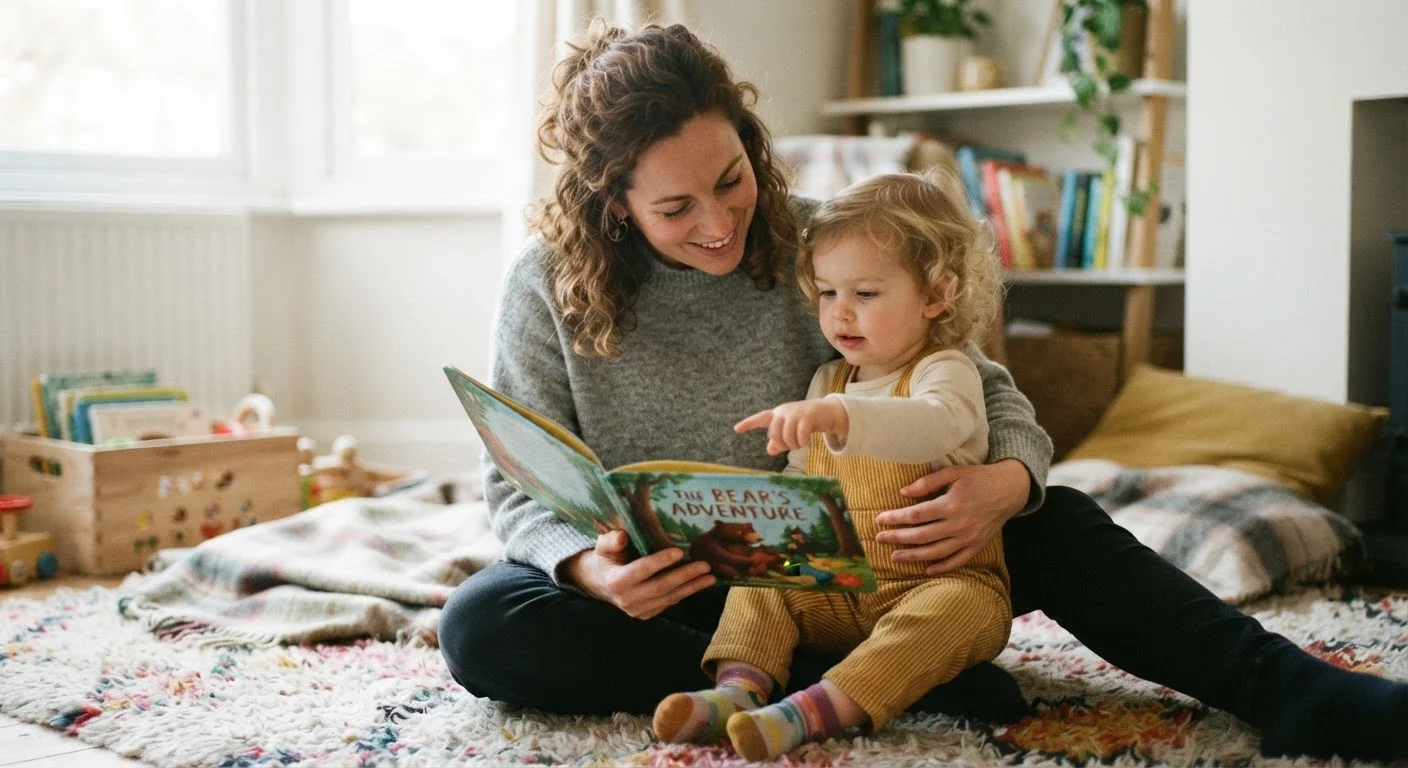
When you read aloud, pause and wonder aloud rather than just reciting the words — 'Oh, I wonder why she looks so worried?' This kind of dialogic reading builds vocabulary and comprehension far more effectively than passive listening.
Studies on dialogic reading show that interactive shared reading, where adults ask open-ended questions and encourage children to respond, produces significantly greater language gains than standard read-aloud alone.
Receptive language (understanding) consistently outpaces expressive language (speaking) at this age. A toddler who understands "go get your shoes" but only speaks a handful of words is still developing very much on track.
Ages 2 to 4: The Language Explosion
The preschool years bring a stunning expansion of language. By age 2, most children are combining two to three words; by age 3, they are producing sentences of four or more words and asking an almost relentless stream of questions. Grammar emerges gradually — first simple rules like adding "-ing" or "-s," then more complex structures like past tense and plurals.
Errors at this stage are entirely normal and even developmentally healthy. When a child says "I goed to the store" or "two mouses," she is demonstrating that she has internalized a grammatical rule — she just hasn't yet learned the exceptions. These "errors" typically self-correct with time and exposure without explicit correction from adults.
Don't Correct — Model Instead
When your child says 'I runned fast!', resist the urge to say 'No, the right word is ran.' Instead, naturally repeat the idea correctly: 'You did! You ran so fast!' Children internalize modeled corrections far more readily than explicit corrections, which can discourage attempts at speaking.
Play is a primary vehicle for language growth during this period. Play-based learning actively builds vocabulary, narrative skills, and conversational turn-taking in ways that structured drills cannot replicate. Pretend play in particular — being a shopkeeper, a doctor, a chef — demands that children use language to build shared worlds with others.
Ages 4 to 6: Moving Toward Conversational Speech
By age 4, most children can tell simple stories with a beginning, middle, and end. Their sentences are longer and more grammatically complete, and they are beginning to adjust their language depending on who they are speaking to — simpler words with younger children, more formal language with unfamiliar adults. This is called register awareness, and it reflects sophisticated social understanding.
Between 4 and 6, children also begin building the foundational skills that support reading. Phonological awareness — the ability to notice and manipulate the sounds within words — is a particularly important bridge. Understanding reading readiness and pre-literacy development can help parents recognize when these skills are taking root. The social dimensions of language also deepen during this window; social skills and language develop in close partnership as children negotiate, collaborate, and make friends through words.
“The most important thing parents can do for language development is not to teach language at all — it is to talk with children, listen to them, and treat them as genuine conversational partners from the very start.”
— Catherine Snow, Professor of Education, Harvard Graduate School of Education, and leading researcher in language development
Signs That May Warrant a Closer Look
Developmental ranges are wide, and variation is normal. That said, certain patterns are generally considered markers worth discussing with a healthcare professional sooner rather than later:
- No babbling by 12 months
- No gestures (pointing, waving) by 12 months
- No single words by 16 months
- No two-word combinations by 24 months
- Any loss of previously acquired language or social skills at any age
These are not automatic diagnoses — they are prompts for conversation. A pediatrician can help assess next steps, which may include a referral to a speech-language pathologist. Understanding what developmental delay means and how it's assessed can help you approach these conversations with greater confidence.
Any Loss of Language Is Always Worth Reporting
If a child who was using words or social behaviors — like eye contact, pointing, or responding to their name — stops doing so, contact your pediatrician promptly rather than waiting for the next routine visit. Regression in language or social communication is one of the most clinically significant early signs across a range of developmental conditions and should always be evaluated without delay.
How Caregivers Support Language Growth Every Day
Research consistently identifies responsive, back-and-forth interaction as the most powerful driver of language development. This doesn't mean flashcards or formal lessons — it means tuning in, following the child's lead, and treating everyday moments as language-rich opportunities.
A few approaches that research supports:
- Serve and return: When your baby babbles, babble back. When your toddler points, name what she's pointing at. These conversational exchanges build brain connections.
- Narrate daily routines: Talk through what you're doing while bathing, cooking, or driving. This steady stream of contextualized language dramatically expands vocabulary.
- Read aloud regularly: Shared reading exposes children to vocabulary, sentence structures, and narrative patterns they rarely encounter in everyday speech.
- Ask open questions: "What do you think will happen?" prompts more language than yes/no questions.
- Avoid overcorrecting: Modeling correct forms ("Yes, you rode your bike!") works better than explicitly pointing out errors.
Bilingual Children Follow the Same Milestones
Children raised in bilingual or multilingual households sometimes start speaking slightly later in each individual language, but their total vocabulary across both languages is typically comparable to monolingual peers. Bilingualism does not cause language delay. If you have concerns, a speech-language pathologist experienced with bilingual development can assess your child in the appropriate language context.
Language growth is not a solo achievement — it is something that happens between people. Every conversation, song, shared book, and silly exchange is quietly doing its work.