

Key Takeaways
Stopping Distance
Stopping distance is the total distance your vehicle travels from the moment you recognize a hazard until the car comes to a complete stop. It has two parts: the distance covered while your brain and body react (reaction distance), and the distance covered while the brakes are actually slowing the car (braking distance). Both parts are affected by conditions well beyond just how fast you're going.
Engineers sometimes break this further into perception distance, reaction distance, and braking distance — three distinct phases that together form total stopping distance.
The Two-Part Process Most Drivers Overlook
Most people think of stopping as a single event — you hit the brakes, the car stops. But there are actually two distinct phases happening before your car goes still.
The first is reaction distance: the distance your vehicle travels from the moment you see a hazard to the moment your foot actually engages the brake. Even a sharp, focused driver takes roughly three-quarters of a second to react. At 60 mph, that's about 66 feet of travel before braking even begins.
The second is braking distance: the distance covered while the brakes are working to slow the car. This phase is governed by physics — the weight of your vehicle, road friction, and your brakes' condition all play a role.
Together, these two phases make up your total stopping distance. Understanding that reaction time is part of the equation helps explain why distraction and fatigue are so dangerous — they extend that first phase before the brakes have any say in the matter.
Use the 3-Second Rule as Your Baseline
Pick a fixed point on the road and count the seconds between when the car ahead passes it and when you do. If it's less than three seconds, you're too close on a dry road. In rain or reduced visibility, double that gap. More space means more time — and more time is what stopping distance is really about.
Why Speed Is the Biggest Variable
Speed doesn't scale stopping distance in a straight line — it scales it exponentially. Specifically, braking distance increases with the square of your speed. That means going from 30 mph to 60 mph doesn't double your braking distance; it roughly quadruples it.
~4x
Braking distance increase when speed doubles
Because braking distance scales with the square of speed, doubling from 30 mph to 60 mph roughly quadruples the distance needed to stop.
50%+
Increase in stopping distance on wet roads
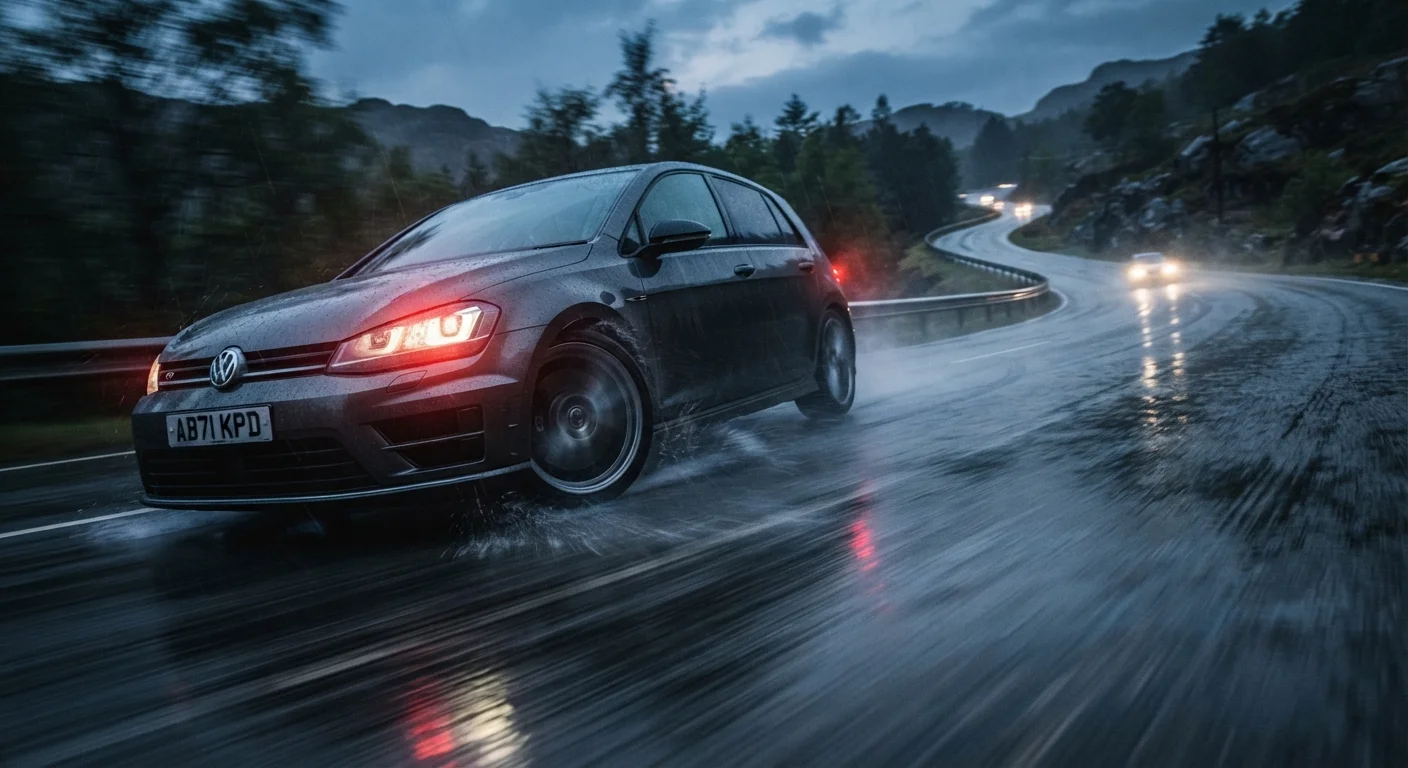
Wet pavement significantly reduces tire-to-road friction, and stopping distances can grow by half or more compared to dry conditions.
~66 ft
Distance traveled during reaction time at 60 mph
Assuming a 0.75-second reaction time — typical for an attentive driver — a vehicle at 60 mph travels roughly 66 feet before braking begins.
This matters practically: if you're traveling 5 mph over the limit on a residential street, you might dismiss it as minor. But those extra miles per hour add meaningful feet to your stopping distance at exactly the moment a child or cyclist might step into the road. As this article on safe speeds vs. speed limits explains, the posted limit sets a legal ceiling — it doesn't tell you what's safe given conditions on the ground.
Road Surface, Tires, and Vehicle Condition
The friction between your tires and the road is what actually brings the car to a stop. Anything that reduces that friction extends your stopping distance.
- Road surface: Wet pavement can increase stopping distance by 50% or more. Ice can multiply it several times over. Loose gravel is unpredictable and can dramatically reduce grip.
- Tire tread: Tread channels water out from under the tire. Worn tires lose that ability fast, especially in rain. U.S. law sets a minimum tread depth of 2/32 of an inch, but the real-world performance of tires degrades well before hitting that legal floor.
- Brake condition: Worn brake pads, warped rotors, or low brake fluid all reduce stopping power. If your brakes feel soft, make noise, or the pedal vibrates, those are warning signs worth taking seriously.
- Vehicle load: A heavier car — whether from cargo, passengers, or a trailer — takes longer to stop. The brakes have more mass to overcome.
These factors compound each other. Worn tires on a wet road with a loaded vehicle is a far more dangerous combination than any single factor alone.
The Human Factor: Reaction Time in the Real World
Laboratory reaction times look clean. Real-world driving is messier. Fatigue, distraction, and impairment all slow down how quickly you perceive and respond to a hazard.
Consider that a tired driver can have reaction times similar to someone over the legal alcohol limit. Glancing at a phone for just two seconds at 60 mph means you've traveled 176 feet blind — before your foot ever moves toward the brake.
Blind spots are a related problem: if you don't see a hazard clearly, your reaction clock doesn't even start until it enters your field of vision, cutting into the margin you have to stop.
The practical upshot: a larger following distance is the single most effective buffer. The standard 3-second rule on dry roads is a floor, not a target. In rain, fog, or heavy traffic, extend it further.
Anti-Lock Brakes Don't Shorten Stopping Distance
A common misconception is that ABS (anti-lock braking systems) help you stop faster. What ABS actually does is prevent wheel lockup so you can steer while braking hard — it doesn't automatically reduce your stopping distance, and on loose or gravel surfaces it can actually increase it. ABS is a control tool, not a speed-reduction shortcut.