

Key Takeaways
Our Verdict
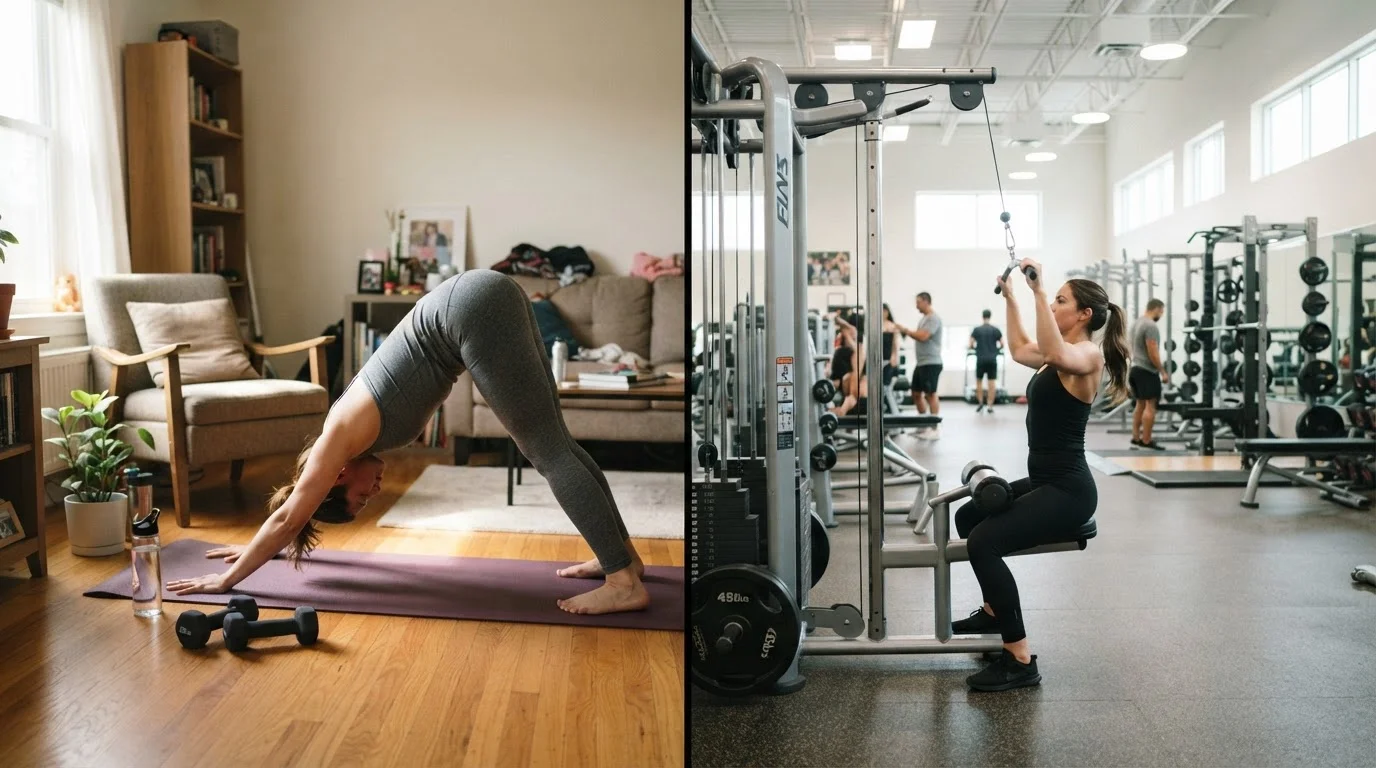
Home workouts and gym workouts each carry genuine advantages and real limitations. Home training wins on cost and convenience; gyms win on equipment range and social structure. For most everyday Americans, the right answer isn't one or the other — it's whichever environment you'll actually show up for consistently.
| Best for | Recommended |
|---|---|
| Those working within tight budgets or unpredictable schedules | Home Workouts |
| Those pursuing strength sports, heavy lifting, or specialized training | Gym Workouts |
| Those who thrive on social motivation and professional guidance | Gym Workouts |
| Those who want maximum flexibility and privacy | Home Workouts |
The Real Cost Comparison
Money is often the first thing people weigh. A gym membership in the U.S. typically runs anywhere from $20 to $80 per month at a standard facility, with premium or specialty gyms reaching well above that. Over a year, that's a meaningful recurring expense — but it also covers access to thousands of dollars' worth of equipment you don't have to store, maintain, or replace yourself.
Home workouts, by contrast, have a higher upfront cost if you buy equipment, but that spending stops. A set of adjustable dumbbells, a resistance band kit, and a yoga mat can equip a solid home gym for a one-time investment. Bodyweight training costs nothing beyond the space you already have.
The honest caveat: many people underuse purchased home equipment, making the cost-per-session higher than it looks on paper. A gym membership you actually use consistently can be a better financial decision than equipment gathering dust. Think carefully about your track record before committing to either.
| Home Workouts | Gym Workouts | |
|---|---|---|
| Monthly cost | $0–$20 (after initial setup) | $20–$80+ ongoing membership |
| Equipment variety | Limited unless heavily invested | Extensive; barbells, cables, machines |
| Convenience | Maximum — no commute required | Requires travel and scheduling |
| Accountability | Relies entirely on self-discipline | Environment and community provide structure |
| Privacy | Complete privacy at all times | Shared public or semi-public space |
| Distraction risk | Higher — household tasks compete | Lower — purpose-built environment |
| Suitability for beginners | Moderate — programming guidance lacking | High — staff and classes available |
Convenience, Commitment, and the Friction Factor
Friction — the small barriers between you and starting a workout — is one of the biggest determinants of whether exercise happens at all. Home workouts eliminate commute time entirely. No packing a bag, no driving, no waiting for equipment. For parents, early risers, or people with erratic schedules, that removed friction can be the difference between exercising and not.
Gyms introduce productive friction for some people. The act of going somewhere specifically to exercise creates a psychological boundary that helps many people mentally switch into workout mode. The environment is purpose-built: no dishes in the sink, no television, no household distractions pulling attention away.
Try a Two-Week Honesty Test
Before committing to a membership or equipment purchase, track where you actually exercise for two weeks using whatever you currently have access to. If you find yourself skipping regularly at home, a gym's structured environment may suit you better. If you get sessions in easily without traveling, home training may be your natural fit. Your existing behavior is a better predictor than your intentions.
If you're exploring ways to build movement into your life beyond scheduled workouts, everyday physical activities that count toward your goals are worth understanding too.
Equipment Access and What It Actually Enables
This is where gyms have a clear functional advantage. Barbells, cable machines, squat racks, rowing machines, and saunas are difficult or impossible to replicate at home without significant space and budget. If your goals include heavy compound lifting, training for a sport, or working with specialized rehabilitation equipment, a gym is genuinely hard to replace.
Home training, however, is far more capable than many people assume. Bodyweight progressions — push-up variations, single-leg squats, pull-ups with a mounted bar — can build real strength and cardiovascular fitness. Resistance bands add load with minimal storage requirements. For general health and fitness goals (which cover most Americans), home setups are functionally adequate.
For those interested in how your training type shapes outcomes, the trade-offs between cardio and strength training are worth examining before deciding which environment best supports your priorities.
~80%
Americans not meeting activity guidelines
The CDC estimates roughly 4 in 5 American adults do not meet federal physical activity recommendations for both aerobic and muscle-strengthening activity.
$150–$500
Typical starter home gym cost
Basic home setups including resistance bands, a mat, and a pull-up bar can be assembled for well under $500, with no recurring cost.
Social Environment and Accountability
A gym provides something home training largely cannot: other people moving. Research in exercise science consistently suggests that social presence — even exercising near strangers — can increase effort and consistency for many individuals. Group classes add coaching, community, and a scheduled time commitment that some people find essential.
Home workouts remove social pressure entirely, which is a feature for some and a bug for others. People who find gym environments intimidating, those managing certain health conditions, or those who genuinely prefer solitude often perform better at home without the social variable.
If you're building a sustainable habit without a gym, there are practical frameworks for staying consistent — strategies for building an exercise habit outside a gym offer a useful starting point.
This article is for general informational purposes only and does not constitute medical or fitness advice. Consult a qualified healthcare or fitness professional before beginning any new exercise program, especially if you have existing health conditions.