

Key Takeaways
The Debt Cycle
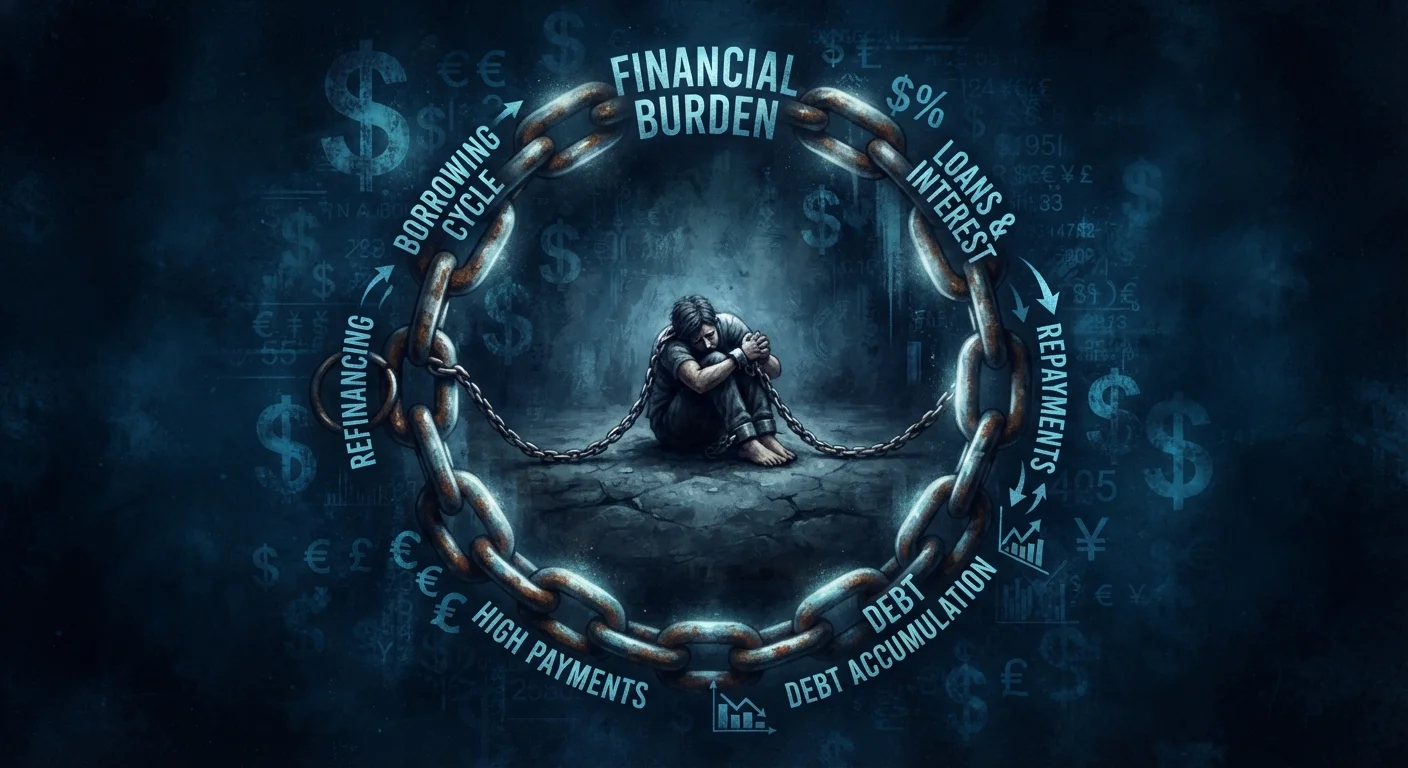
The debt cycle is a repeating pattern where a person borrows money, struggles to repay it, and is forced to borrow again just to cover basic expenses or existing debt payments. Interest charges and fees accumulate over time, making the original balance harder to reduce. The cycle can persist for months or years, even when someone is actively trying to pay down what they owe.
High-interest revolving debt — such as credit card balances — is particularly cycle-prone because minimum payments may cover little more than accrued interest, leaving the principal largely intact.
How the Debt Cycle Actually Works
At its core, the debt cycle is a math problem that compounds over time. When you carry a balance on high-interest debt, interest is charged on what you owe — and if you don't pay enough to cover both the interest and reduce the principal, your balance either stays flat or grows. That dynamic alone keeps millions of people running in place financially.
The mechanics look like this: you borrow $3,000 on a credit card with an 22% annual interest rate. If you make only the minimum payment each month, most of that payment disappears into the interest charge. The principal drops slowly — sometimes by only a few dollars per cycle — and the account stays nearly as large as when you started.
Compounding makes this worse. Interest accrues on the total outstanding balance, including any previously charged interest that wasn't fully paid. Over time, the debt becomes self-sustaining: it grows on its own, even without new purchases.
$6,000+
Average US credit card balance per cardholder
According to Federal Reserve data and consumer finance analyses, the average indebted cardholder in the US carries a balance in this range, often across multiple accounts.
20%+
Average credit card interest rate in the US
Federal Reserve data shows average credit card interest rates have exceeded 20% APR in recent years, dramatically amplifying the compounding effect on unpaid balances.
Years
Time to clear a balance on minimum payments
Consumer finance calculations consistently show that paying only the minimum on a typical credit card balance can extend repayment to a decade or more.
What Keeps People Trapped
The debt cycle isn't just a math problem — it's a structural one. Several interlocking factors make it genuinely difficult to escape, even for disciplined people.
- Income gaps: When monthly expenses exceed take-home pay, borrowing fills the shortfall. This isn't recklessness — it's survival. But every borrowed dollar carries interest, widening the gap the following month.
- No emergency cushion: Without savings to fall back on, any unexpected expense — a medical bill, a car repair, a job gap — goes directly onto a credit card. This is one of the most common re-entry points into the cycle.
- Minimum payment traps: Card issuers set minimum payments low enough to keep accounts current while maximising the interest they collect. Paying the minimum is often mistaken for making progress, when it's actually treading water.
- Psychological exhaustion: Debt creates financial stress, and chronic stress impairs decision-making. People who feel overwhelmed by debt are less likely to track spending, negotiate rates, or seek help — which makes the situation worse over time.
Behavioural patterns that undermine debt repayment are often just as significant as the interest rate itself.
Call Your Card Issuer Before Giving Up
Many credit card companies have hardship programs that can temporarily reduce your interest rate or minimum payment — but they rarely advertise them. A single phone call asking about hardship options or a rate reduction can sometimes lower your cost of debt meaningfully. It's worth trying before looking at more complex solutions.
The Role of Interest Rates in the Cycle
Not all debt is equally dangerous. A mortgage at 7% and a credit card at 27% behave very differently over time. High-interest revolving debt — the kind with no fixed end date — is the primary driver of most personal debt cycles.
When your interest rate is high enough, paying down the principal requires significantly more than the minimum payment just to make a visible dent. For example, on a $5,000 balance at 25% APR, you'd need to pay roughly $150 per month to make meaningful progress — yet the minimum payment might be set at $25 to $50.
“Debt is like any other trap — easy enough to get into, hard enough to get out of. The interest rate is the wall that keeps the trap closed.”
— Consumer Financial Protection Bureau, U.S. federal agency focused on consumer financial protection and education
Reducing your interest rate — through negotiation, balance transfers, or consolidation — directly slows the cycle. Our explainer on when debt consolidation makes sense covers how this can work in practice.
Breaking Out: What Actually Moves the Needle
Escaping the debt cycle requires attacking it from multiple angles at once. No single action is usually enough on its own.
- Stop adding to the balance. This sounds obvious, but it means finding another way to cover essential shortfalls — whether through cutting costs, increasing income, or accessing assistance programs — rather than reaching for the card.
- Target the highest-interest debt first. The avalanche method directs every extra dollar toward the account charging the most interest, which reduces the compounding effect fastest. Strategies for managing multiple debts simultaneously can help structure this approach.
- Build even a small emergency fund. A $500 to $1,000 buffer prevents the next unexpected expense from going straight back on a card. It's a circuit breaker for the cycle.
- Track cash flow monthly. A monthly financial reset checklist helps catch spending drift before it becomes a new balance.
Progress is rarely linear. A setback doesn't restart the clock — it's a detour, not a failure. For a fuller picture of the journey from debt stress to financial stability, see our complete roadmap from financial stress to stability.
This article is for general informational purposes only and does not constitute personalised financial advice. Consult a licensed financial professional for guidance specific to your situation.