

Key Takeaways
Risk-Return Trade-Off
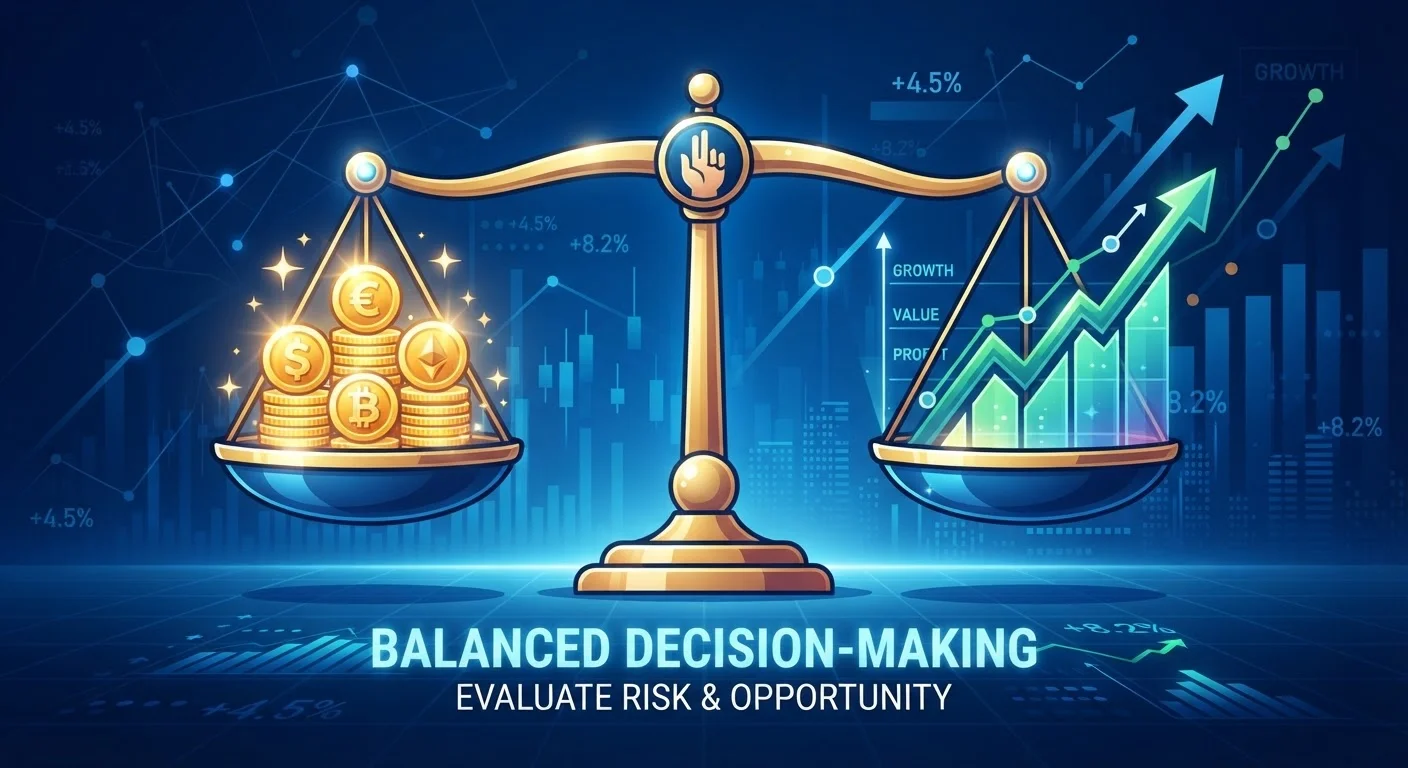
The risk-return trade-off is the fundamental investing principle that higher potential returns come with higher potential for loss. In other words, to have a shot at earning more, you generally have to accept the possibility of losing more. This relationship shapes every investment decision, from keeping money in a savings account to buying shares of stock.
In finance, this relationship is often measured using metrics like standard deviation (which captures how much returns fluctuate) and the Sharpe ratio (which adjusts returns for the level of risk taken).
The Core Idea: No Free Lunch in Investing
If you've ever wondered why a savings account pays next to nothing while stocks can double in value — or crash — the answer comes down to one concept: the risk-return trade-off.
The rule is straightforward. Investments that can earn more also carry a greater chance of loss. Investments that protect your money reliably tend to grow it slowly. There is no investment that offers high returns with no risk — and if someone tells you otherwise, that's a warning sign, not an opportunity.
This isn't just theory. It plays out every time someone decides where to put their money. Understanding it won't make investing easy, but it will help you make decisions with open eyes. For a broader foundation, see our beginner's guide to investing.
~10%
Average annual U.S. stock market return (historical)
The S&P 500 has historically averaged roughly 10% annually before inflation over long periods, though individual years vary widely and past performance does not guarantee future results.
~34%
S&P 500 peak-to-trough drop in early 2020
The U.S. stock market fell approximately 34% in about five weeks during the early 2020 market sell-off, illustrating how quickly equity risk can materialize.
3–5%
Typical yield range for U.S. Treasury bonds
U.S. Treasury yields vary with economic conditions, but historically sit well below long-term stock returns — reflecting their much lower default risk.
Risk and Return Across Investment Types
Different asset types sit at different points on the risk-return spectrum. Cash and savings accounts sit at the low end — your principal is stable, but growth is minimal. U.S. Treasury bonds offer slightly more return than cash, with very low default risk, but prices can still fluctuate. Corporate bonds offer higher interest than government bonds, but with greater risk that the company could default.
At the higher end, stocks can deliver strong long-term growth — but they can also lose 30%, 40%, or more in a downturn. Individual stocks carry more risk than diversified funds because a single company can fail entirely. Alternative investments like real estate investment trusts or commodities add another layer of complexity and variability.
Stocks, bonds, and cash each play a different role in a portfolio, and understanding where they sit on the risk spectrum helps you decide how much of each makes sense for you.
Time Horizon Changes Everything
One of the most important factors in how much risk makes sense for you is time — specifically, how long before you need to use the money you're investing.
If you need the money in two years, a steep market drop has no time to recover, which makes higher-risk investments genuinely dangerous for that goal. If you're investing for 25 years, the same drop becomes a temporary setback — history shows markets have recovered from significant downturns over long periods, though past performance doesn't guarantee future results.
This is why many financial advisers suggest shifting toward lower-risk investments as you approach a specific financial goal. It's not that risk becomes bad — it's that your ability to absorb short-term losses shrinks as your deadline gets closer. A longer runway also allows compound interest to work in your favor — returns building on returns over time.
Match Risk to the Purpose of the Money
Before choosing any investment, ask yourself when you'll need the money and what happens if it loses value right before then. Emergency funds and near-term goals belong in stable, low-risk accounts. Long-term goals — retirement, for instance — can typically afford more volatility. Matching risk level to time horizon is one of the most practical rules in personal finance.
Managing Risk Without Eliminating It
You can't invest without taking on some risk. But you can manage how that risk is structured. The most widely used tool is diversification — spreading money across different types of investments so that poor performance in one area doesn't devastate the whole picture.
Diversification is one of the most fundamental principles in investing, and it's more nuanced than simply owning multiple things. True diversification means assets that don't all move in the same direction at the same time.
It's also worth separating risk types. Market risk affects nearly all investments and can't be diversified away. Specific risk — the chance that one company or sector collapses — can be reduced by spreading your holdings. Understanding which type of risk you're managing shapes your strategy significantly. For plain-language definitions of terms like these, a glossary of key investing terms can be a useful reference.
“Risk comes from not knowing what you're doing.”
— Warren Buffett, Investor and Chairman of Berkshire Hathaway
This article is for general informational purposes only and does not constitute personalized financial or investment advice. Consider speaking with a licensed financial adviser before making investment decisions based on your individual circumstances.