

Key Takeaways
Diversification
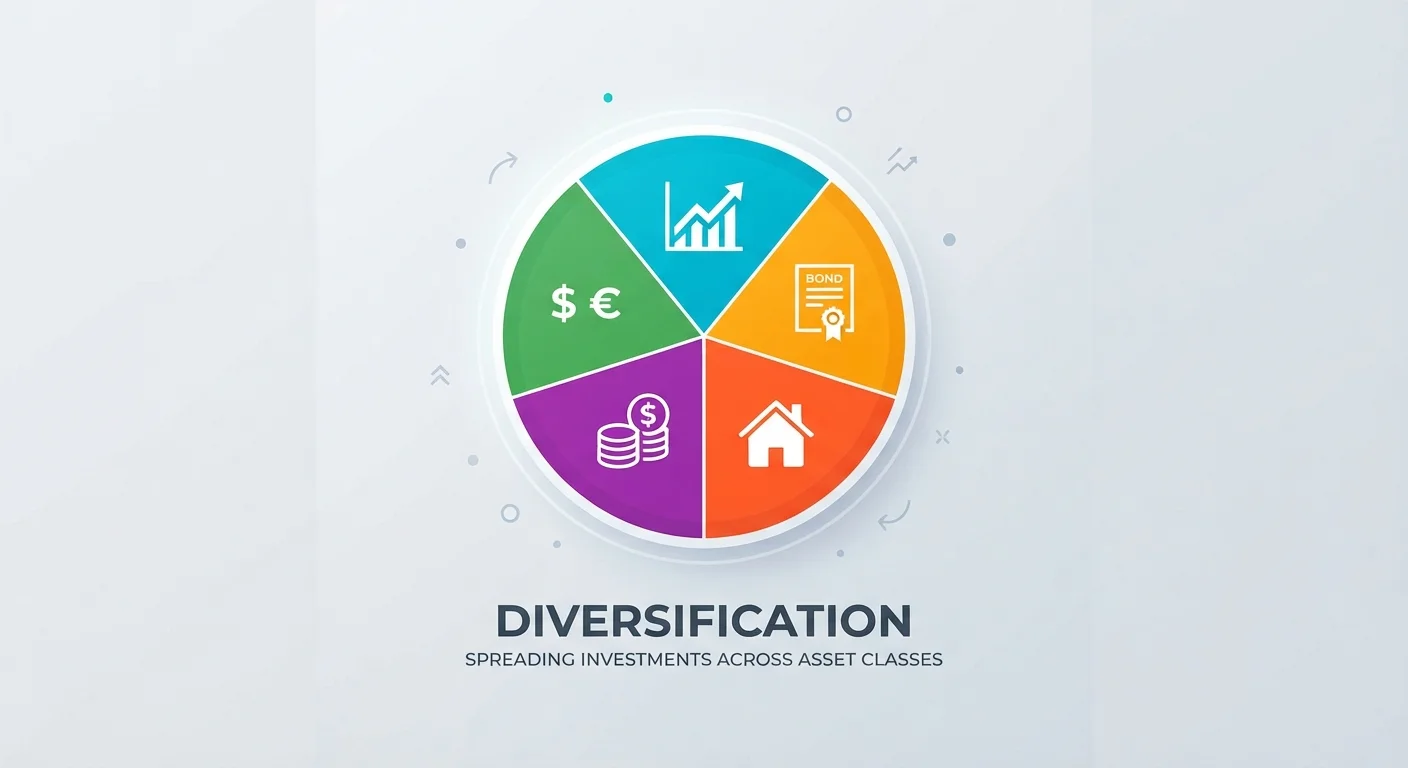
Diversification means spreading your money across different types of investments — such as stocks, bonds, and real estate — so that a decline in one area doesn't sink your entire portfolio. The logic is straightforward: if your investments don't all move in the same direction at the same time, losses in one place can be offset by stability or gains elsewhere.
In portfolio theory, diversification works by combining assets with low or negative correlation, meaning their prices don't move in lockstep. This can reduce a portfolio's overall volatility without proportionally reducing its expected return — the core insight behind Modern Portfolio Theory.
The Simple Truth Behind the Term
Diversification means spreading your money across different types of investments so that poor performance in one area doesn't devastate your entire portfolio. The old saying — "don't put all your eggs in one basket" — captures the spirit, but the mechanics run a bit deeper than that.
The key insight is that different investments often respond differently to the same economic events. When one holding falls, another may hold steady or even rise. That variation is what gives diversification its protective power. A portfolio where every investment tends to move in the same direction at the same time isn't truly diversified — regardless of how many individual positions it contains.
Two Kinds of Risk — and What Diversification Controls
Finance education typically divides investment risk into two categories:
- Unsystematic risk is specific to a single company or sector — a product recall, a management scandal, or a sudden collapse in demand for one industry. Diversification can significantly reduce this type of risk by ensuring no single holding dominates your portfolio.
- Systematic risk is broader — recessions, interest rate shifts, geopolitical shocks. These events tend to affect most investments simultaneously, and no amount of diversification makes them disappear.
That distinction shapes realistic expectations. Understanding the risk-return trade-off helps clarify what you're managing when you diversify — and where the limits are. And because stocks, bonds, and cash each carry different risk profiles, mixing asset classes is one of the most effective starting points for any diversified portfolio.
What a Diversified Portfolio Actually Looks Like
Within a stock portfolio, diversification typically spans several dimensions:
- Sectors — technology, healthcare, consumer goods, energy, financials, and others
- Company sizes — large-cap companies tend to behave differently than small-cap ones
- Geographies — international markets don't always move in sync with domestic ones
Adding bonds introduces another protective layer. Stocks and bonds don't always move in opposite directions, but they often respond differently enough to smooth out a portfolio's overall swings. That's why most long-term investment frameworks include both.
Most everyday investors don't build this kind of diversification security by security. They use funds — mutual funds or ETFs (exchange-traded funds) — that hold hundreds of securities at once. ETFs and mutual funds work differently in a few important ways, but both provide broad exposure that would take far longer to replicate through individual stock selection.
You Don't Have to Build It from Scratch
Broad index funds and target-date retirement funds provide built-in diversification the moment you invest. Many workplace 401(k) plans already include these options. You don't need to personally select dozens of individual securities to hold a well-diversified portfolio — and you don't need a large sum of money to get started.
The Trade-Off Worth Understanding
A well-diversified portfolio won't be the top performer in any given year. When one sector or asset class has a strong run, a concentrated bet in that area will outperform a spread-out portfolio. Diversification means accepting that trade-off deliberately — giving up some upside potential in exchange for reducing the severity of losses.
For most long-term investors, that's a worthwhile exchange. Large losses are mathematically harder to recover from than moderate ones: a 50% loss requires a 100% gain just to break even. Common investing myths often push people toward chasing returns rather than managing risk — understanding diversification helps counter that instinct.
If any of the terms here are unfamiliar, a plain-language investing glossary is a useful next step before exploring further.
This article is for general informational and educational purposes only and does not constitute personalized financial or investment advice. Consult a qualified financial adviser before making decisions about your own investments.