

Key Takeaways
Option A
Index Funds
The low-cost, follow-the-market approach.
Best for: Investors who want broad market exposure with minimal fees and no reliance on a fund manager's picks.
Option B
Actively Managed Funds
The hands-on, beat-the-market approach.
Best for: Investors who believe skilled managers can outperform the market and are willing to pay higher fees for that potential.
If you want a low-cost, hands-off strategy for long-term growth
Index Funds
Index funds keep fees low and consistently deliver the market's return, which outpaces most active funds over time.
If you're investing in a less-efficient market segment where research may add value
Actively Managed Funds
In some niche or emerging-market categories, skilled managers may have more room to add value compared to large-cap domestic markets.
If you're just starting out and want simplicity
Index Funds
Index funds require no manager selection, have lower minimums in many cases, and remove the guesswork of picking a winning active strategy.
If you have a shorter time horizon and want tactical flexibility
Actively Managed Funds
Some active managers can defensively reposition a portfolio during volatility, though this involves trade-offs and is not guaranteed to help.
How Each Fund Type Actually Works
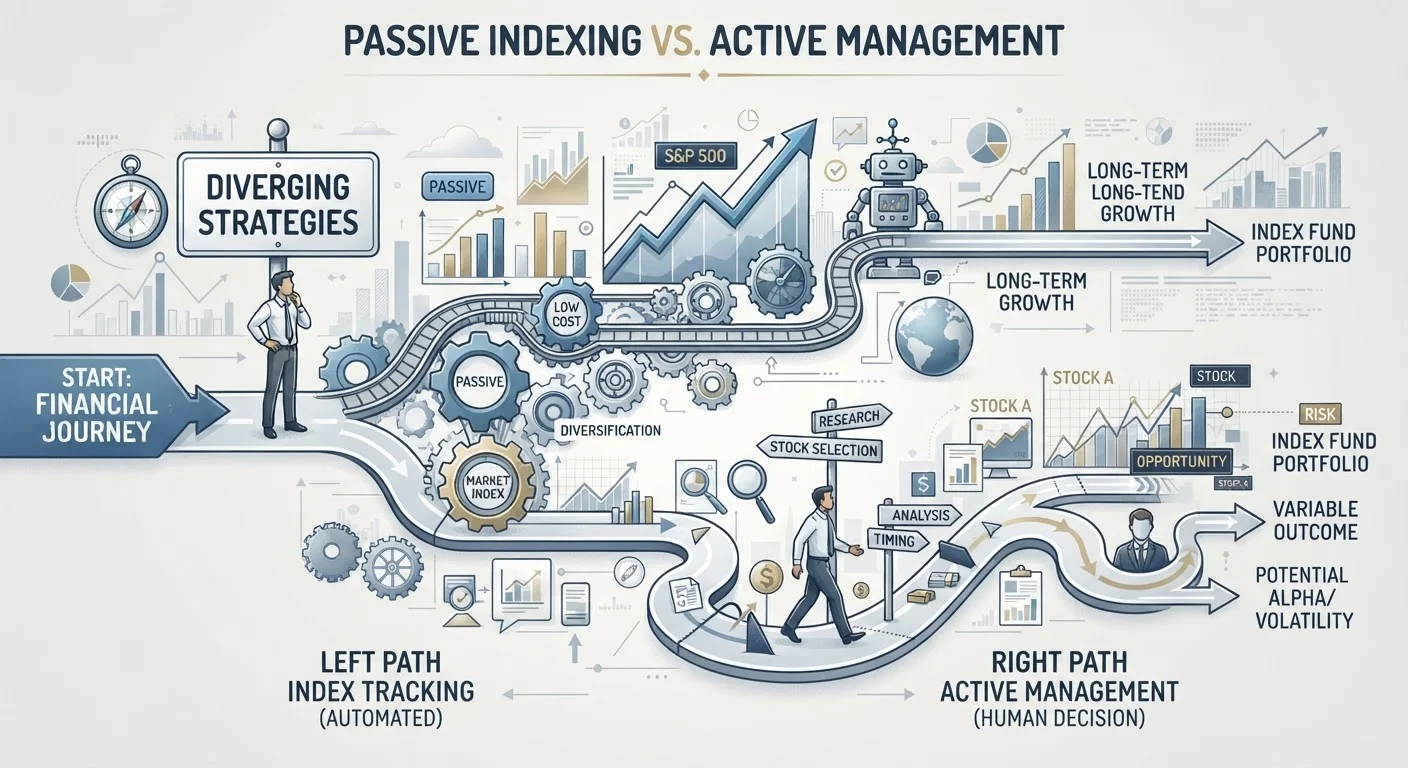
An index fund is designed to replicate the performance of a specific market index — such as the S&P 500, which tracks 500 large U.S. companies. The fund simply buys the same securities, in the same proportions, as that index. No manager is making judgment calls about which stocks to hold or sell. The portfolio changes only when the index itself changes.
An actively managed fund, by contrast, employs a portfolio manager — and usually an entire research team — whose job is to analyze markets and make deliberate investment decisions. The goal is to beat a benchmark index by identifying undervalued securities or avoiding overvalued ones. That takes expertise, research infrastructure, and continuous trading activity.
To understand where each type fits in a broader strategy, it helps to first get grounded in the building blocks of a portfolio — since both fund types use the same underlying assets.
Cost: The Biggest Practical Difference
Every fund charges an expense ratio — an annual fee expressed as a percentage of your investment. This is where index funds hold a clear structural advantage.
| Criterion | Index Funds | Actively Managed Funds |
|---|---|---|
| Typical expense ratio | 0.03%–0.20% | 0.50%–1.50%+ |
| Management style | Passive — mirrors an index | Active — manager selects holdings |
| Goal | Match market returns | Beat a benchmark index |
| Trading frequency | Low — changes only with index | High — ongoing buy/sell decisions |
| Tax efficiency | Generally higher | Often lower due to turnover |
| Long-term performance (typical) | Beats most active funds after fees | Majority underperform over 10+ years |
| Manager risk | None — no active decisions | Present — strategy may lag market |
Because index funds don't require active research or frequent trading, their costs stay low. Actively managed funds must cover analyst salaries, trading commissions, and management fees, which push expense ratios significantly higher. Over a 20- or 30-year horizon, even a 0.75% annual difference in fees compounds into a material drag on returns.
~85%
Active U.S. large-cap funds underperforming index over 15 years
According to S&P Dow Jones Indices SPIVA U.S. Scorecard data, roughly 85% of actively managed large-cap U.S. equity funds have underperformed the S&P 500 over 15-year periods.
1%+
Typical annual fee gap between active and index funds
The average expense ratio for actively managed equity funds is often more than 1 percentage point higher than comparable index funds, which compounds significantly over decades.
It's also worth noting that active funds often generate more taxable events through frequent buying and selling — a consideration for accounts that aren't tax-sheltered.
Returns: Does Active Management Pay Off?
The central promise of an actively managed fund is simple: pay more, get more. The evidence, however, doesn't consistently support that promise over long periods.
Research from S&P Dow Jones Indices — published in their ongoing SPIVA (S&P Indices Versus Active) reports — has repeatedly shown that the majority of actively managed U.S. equity funds underperform their benchmark index over 10- and 15-year periods, particularly after fees are factored in. Some managers outperform in shorter windows, but sustaining that outperformance is uncommon, and identifying those managers in advance is genuinely difficult.
That said, context matters. In markets where information is less widely available — certain international markets or specialized sectors — active management may have more opportunity to add value. The track record is weakest in large-cap U.S. equities, where the market is considered highly efficient.
If you're weighing how to put money to work consistently, strategies like dollar-cost averaging vs. lump-sum investing are worth understanding regardless of which fund type you choose.
Risk and Diversification
Both fund types carry market risk — if the broader market declines, most funds will decline too. Neither is a safe haven. But the sources of risk differ.
Index funds carry market risk almost exclusively: your returns track the index, for better or worse. Active funds add a layer of manager risk — the possibility that the fund's strategy or picks underperform the market even when the market itself is doing well.
Diversification is built into both structures. However, a concentrated active fund might hold far fewer positions than a broad index fund, which can amplify volatility in either direction.
If you prefer to have someone else handle allocation decisions entirely, robo-advisers vs. DIY investing covers another dimension of that trade-off. And for a closer look at fund structure itself, ETFs vs. mutual funds explains how the same fund strategy can be delivered in different wrappers.
These Aren't Mutually Exclusive Choices
Many investors hold both index funds and actively managed funds in the same portfolio. A common approach is to use low-cost index funds as the core of a portfolio and allocate a smaller portion to active strategies in markets where the investor believes active management has more merit. There's no requirement to choose one type exclusively.
This article is for general informational and educational purposes only and does not constitute personalized financial or investment advice. Past performance does not guarantee future results. Please consult a licensed financial adviser before making investment decisions.