

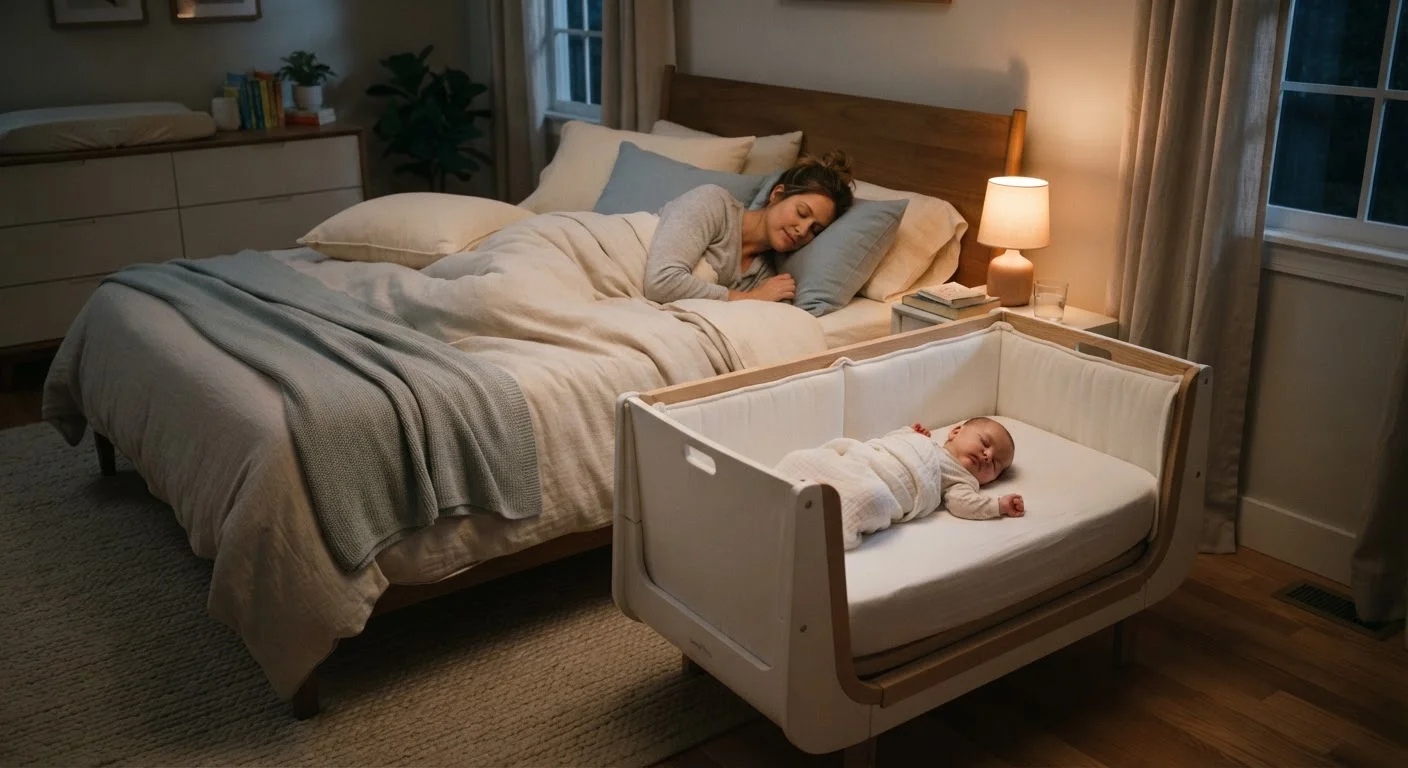
Key Takeaways
Option A
Room-Sharing
The AAP-recommended middle ground for infant sleep.
Best for: Parents who want to stay close to their baby at night while following current safe sleep guidance.
Option B
Co-Sleeping (Bed-Sharing)
A culturally common practice that carries documented infant safety risks.
Best for: Understanding the risks — not a recommended practice for infants under 12 months according to major pediatric health organizations.
If you want to stay close to your newborn at night
Room-Sharing
Placing your baby's crib or bassinet in your room keeps them within arm's reach for nighttime feeds while maintaining a separate, safe sleep surface.
If you are breastfeeding and tired at night
Room-Sharing
Room-sharing makes nighttime feeding more convenient without requiring baby to share the adult bed, reducing the risk of falling asleep together unsafely.
If you are researching whether bed-sharing is right for your family
Room-Sharing
Current pediatric consensus strongly recommends against infant bed-sharing due to suffocation and SIDS risks; room-sharing offers closeness with significantly lower risk.
Two Terms, One Big Difference
Many parents use "co-sleeping" and "room-sharing" interchangeably, but they describe meaningfully different sleeping arrangements — and that distinction directly affects infant safety.
Room-sharing means your baby sleeps on their own dedicated sleep surface — a crib, bassinet, or play yard — placed in the same room as the parent or caregiver. Co-sleeping (also called bed-sharing) means the baby shares the same sleep surface, such as an adult mattress, sofa, or armchair, with another person.
The American Academy of Pediatrics (AAP) recommends room-sharing for at least the first six months of an infant's life, and ideally through the first year. The AAP simultaneously advises against bed-sharing for infants, citing well-documented risks of suffocation, overlay, and SIDS (Sudden Infant Death Syndrome).
| Criterion | Room-Sharing | Co-Sleeping (Bed-Sharing) |
|---|---|---|
| Sleep surface | Separate crib, bassinet, or play yard | Same adult bed, sofa, or armchair |
| AAP recommendation | Recommended for first 6–12 months | Advised against for infants |
| SIDS / suffocation risk | Lower when guidelines followed | Significantly elevated |
| Nighttime feeding access | Convenient — baby is nearby | Immediate — but fall-asleep risk rises |
| Risk increases with parental smoking | Minimal impact if separate surface used | Risk multiplied substantially |
| Risk increases with alcohol/medication use | Minimal impact if separate surface used | Risk increases significantly |
Understanding this split is the first step toward making an informed choice for your family. If you are setting up your home before a baby arrives, our newborn home preparation guide covers safe sleep setup alongside other essential checklists.
The Risks of Bed-Sharing
Bed-sharing is one of the leading risk factors for sleep-related infant deaths in the United States. When a baby shares a sleep surface with an adult, several hazards become possible: soft bedding can cover the infant's face, a sleeping adult can inadvertently roll onto the baby, and gaps between the mattress and headboard or wall can cause entrapment.
~3,500
Annual sleep-related infant deaths in the US
The CDC estimates approximately 3,500 infants die each year in the US from sleep-related causes, including SIDS, suffocation, and entrapment.
50%+
Sleep-related deaths involving bed-sharing
Research published in pediatric journals consistently finds that a majority of sleep-related infant deaths involve a shared sleep surface.
5x
Increased risk when parent smokes and bed-shares
AAP policy statements note that the combination of parental smoking and bed-sharing raises infant death risk substantially compared to room-sharing alone.
Risks are heightened significantly in specific circumstances. According to AAP guidance, bed-sharing becomes especially dangerous when a caregiver has consumed alcohol, sedating medications, or drugs; when a caregiver is a smoker (even if not smoking in bed); when the baby is a premature infant or low birth weight; and when the sleep surface is a sofa, recliner, or waterbed rather than a firm mattress.
It is worth noting that bed-sharing is practiced widely across many cultures and that some families feel it supports bonding and breastfeeding. However, pediatric health organizations emphasize that the risks for infants — particularly in the first year — are not eliminated by careful behavior alone, and that safer alternatives exist for families seeking closeness.
Cultural Context Matters — So Does Safety
Bed-sharing is deeply embedded in many cultural traditions around the world, and many parents find it supports bonding and breastfeeding. Pediatric guidance is not meant to dismiss those values. Rather, current research consistently finds that the physical sleep environment — soft surfaces, loose bedding, and impaired caregiver alertness — creates risks that are difficult to mitigate fully when sharing a surface with an infant. If this is an area where your cultural background and medical guidance feel at odds, it is a valuable conversation to have openly with your pediatrician.
Making Room-Sharing Work in Practice
Room-sharing does not require a large nursery or expensive equipment. The goal is a firm, flat, separate sleep surface close enough to be practical but free of adult bedding, pillows, and soft objects. A bedside bassinet or a standard crib positioned near the parental bed both meet this standard.
A few practical points that support safer room-sharing:
- Place the baby on their back for every sleep, including naps.
- Use a firm, flat sleep surface with a fitted sheet — no loose blankets, bumper pads, or stuffed animals.
- If you feed your baby in bed and feel yourself getting drowsy, place the baby back in their own sleep space before falling asleep.
- Keep the room at a comfortable temperature — overheating is an independent SIDS risk factor.
Building consistent sleep habits early can make the transition to the baby's own room smoother when the time comes. Our guide to healthy sleep habits for children under five offers evidence-informed strategies for establishing routines without pressure.
This article is for general informational purposes only and does not constitute medical advice. Always consult your pediatrician or a qualified healthcare professional regarding your baby's sleep arrangements and individual health needs.