

| MOT required from | 3 years after first registration (GOV.UK) |
| MOT frequency | Annually after the first test (GOV.UK) |
| Road tax payment options | Annually or every 6 months (DVLA) |
| Fine for no road tax | Up to £80 fixed penalty (GOV.UK) |
| Fine for no MOT | Up to £1,000 (GOV.UK) |
| SORN declaration cost | Free (DVLA) |
What These Three Requirements Actually Are
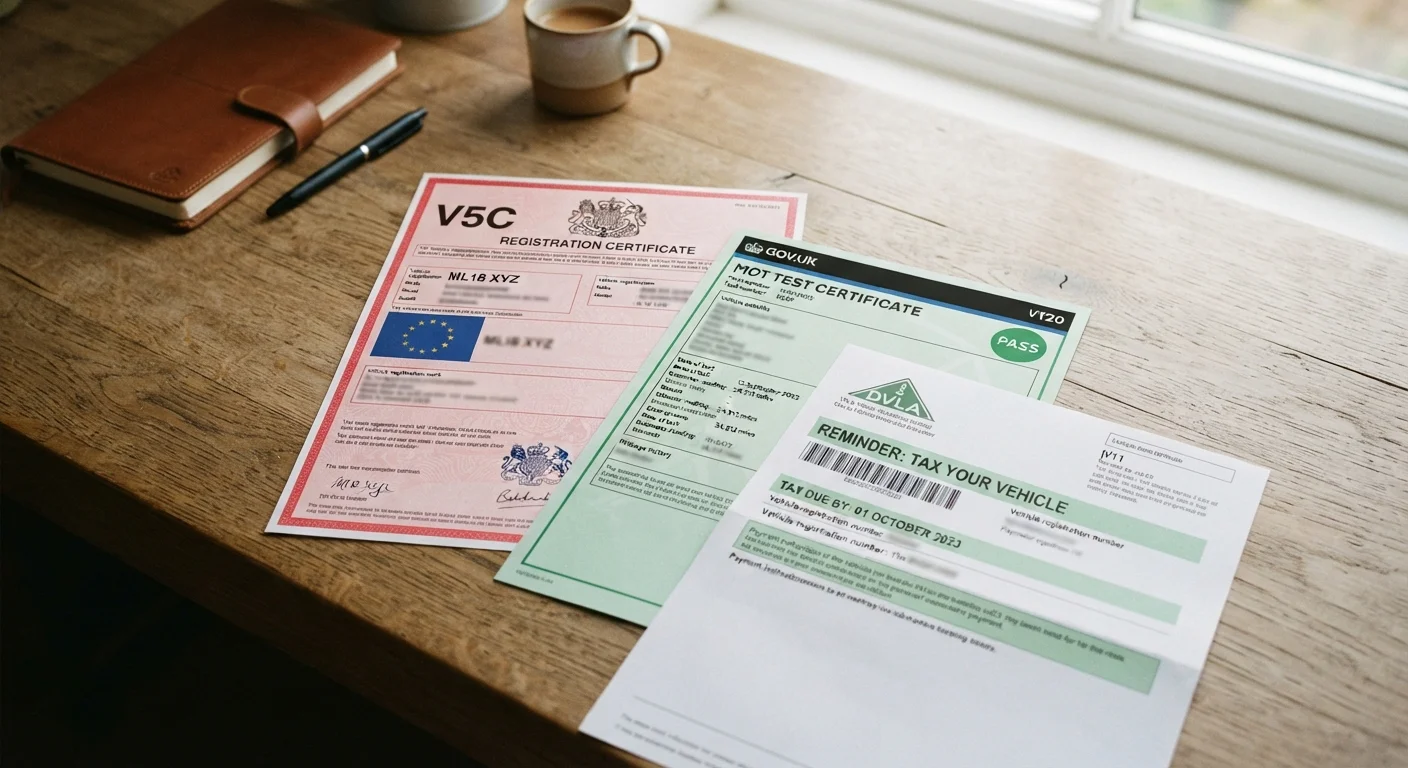
If you own a car in the UK, three legal obligations will come around on a regular basis: vehicle registration, the MOT test, and road tax (officially called Vehicle Excise Duty, or VED). They're separate things managed through different systems, but they're all non-negotiable if you want to drive legally. Missing any one of them can result in fines, penalties, or having your vehicle seized.
| MOT required from | 3 years after first registration (GOV.UK) |
| MOT frequency | Annually after the first test (GOV.UK) |
| Road tax payment options | Annually or every 6 months (DVLA) |
| Fine for no road tax | Up to £80 fixed penalty (GOV.UK) |
| Fine for no MOT | Up to £1,000 (GOV.UK) |
| SORN declaration cost | Free (DVLA) |
Here's a plain-English breakdown of each:
- Vehicle Registration - This is the process of recording your car with the Driver and Vehicle Licensing Agency (DVLA) and is linked to your number plate. It's mostly a one-time setup when a car is new, but you must notify the DVLA whenever ownership changes, or if your address, vehicle details, or status change.
- MOT - An annual roadworthiness test required for most vehicles over three years old. It checks that your car meets minimum safety and emissions standards. Passing it doesn't mean your car is in perfect shape - just that it clears the legal baseline.
- Road Tax (VED) - A tax paid to use your vehicle on public roads. The amount depends on your vehicle's CO₂ emissions and when it was registered. You can pay annually or in six-monthly instalments, though the six-month option costs slightly more overall.
For a broader look at what car ownership costs beyond these basics, see everything that comes with owning a car.
When Each Is Due and What Happens If You Miss It
Timing matters. Each of these has its own renewal cycle and its own set of consequences for falling behind.
Vehicle Registration
Your V5C logbook (registration document) should always reflect the current keeper and address. When you buy or sell a car, you must notify the DVLA promptly - the seller needs to complete the relevant section of the V5C, and the buyer needs to register as the new keeper. Failing to update details can cause problems with fines, recalls, and tax renewals arriving at the wrong address.
MOT
Your MOT expiry date is printed on your certificate and is also visible on the government's free MOT history checker. If your MOT lapses, you're committing an offence simply by driving on a public road - even to a garage, with limited exceptions. Fines can reach up to £1,000. Your car insurance may also be voided if you drive without a valid MOT, which compounds the risk significantly.
Your MOT and Insurance Are Linked
Driving without a valid MOT doesn't just risk a fine - it can invalidate your car insurance policy entirely. If you're involved in an accident with a lapsed MOT, your insurer may refuse to pay out. Always check your MOT expiry before your next renewal and renew it early if needed. You can book an MOT up to a month before the current one expires without losing time on the new certificate.
Road Tax (VED)
Road tax is renewed annually or every six months and is linked directly to the vehicle, not the driver. Since 2014, there's no physical tax disc - but enforcement cameras check registrations automatically. Driving without valid road tax can result in a £80 fixed penalty (reduced if paid quickly), and the vehicle can be clamped or impounded. You can check your vehicle's tax status on the GOV.UK website at any time.
These recurring costs are worth budgeting for in advance. The running costs new car owners rarely anticipate article covers how to plan for them alongside other ownership expenses.
SORN: When Your Car Is Off the Road
If your vehicle is taken off public roads - stored in a garage, undergoing a long repair, or simply not being used - you can declare it SORN (Statutory Off Road Notification) via the DVLA. Once a SORN is in place, you don't need to pay road tax while the vehicle is off the road. However, you also cannot drive or park it on any public road.
SORN is free to declare and takes effect immediately when done online or by phone. It continues until you tax the vehicle again, sell it, or scrap it. If you're keeping a car without taxing it and it's not on a public road, a SORN isn't optional - it's required.
V5C
The vehicle registration certificate, commonly called the logbook. It records the registered keeper, not necessarily the legal owner, and must be updated whenever the car changes hands or the keeper's details change.
MOT
An annual test of roadworthiness required by law for most vehicles over three years old. It checks safety systems, emissions, and mechanical condition against a set minimum standard.
VED (Vehicle Excise Duty)
The official name for road tax. It's a tax levied on vehicles used on public roads, with rates based on CO₂ emissions and the vehicle's registration date.
SORN
Statutory Off Road Notification. A declaration made to the DVLA that a vehicle is being kept off public roads, exempting it from road tax while the SORN is active.
DVLA
The Driver and Vehicle Licensing Agency. The UK government body responsible for maintaining the register of vehicles and drivers, collecting VED, and issuing driving licences.
For new owners getting to grips with all of this, the first year of car ownership roadmap is a practical companion to understanding what's due and when.