

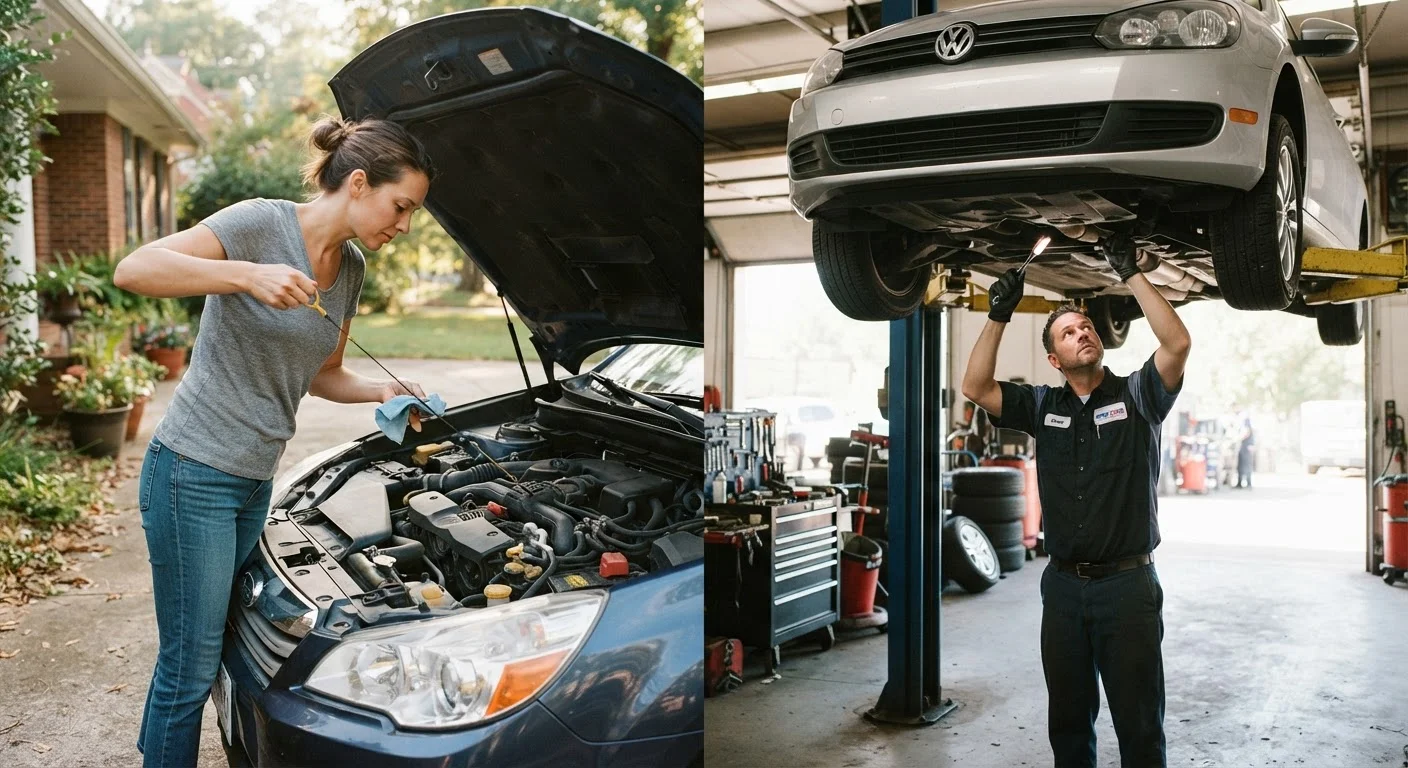
Key Takeaways
Saves money on routine, repeat maintenance costs
Doing your own oil changes, filter swaps, and fluid top-offs over several years adds up to real savings, especially on high-mileage vehicles that need more frequent attention.
Builds familiarity with your own vehicle
Regularly looking under the hood helps you spot leaks, worn belts, or low fluids earlier - before they become expensive problems.
Flexible timing - no appointment needed
You can handle a wiper blade or cabin filter on your own schedule, which matters when a garage appointment is days away.
Simple jobs carry genuinely low risk
Tasks like topping off washer fluid or replacing an air filter have almost no margin for harm, making the DIY case straightforward.
Mistakes on safety systems can go undetected
An incorrectly bled brake line or a loose caliper bolt may not show any symptoms until the vehicle is under stress - making the failure sudden rather than gradual.
Consumer tools often aren't precise enough
Torque specs, especially on wheel fasteners and suspension components, matter significantly. A standard socket wrench without a torque attachment can leave fasteners too loose or too tight.
Modern vehicles require diagnostic equipment
Many maintenance procedures on vehicles built in the last decade require resetting a computer or reading fault codes - something a basic toolkit can't do.
DIY errors can cost more to fix than the original job
A stripped drain plug thread, a cracked plastic housing, or a misrouted brake line can turn a simple job into a significantly more expensive repair at a garage.
Our Verdict
DIY maintenance makes good sense for routine, low-stakes tasks where the steps are clear and a mistake is easy to catch. For anything involving brakes, steering, suspension, or safety electronics, a qualified mechanic isn't a luxury - it's just the sensible call. Knowing where that line falls saves you money and keeps you safer.
Drivers who want to stay on top of basic upkeep themselves while recognizing which jobs carry real risk if done incorrectly.
The Tasks Most Drivers Can Handle Themselves
A surprising number of routine maintenance jobs don't require specialized tools, a lift, or years of training. If you have a clean workspace, your owner's manual, and a bit of patience, these are generally safe to tackle yourself:
- Engine oil and filter changes - straightforward on most vehicles once you've done it once, though the oil specification and drain plug location vary by model.
- Cabin and engine air filter replacements - usually a matter of unclipping a housing and swapping the filter. Your manual will show exactly where.
- Windshield wiper blades - these clip on and off in minutes. No mechanical knowledge required.
- Checking and topping off fluids - coolant, washer fluid, and power steering fluid reservoirs are clearly labeled under the hood. Transmission fluid is trickier and varies by vehicle, so check your manual before touching it.
- Battery terminals - cleaning corrosion from terminals with a wire brush and replacing a battery are manageable tasks, though note that disconnecting the battery can reset certain settings on modern vehicles.
These jobs show up regularly in typical maintenance schedules, and doing them yourself can keep routine costs down without introducing meaningful risk.
Where DIY Tends to Cause More Problems Than It Solves
Some jobs look approachable on video but carry real consequences if done incorrectly - or if you don't have the right equipment to confirm the work is actually right.
Saves money on routine, repeat maintenance costs
Doing your own oil changes, filter swaps, and fluid top-offs over several years adds up to real savings, especially on high-mileage vehicles that need more frequent attention.
Builds familiarity with your own vehicle
Regularly looking under the hood helps you spot leaks, worn belts, or low fluids earlier - before they become expensive problems.
Flexible timing - no appointment needed
You can handle a wiper blade or cabin filter on your own schedule, which matters when a garage appointment is days away.
Simple jobs carry genuinely low risk
Tasks like topping off washer fluid or replacing an air filter have almost no margin for harm, making the DIY case straightforward.
Mistakes on safety systems can go undetected
An incorrectly bled brake line or a loose caliper bolt may not show any symptoms until the vehicle is under stress - making the failure sudden rather than gradual.
Consumer tools often aren't precise enough
Torque specs, especially on wheel fasteners and suspension components, matter significantly. A standard socket wrench without a torque attachment can leave fasteners too loose or too tight.
Modern vehicles require diagnostic equipment
Many maintenance procedures on vehicles built in the last decade require resetting a computer or reading fault codes - something a basic toolkit can't do.
DIY errors can cost more to fix than the original job
A stripped drain plug thread, a cracked plastic housing, or a misrouted brake line can turn a simple job into a significantly more expensive repair at a garage.
Brake pad replacement is a common example. Swapping pads is mechanically straightforward, but it's easy to miss a worn rotor, incorrectly seat a caliper, or introduce a small leak at a brake line fitting. None of that is obvious until you're decelerating hard. Similarly, suspension work involves components under load and torque specs that matter - overtightened or undertightened fasteners can cause failure well after the job appears complete.
Anything touching the vehicle's safety systems - ABS, airbag modules, stability control sensors - generally requires a diagnostic scan tool and manufacturer-specific procedures. Attempting these without the right equipment can disable the system or trigger fault codes that mask real problems later.
Common maintenance myths sometimes make these jobs sound simpler than they are. The internet has plenty of tutorials, but tutorials can't account for your specific vehicle's condition, age, or quirks.
How to Judge Any Specific Task
A few practical questions help draw the line on almost any job:
Your Owner's Manual Is the Starting Point
Before attempting any maintenance task, check your owner's manual for the exact specification - oil grade, filter part number, torque value, or fluid type. Generic advice online may not match your specific vehicle. If you no longer have a printed copy, most manufacturers make digital versions available through their websites.
- Can you verify it worked? An oil change is easy to confirm - the dipstick tells you. A brake bleed is harder to verify without feeling the pedal under load on a safe surface. If you can't confirm the job is correct, that's a strong signal to use a garage.
- What fails if you get it wrong? A loose wiper blade is annoying. A loose wheel bearing or incorrectly torqued lug nut is dangerous. Scale the decision to the consequence.
- Do you have the right tools? Some jobs technically require a torque wrench, a spring compressor, a scan tool, or a specific socket size. Improvising on safety-critical fasteners is where DIY repairs go wrong most often.
For a broader look at which tasks most commonly backfire, car ownership basics covers what every driver should understand before picking up a wrench.
~35%
Share of car repairs attempted by owners
Industry surveys consistently show roughly a third of vehicle owners attempt at least some repairs themselves, though the share varies by task complexity.
2-4x
Labour cost multiplier at independent vs. dealer garages
Labour rates at franchised dealerships are often two to four times higher than independent shops, making professional work more accessible than many drivers assume.