

Key Takeaways
New Orleans as a Travel Destination
New Orleans is a major US city in Louisiana defined by its Creole and African American cultural heritage, distinct neighborhood geography, live music traditions, and a culinary identity unlike anywhere else in the country. It is far more layered than its party-district reputation suggests. Understanding what the city actually contains helps travelers make more intentional choices about where to spend their time.
New Orleans sits below sea level in a river delta, which shapes everything from its architecture (raised foundations, no basements) to its ongoing flood-resilience infrastructure challenges — context worth knowing before you visit.
The French Quarter Is Not the Whole City
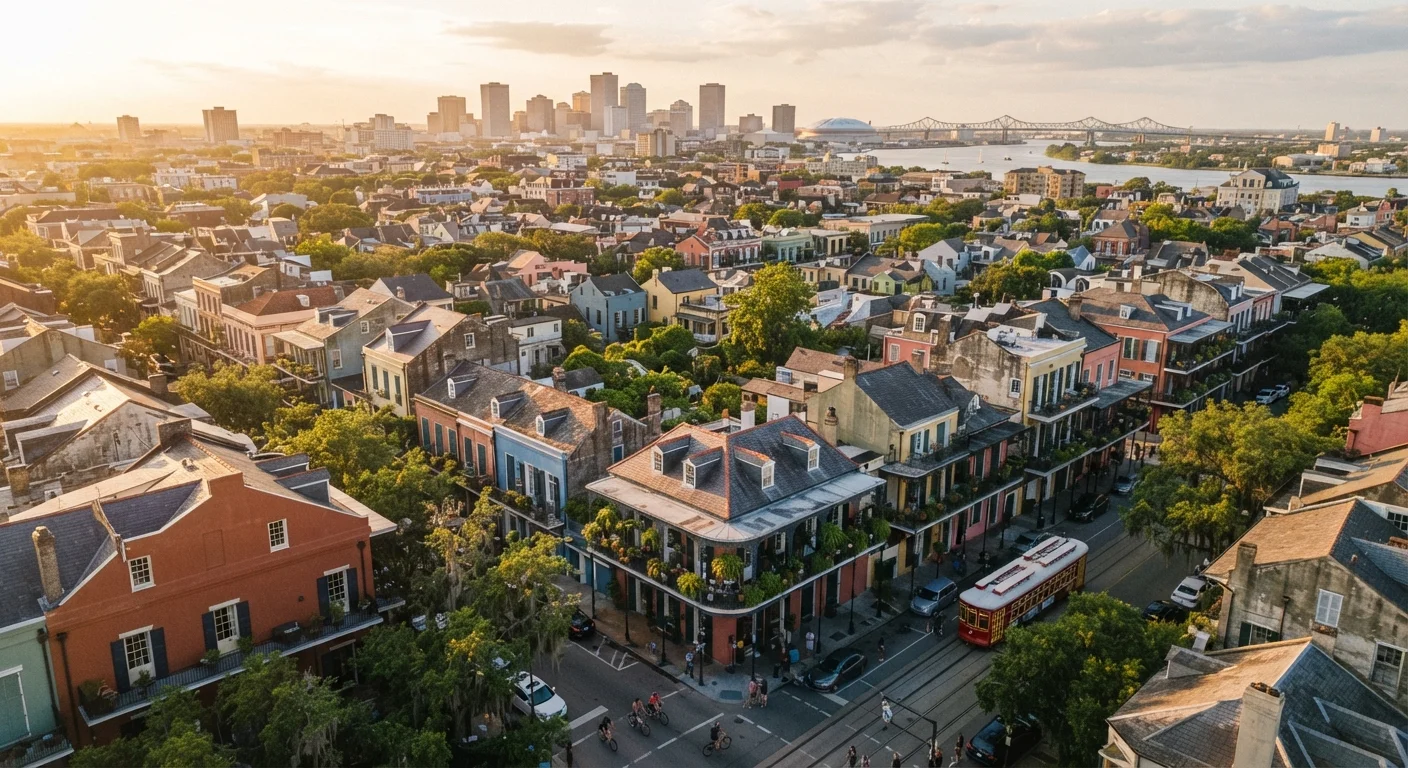
Most visitors arrive with a mental image of New Orleans assembled from TV, film, and travel marketing: Bourbon Street neon, beads, and balconies. That image captures one block-by-block reality of the French Quarter — but the Quarter is roughly one square mile in a city that spreads across more than 350 square miles.
The French Quarter is genuinely worth seeing. Its architecture — Creole townhouses, cast-iron galleries, narrow courtyards — is historically significant and visually striking. But it also runs hot with commercial tourism, and the experience on Bourbon Street specifically is closer to a theme park than a neighborhood.
Travelers who branch out even a few blocks find a different city. The Tremé, just north of the Quarter, is one of the oldest African American neighborhoods in the country and the acknowledged birthplace of jazz as a cultural practice. The Marigny and Bywater, directly downriver, have become centers of contemporary art, independent music venues, and neighborhood restaurants where locals actually eat.
A Note on Neighborhood Safety and Context
New Orleans neighborhoods vary considerably in character and foot traffic. Some areas that appear on tourism maps are primarily residential or have limited visitor infrastructure. Before exploring unfamiliar areas, it's worth checking current local resources, asking your accommodation for honest guidance, and using common urban travel sense. Conditions change, and no article can substitute for current, on-the-ground information.
Music as Living Culture, Not Background Noise
New Orleans music is discussed endlessly in tourism contexts, but it's worth being precise about what that actually means on the ground. Jazz did not stop evolving in 1920. The city has a continuous, living brass band tradition — heard most honestly at second-line parades, which are neighborhood processions organized by Social Aid and Pleasure Clubs that happen most Sundays during the cooler months.
Bounce music, a New Orleans-specific hip-hop genre, has deep community roots and has produced nationally recognized artists. Gospel traditions anchor dozens of neighborhood churches. The music you'll hear in the tourist corridor is often performed for tourists; the music you'll hear at a neighborhood bar in the Marigny or at a community second-line is performed for the community.
“The music of New Orleans is not a product — it's a practice. It exists in the streets, in the churches, in the second lines, and it always has. The stage version is a translation.”
— Ned Sublette, Music historian and author of 'The World That Made New Orleans'
This distinction matters both for the quality of your experience and for the ethics of it. Attending a second-line parade, for example, means entering a cultural practice with its own norms — it's worth doing a little homework beforehand about what's appropriate as a visitor.
Food That Reflects a Specific History
New Orleans cuisine is one of the most distinctive regional food cultures in the United States, and it didn't emerge from a single tradition. Dishes like red beans and rice, gumbo, and jambalaya reflect a layering of West African, French, Spanish, Caribbean, and Indigenous ingredients and techniques accumulated over centuries.
350+
Square miles in New Orleans city limits
The French Quarter covers roughly one square mile of that total, underscoring how geographically limited a Quarter-only visit is.
7+
Distinct recognized neighborhoods worth exploring
The city is commonly understood to contain dozens of named neighborhoods, each with distinct architectural, cultural, and demographic character.
~100,000
Residents displaced by Hurricane Katrina
The 2005 storm caused one of the largest domestic displacement events in US history, with effects still visible in the city's geography and demographics.
Understanding that history changes how you eat in the city. A bowl of gumbo is not just a local specialty — it's a dish whose roux technique, okra, and file powder draw from specific African and Indigenous contributions. Knowing that background makes the food more interesting, not less.
Travelers focused only on the tourist-facing restaurant scene in the Quarter will miss a substantial part of the picture. Mid-City, Gentilly, and the Seventh Ward have neighborhood restaurants, po'boy shops, and lunch counters that reflect how New Orleanians actually eat day to day.
Explore Beyond the Tourist Corridor
The St. Claude Avenue corridor in the Marigny and Bywater, the Freret Street strip in Uptown, and the restaurants along Magazine Street in the Garden District all offer food and culture experiences oriented toward locals rather than tourists. These areas are generally easy to reach by streetcar or rideshare and reward the extra effort.
Honest Context: What the City Is Also Navigating
Visiting New Orleans without any awareness of its ongoing challenges produces a shallow trip and can make visitors unintentionally tone-deaf. The city is still managing the long-term effects of Hurricane Katrina (2005), which caused catastrophic flooding, displacement of over 100,000 residents, and the loss of entire neighborhoods. Some areas never fully recovered. Population remains below pre-Katrina levels.
The city also grapples with persistent poverty, infrastructure strain, and the ongoing reality of being a coastal, below-sea-level city in an era of intensifying storm seasons. These aren't talking points to recite on a trip — they're context that helps you understand why certain neighborhoods look the way they do, why certain community institutions matter as much as they do, and why residents may have complicated feelings about tourism economies.
None of this means New Orleans is not worth visiting — it clearly is, on many levels. It means visiting with awareness makes you a better guest and a more honest observer of one of America's most genuinely singular cities.