

Key Takeaways
Start here
How a Cruise Ship Is Organized
Next
What's Included in Your Fare
Then
Embarkation Day: What to Expect
Go deeper
Life Onboard: Daily Rhythms and Routines
Before you arrive
Port Days and Shore Excursions
Wrap up
Disembarkation: How the Last Day Works
How a Cruise Ship Is Organized
Modern cruise ships are essentially floating resorts, and understanding their layout makes everything less confusing. Ships are divided into decks (floors), numbered from bottom to top. The lower, inner decks hold crew areas and machinery; passenger cabins typically begin a few decks up. Public spaces — pools, restaurants, theaters, and shops — are concentrated on mid-to-upper decks.
Cabins are categorized by type: interior (no window), ocean-view (porthole or window), balcony, and suite. Interior cabins are the most affordable and perfectly comfortable for sleeping; many first-timers choose them and spend most of their time outside the room anyway.
Embarkation
The process of boarding the cruise ship at the start of your voyage, including check-in, security, and receiving your cabin keycard.
Disembarkation
The process of leaving the ship at the end of your cruise, including luggage collection and clearing customs or immigration at the home port.
Port day
A day when the ship docks at or anchors near a destination so passengers can go ashore and explore.
Sea day
A full day spent sailing at sea with no port stop — passengers spend the time entirely onboard the ship.
Shore excursion
A guided tour or activity arranged for port days, either through the cruise line or booked independently on land.
Gratuities
Service charges added to your onboard account to compensate crew members; most lines apply these automatically at a daily rate per person.
When you board, grab a ship map from guest services or download the cruise line's app. Large ships can span 18 or more decks and stretch the length of several city blocks. Give yourself the first afternoon to orient before the crowds settle in.
What's Included in Your Fare
Your base cruise fare almost always covers your cabin, main dining room meals, buffet access, and the majority of onboard entertainment — shows, pools, fitness center, and deck activities. That's a meaningful amount of value bundled into one price.
What it typically does not cover: specialty restaurants (think sushi bars or steakhouses), alcoholic beverages, Wi-Fi, shore excursions, spa treatments, and gratuities. These extras add up quickly. Hidden costs first-time cruisers often miss — like daily service charges and port fees — are worth reviewing before you finalize your budget.
Do the Math Before Buying Packages
Before adding a drinks package or Wi-Fi bundle at booking, estimate your actual daily usage honestly. A drink package only saves money if you consume enough to justify it. Check the per-day cost against your realistic habits — moderate drinkers and light internet users often come out ahead paying à la carte.
Some lines offer package deals bundling drinks, Wi-Fi, or specialty dining at a discount. Whether these are worth it depends entirely on how you plan to use them — a non-drinker has little use for an alcohol package. Do the math based on your habits before committing.
Embarkation Day: What to Expect
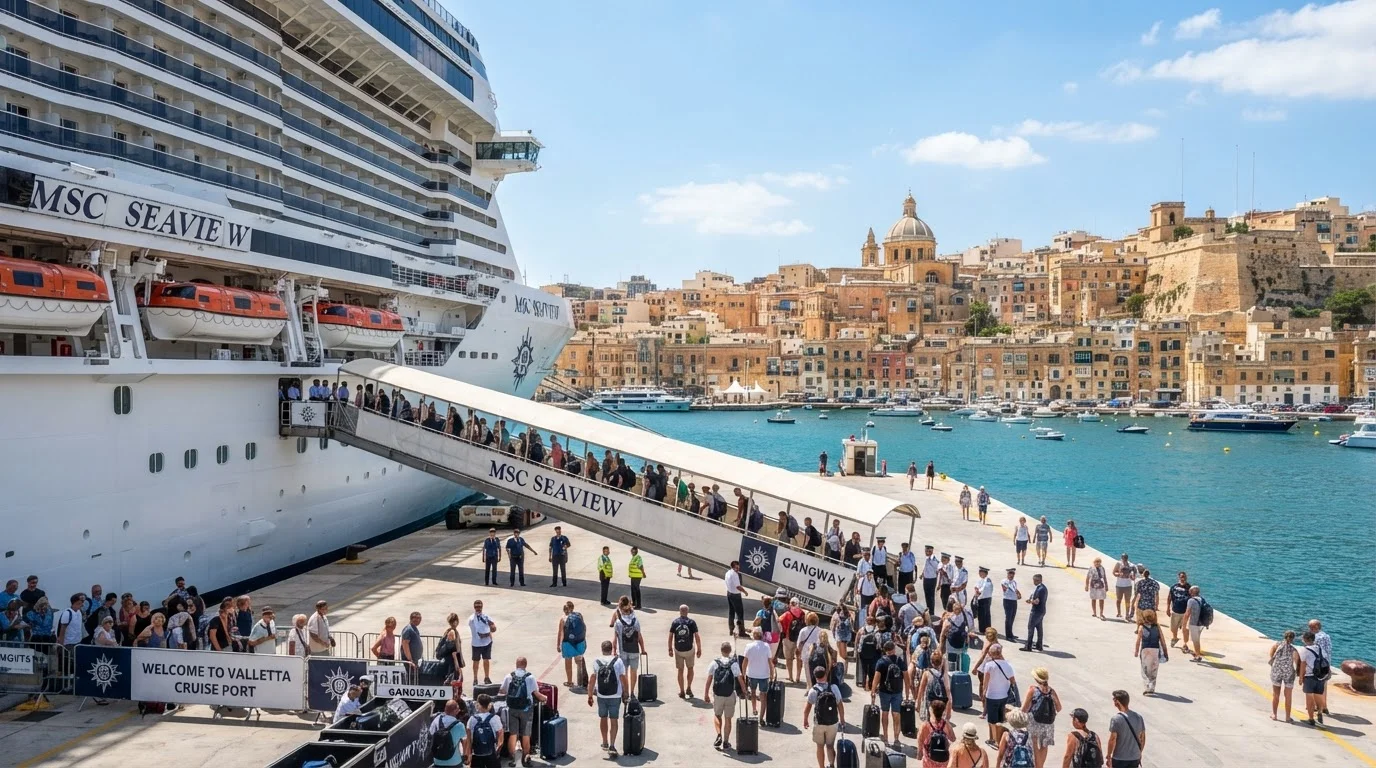
Embarkation — the process of boarding the ship — is the most logistically busy part of any cruise. You'll arrive at the cruise terminal, check in your luggage (it's delivered to your cabin later), clear security and immigration, and receive your keycard.
Lines can be long if you arrive at peak times, typically early afternoon. Many experienced cruisers aim to arrive around 10–11 a.m. when terminals are less crowded. Cabins usually aren't ready until early afternoon, but public areas like the pool deck and buffet are open right away.
Don't Risk Missing the Ship
Cruise ships operate on fixed schedules and will depart without late passengers — this is not a figure of speech. If you're flying in on embarkation day and your flight is delayed, you could miss the voyage entirely. Arriving the evening before is the single most reliable way to avoid this scenario.
Ships depart on a strict schedule. The standard guidance is to arrive at the terminal at least 90 minutes before the published departure time — and earlier is safer. If you're flying in on embarkation day, consider arriving the night before to protect against flight delays.
Life Onboard: Daily Rhythms and Routines
Each evening, a daily program — sometimes called a Cruise Compass or equivalent — is slipped under your cabin door or available via the ship's app. It lists every activity, dining option, show time, and special event for the next day. Reading it before bed helps you plan and prevents the feeling of wandering without purpose.
Mornings on port days are typically early — ships often dock by 7 or 8 a.m. On sea days, the pace is slower and entirely self-directed. Making the most of sea days takes some intentionality; ships offer far more than most first-timers realize until they're already home.
Main dining rooms offer set meal times (early or late seating) or flexible open dining depending on the line. Specialty restaurants require reservations and an additional fee. Dress codes range from casual to formal depending on the evening — check your cruise line's policy in advance.
Port Days and Shore Excursions
On port days, the ship docks or anchors near a destination and passengers go ashore. You can book shore excursions through the cruise line or independently. Cruise-line excursions tend to be more expensive but offer the advantage of a guaranteed return time — the ship will wait for a cruise-organized tour if it runs late, but it will not wait for independent travelers.
If you choose to explore independently, research the port ahead of time. Understand how far the town center is from the dock, whether transportation is needed, and what the ship's all-aboard time is. Missing the ship is a real possibility if timing goes wrong, and you'd be responsible for catching up at the next port at your own expense.
Not every port day needs to be packed with activity. Some passengers prefer simply walking the nearby area, finding a local café, or returning to the ship early when crowds go ashore. There's no wrong approach.
Disembarkation: How the Last Day Works
The final night onboard, you'll place your luggage outside your cabin door by a set time (usually around 10–11 p.m.) so it can be collected and sorted for pickup in the terminal. Keep a small bag for overnight essentials and your travel documents.
Disembarkation is assigned in waves based on your travel plans — those with early flights go first. Self-assist disembarkation, where you carry your own bags off, typically departs earliest. Otherwise, you wait in a lounge until your group is called, then collect your luggage from the terminal.
Plan your onward travel conservatively. A noon flight home is rarely enough buffer; afternoon departures are safer. And if you've enjoyed the experience, cruise loyalty programs are worth understanding before your next booking — perks and status can build surprisingly quickly.
For a complete packing checklist to help you prepare for both embarkation and disembarkation day, see our cruise packing guide.