

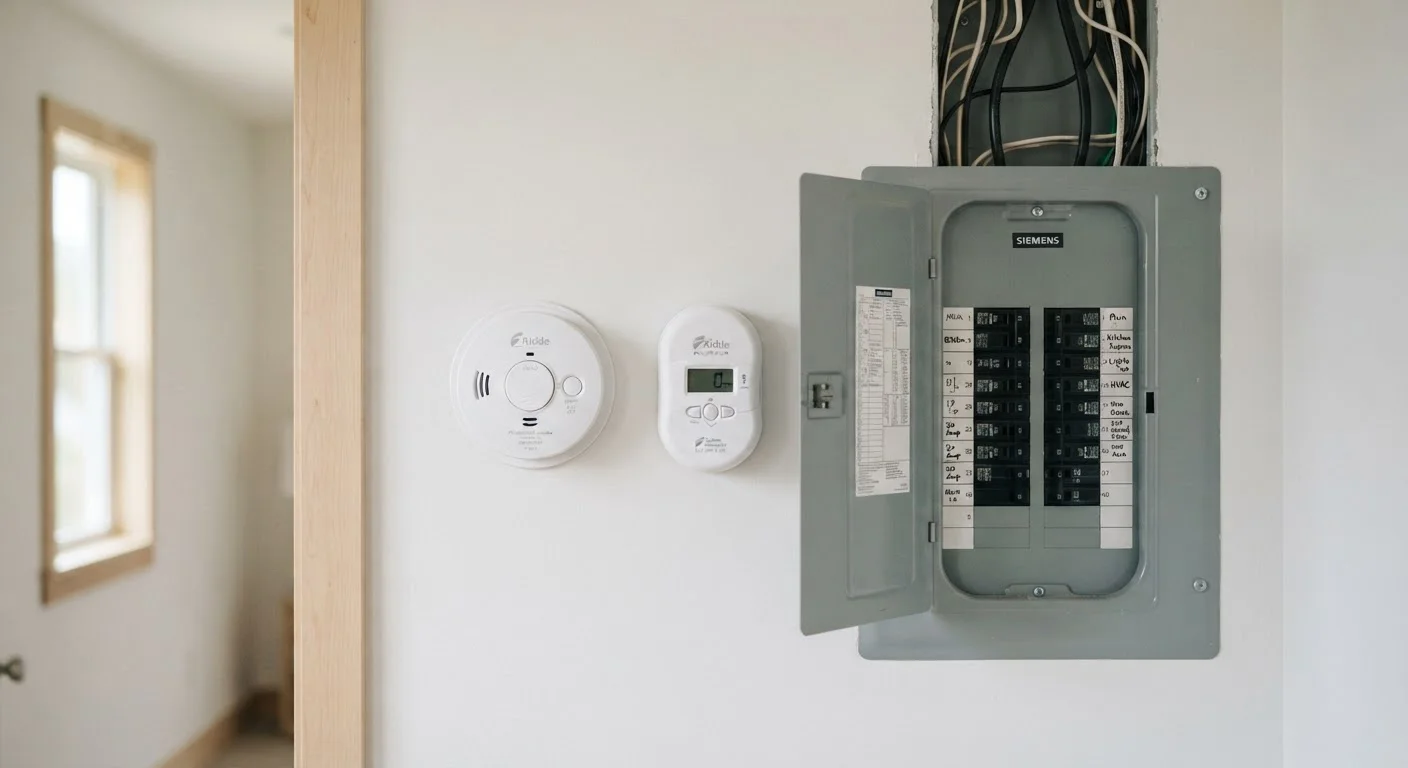
| Smoke Alarm Lifespan | 10 years (NFPA 72) |
| CO Detector Lifespan | 5–7 years (varies by model) (Check manufacturer label for exact date) |
| Recommended Test Frequency | Monthly (NFPA and CPSC guidance) |
| Battery Replacement Interval | At least once yearly (or use sealed 10-year units) |
| Smoke Alarm Placement | Every level, inside each bedroom, outside every sleeping area (NFPA 72) |
| CO Detector Placement | Every level, near sleeping areas |
| Electrical Panel Work | Internal work requires a licensed electrician |
| GFCI Protection Required In | Kitchens, bathrooms, garages, and outdoor areas (National Electrical Code (NEC)) |
Three Systems That Form the Foundation of Home Safety
Smoke alarms, carbon monoxide detectors, and circuit breakers each guard against a distinct hazard — fire, toxic gas, and electrical overload — but share a common thread: they work only when correctly installed and consistently maintained. This reference covers the core facts every homeowner needs for each device: how it works, where it belongs, and what upkeep it requires. If you're building a broader maintenance habit from the ground up, our guide to first-year homeowner upkeep is a practical companion.
| Smoke Alarm Lifespan | 10 years (NFPA 72) |
| CO Detector Lifespan | 5–7 years (varies by model) (Check manufacturer label for exact date) |
| Recommended Test Frequency | Monthly (NFPA and CPSC guidance) |
| Battery Replacement Interval | At least once yearly (or use sealed 10-year units) |
| Smoke Alarm Placement | Every level, inside each bedroom, outside every sleeping area (NFPA 72) |
| CO Detector Placement | Every level, near sleeping areas |
| Electrical Panel Work | Internal work requires a licensed electrician |
| GFCI Protection Required In | Kitchens, bathrooms, garages, and outdoor areas (National Electrical Code (NEC)) |
Smoke Alarms: How They Detect and Where to Place Them
Smoke alarms detect combustion byproducts early enough to give occupants time to evacuate. Two sensor technologies are in common use:
- Ionization sensors respond quickly to fast-flaming fires — paper, cooking grease, or dry wood.
- Photoelectric sensors are more responsive to slow, smoldering fires, such as those that start in upholstered furniture or inside wall cavities.
Combination units incorporating both sensor types are widely available. The National Fire Protection Association (NFPA) recommends placing alarms on every level of the home, inside each bedroom, and outside every sleeping area. Where possible, interconnect alarms — wired or wirelessly — so that triggering one activates all others. Every smoke alarm has a manufacture date stamped inside the unit; replace it at the 10-year mark regardless of how it appears to be functioning.
Carbon Monoxide Detectors: Protecting Against an Invisible Hazard
Carbon monoxide is produced by incomplete combustion in gas furnaces, boilers, water heaters, fireplaces, and vehicles running in attached garages. At elevated concentrations it binds to hemoglobin more readily than oxygen, causing symptoms ranging from headache and dizziness to unconsciousness. Because CO is colorless and odorless, a dedicated detector is the only reliable early warning.
Install CO detectors on every level of the home and within 10–15 feet of each sleeping area. Most manufacturers recommend mounting them at outlet height rather than on the ceiling — always follow your specific model's installation instructions, as guidance varies. Service life is typically five to seven years; the replacement date is printed on the unit's label. If a CO alarm sounds, evacuate the home immediately and call 911 from outside.
Ionization alarm
A smoke detector that uses a small ionization chamber to sense combustion particles. It reacts quickly to fast-flaming fires but may respond more slowly to slow, smoldering ones.
Photoelectric alarm
A smoke detector that uses a light beam inside a sensing chamber. Smoke particles scatter the beam and trigger the alarm; this type responds well to slow, smoldering fires.
Carbon monoxide (CO)
A colorless, odorless gas produced by incomplete combustion of fuels such as gas, wood, and oil. At elevated concentrations it is toxic because it binds to hemoglobin, blocking oxygen delivery in the body.
Circuit breaker
An automatic safety switch in a home's electrical panel that trips — cutting power — when it detects a current overload or short circuit. Unlike a fuse, it can be reset by hand after the underlying problem is addressed.
GFCI
Ground Fault Circuit Interrupter. A device that cuts electrical power within milliseconds when it detects current leaking outside the intended circuit path, reducing shock risk in wet areas.
AFCI
Arc Fault Circuit Interrupter. A breaker that detects irregular electrical arcing inside wires or connections — the kind that can ignite wall insulation — and cuts power before a fire starts.
Circuit Breakers: Your Home's Electrical Safety Net
A circuit breaker is an automatic switch that opens — or "trips" — when it detects a current overload or short circuit, cutting power before wiring overheats or sparks. Most modern home panels include two specialized types beyond standard breakers:
- GFCI (Ground Fault Circuit Interrupter) outlets or breakers in kitchens, bathrooms, garages, and outdoor areas protect against shock when current contacts water.
- AFCI (Arc Fault Circuit Interrupter) breakers in living spaces detect the irregular arcing inside wiring that standard breakers cannot sense, helping prevent hidden electrical fires.
A breaker that trips repeatedly is signaling a real problem — an overloaded circuit or a wiring fault — not a minor nuisance. Resetting it without investigating the cause does not fix the underlying issue. All hands-on work inside the panel enclosure must be handled by a licensed electrician. Check local code requirements before any panel changes; many jurisdictions require permits and subsequent inspections.
Routine Maintenance That Keeps Each System Reliable
Monthly testing takes under a minute per device: press the built-in test button on each smoke alarm and CO detector and confirm the alert sounds. Replace standard batteries at least once a year — many homeowners tie this to a recurring calendar date. Sealed 10-year batteries remove the annual swap, but the unit itself still reaches end of life and must be replaced on schedule.
For the electrical panel, limit your own involvement to visual checks: scan for tripped breakers, heat staining, or any unusual odor near the enclosure. Never open the panel cover or touch internal components yourself. Weave all three checks into a regular seasonal schedule — see our quarterly home maintenance checklist for a full calendar of inspections and tasks.