

Key Takeaways
Option A
Engineered Hardwood
The dimensionally stable, moisture-tolerant modern option.
Best for: Homeowners installing flooring below grade, over radiant heat systems, or in rooms with variable humidity.
Option B
Solid Hardwood
The time-tested, refinishable classic for above-grade living spaces.
Best for: Above-grade rooms with controlled humidity where long-term refinishing and maximum longevity are priorities.
If you're installing flooring in a basement or below-grade space
Engineered Hardwood
Its layered core resists the moisture fluctuations common underground. Solid hardwood is prone to warping in these conditions.
If long-term refinishing potential is your top priority
Solid Hardwood
Solid planks are typically 3/4 inch thick and can be sanded and refinished multiple times over decades, extending the floor's life significantly.
If you have a radiant floor heating system
Engineered Hardwood
Solid wood expands and contracts unpredictably with the temperature cycling of radiant heat; engineered products are engineered to tolerate this movement.
If you want an authentic, traditional wood floor on a stable above-grade subfloor
Solid Hardwood
In a controlled above-grade environment, solid hardwood offers unmatched character and the longest possible refinishing lifespan.
If you're a renter finishing a space or expect to move within 10 years
Engineered Hardwood
Floating installation options make engineered hardwood easier to remove or replace, and its cost is often lower upfront.
What Makes Them Different Beneath the Surface
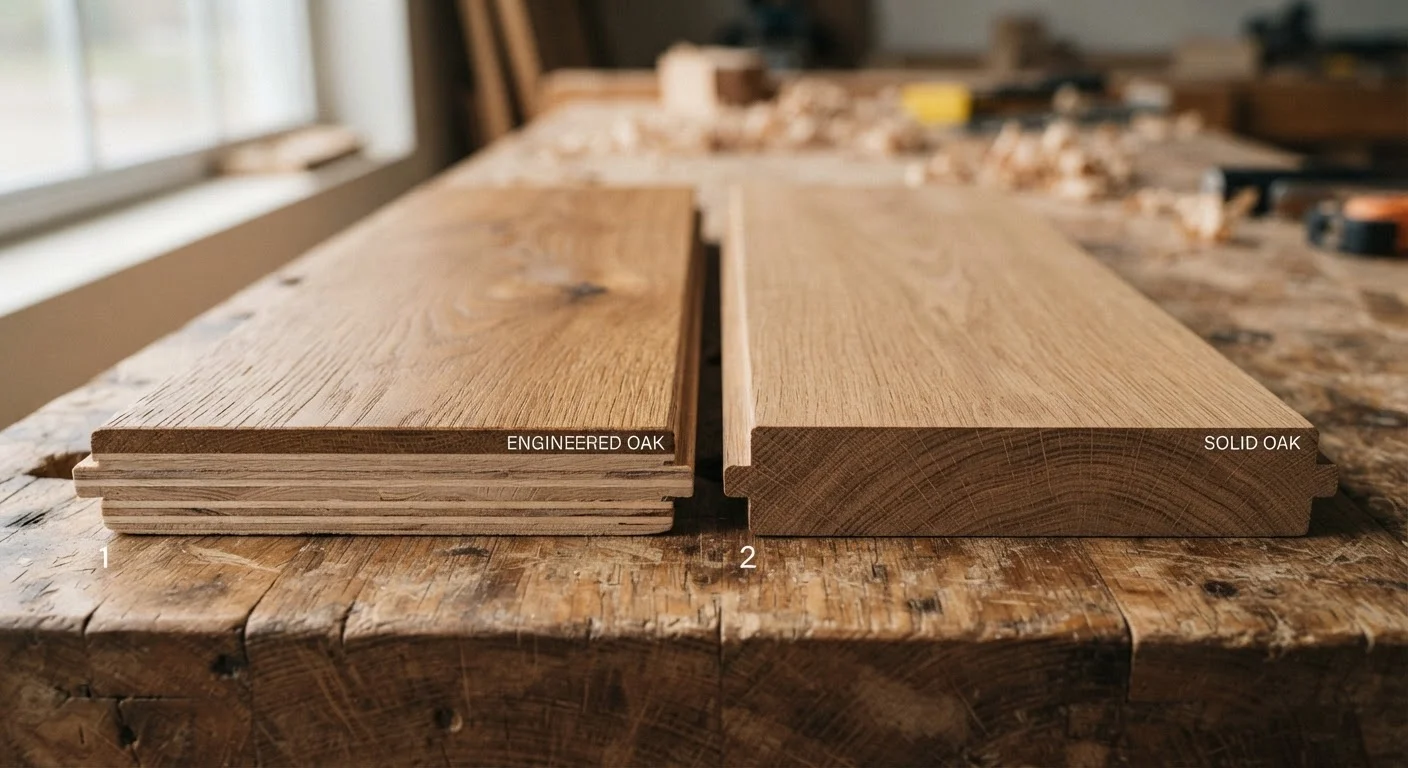
From across the room, engineered hardwood and solid hardwood are essentially indistinguishable. Both display genuine wood grain, both accept stain and finish, and both feel solid underfoot. The difference is structural.
Solid hardwood is milled from a single piece of timber — typically 3/4 inch thick — giving the entire plank uniform wood composition. That density is both its strength and its weakness: real wood expands and contracts with changes in humidity, which is why solid hardwood has traditionally been restricted to above-grade, climate-controlled rooms.
Engineered hardwood uses a real hardwood veneer on top — usually 1/12 to 1/6 of an inch thick — bonded to a core of cross-layered plywood or high-density fiberboard (HDF). Those alternating layers work against each other when humidity changes, dramatically reducing the seasonal movement that causes solid wood to gap, cup, or buckle.
| Criterion | Engineered Hardwood | Solid Hardwood |
|---|---|---|
| Core construction | Cross-ply plywood or HDF core | Single solid timber plank |
| Moisture resistance | Better — tolerates humidity swings | Lower — prone to expansion/contraction |
| Below-grade installation | Generally suitable | Not recommended |
| Over radiant heat | Suitable (check manufacturer specs) | Typically not recommended |
| Installation methods | Nail, glue, or float | Nail or staple only |
| Refinishing cycles | 1–3 times (veneer-dependent) | 5–10 times over lifespan |
| Typical plank thickness | 3/8 to 9/16 inch | 3/4 inch (standard) |
| Expected lifespan | 25–30+ years | 80–100 years with refinishing |
Moisture Tolerance and Where You Can Install Each
Moisture is the single biggest factor separating these two products in real-world use.
Solid hardwood should not be installed in basements, directly over concrete slabs without a proper moisture barrier and subfloor system, or in rooms where humidity swings dramatically — bathrooms and laundry rooms are common examples. Even well-managed environments can cause solid wood to develop seasonal gaps in winter and minor crowning in summer.
Engineered hardwood can handle moderate moisture exposure and performs reliably over concrete slabs and below-grade installations, provided the area doesn't experience standing water or flooding. It is also the correct choice over radiant heat systems, since the constant temperature cycling is hard on solid planks.
~25%
Moisture content range that causes solid wood movement
Wood shrinks and swells as indoor relative humidity shifts; solid hardwood is particularly sensitive to changes between roughly 30% and 50% relative humidity indoors.
3–5x
More installation locations suited to engineered hardwood
Industry guidance from flooring trade organizations notes that engineered hardwood can be installed on, above, or below grade, while solid hardwood is restricted to on or above grade.
Neither product is waterproof flooring. For genuinely wet spaces, luxury vinyl plank or tile remain more appropriate options.
Installation Methods: Nail, Glue, or Float
Installation flexibility is another area where the two products diverge meaningfully.
Solid hardwood is almost always nail- or staple-down only, requiring a wood subfloor of adequate thickness (typically 3/4-inch plywood). This makes it unsuitable for direct installation over concrete without a plywood underlayment.
Engineered hardwood supports three installation methods: nail-down, glue-down, and floating. The floating method — where planks click or glue together but aren't fastened to the subfloor — is particularly appealing for DIYers and renters. Glue-down is common over concrete and is often specified for radiant heat applications.
Before committing to either product, measure your subfloor's flatness. Most manufacturers require subfloors to be flat within 3/16 inch over 10 feet. High spots and dips must be addressed regardless of which flooring you choose.
Permits and Professional Installation
Flooring installation generally does not require a building permit in most U.S. jurisdictions, but work that involves modifications to radiant heating systems or subfloor structure may require licensed contractor involvement. Always verify local code requirements before beginning a project. When in doubt, consult a licensed flooring professional to assess your subfloor condition and installation suitability.
Refinishing Potential: How Many Times Can You Sand It?
One of the most discussed trade-offs between these two options is refinishing capacity — essentially, how many times you can sand away surface scratches and reapply finish to restore the floor's appearance.
Solid hardwood, at 3/4 inch thick, can generally be sanded and refinished anywhere from 5 to 10 times over its lifetime, depending on how aggressively each sanding removes material. That translates to a floor that can last 80 to 100 years with proper care.
Engineered hardwood is limited by the thickness of its veneer layer. Thicker veneer products (1/6 inch and above) may allow two or three refinishing cycles, while thinner veneers may permit only one light scuff-and-recoat. It's worth confirming the veneer thickness with the manufacturer's documentation before purchase.
For a family home where floors will see heavy traffic and you want to refinish them every 10 to 15 years, solid hardwood offers a meaningful long-term advantage — provided your space supports it.