
| Gland type | Endocrine (hormone-producing) |
| Location | Front of the neck, below the larynx |
| Primary hormones produced | T3 (triiodothyronine) and T4 (thyroxine) |
| Regulating signal | TSH (thyroid-stimulating hormone) from the pituitary gland |
| Most common thyroid disorder | Hypothyroidism (American Thyroid Association) |
| Who is most often affected | Women are diagnosed more often than men (American Thyroid Association) |
What the Thyroid Gland Actually Does
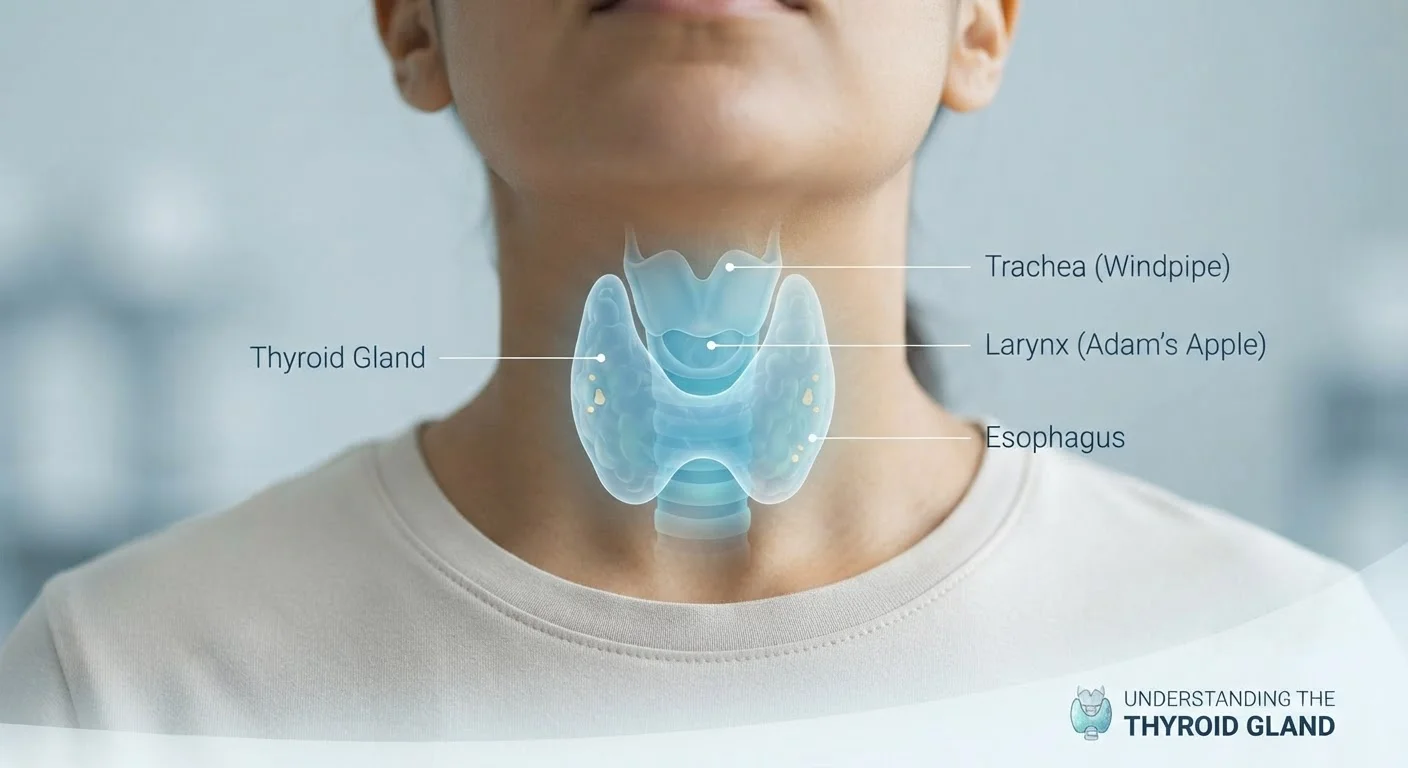
Your thyroid is a small, butterfly-shaped gland that sits at the front of your neck, just below the Adam's apple. Despite its size, it drives an enormous range of body functions by producing two key hormones: thyroxine (T4) and triiodothyronine (T3). These hormones regulate how quickly your cells use energy — your metabolic rate — and they influence everything from body temperature and heart rate to mood and digestive speed.
The thyroid operates under the direction of the pituitary gland in the brain, which releases thyroid-stimulating hormone (TSH) to signal when more or less thyroid hormone is needed. When this feedback loop breaks down, thyroid disease develops. Problems generally fall into two broad categories: the gland producing too little hormone or too much.
| Gland type | Endocrine (hormone-producing) |
| Location | Front of the neck, below the larynx |
| Primary hormones produced | T3 (triiodothyronine) and T4 (thyroxine) |
| Regulating signal | TSH (thyroid-stimulating hormone) from the pituitary gland |
| Most common thyroid disorder | Hypothyroidism (American Thyroid Association) |
| Who is most often affected | Women are diagnosed more often than men (American Thyroid Association) |
Hypothyroidism: When the Thyroid Is Underactive
Hypothyroidism means the thyroid gland is not producing enough hormone to meet the body's needs. Because metabolism slows down, nearly every system in the body operates at a lower gear. Common symptoms include:
- Persistent fatigue and low energy
- Unexplained weight gain
- Feeling cold even in warm environments
- Dry skin, brittle nails, and hair thinning
- Slowed heart rate and constipation
- Difficulty concentrating, sometimes called "brain fog"
- Low mood or depression
The most common cause worldwide is Hashimoto's thyroiditis, an autoimmune condition in which the immune system gradually attacks thyroid tissue. You can learn more about the shared mechanisms behind autoimmune diseases in our article on autoimmune conditions. Hypothyroidism is typically diagnosed with a blood test measuring TSH levels — a high TSH reading generally indicates the thyroid is underperforming. Treatment usually involves a daily oral medication to replace the missing hormone, prescribed and monitored by a healthcare provider.
Hyperthyroidism: When the Thyroid Is Overactive
Hyperthyroidism occurs when the thyroid produces more hormone than the body needs, sending the metabolism into overdrive. Symptoms tend to feel like the body is running too fast:
- Unexplained weight loss despite normal or increased appetite
- Rapid or irregular heartbeat (palpitations)
- Feeling warm or sweating excessively
- Anxiety, irritability, and difficulty sleeping
- Tremor in the hands or fingers
- Frequent bowel movements
- Muscle weakness
The most common cause is Graves' disease, another autoimmune condition in which antibodies stimulate the thyroid to overproduce hormones. Hyperthyroidism can also result from thyroid nodules that become overactive (sometimes called a toxic nodule) or from inflammation of the gland (thyroiditis). A low TSH reading on a blood test typically points toward an overactive thyroid. Treatment options — which may include medication, radioactive iodine therapy, or surgery — are determined by a doctor based on the individual's situation.
Symptoms Overlap — Professional Diagnosis Is Essential
Many symptoms of thyroid disorders — fatigue, weight changes, mood shifts — are shared with other common health conditions. A blood test measuring TSH, and sometimes T3 and T4 levels, is the standard way to diagnose thyroid dysfunction. Never self-diagnose or adjust thyroid medication without guidance from a qualified healthcare professional.
Other Thyroid Conditions Worth Knowing
Beyond hypo- and hyperthyroidism, several other thyroid conditions are commonly encountered:
- Goiter
- An enlargement of the thyroid gland, visible as a swelling at the base of the neck. Goiter can occur with underactive, overactive, or normally functioning thyroid hormone levels. Iodine deficiency — addressed in our vitamins and minerals reference — was historically a leading cause, though it is less common in iodine-sufficient countries today.
- Thyroid nodules
- Lumps or growths within the thyroid gland. Most are benign and discovered incidentally during imaging. A small percentage may require further evaluation to rule out malignancy.
- Thyroid cancer
- Generally rare relative to other cancers, thyroid cancer is often detected early and responds well to treatment in many cases. However, outcomes vary by type and individual circumstances, so any concern warrants prompt medical evaluation.
- Thyroiditis
- Inflammation of the thyroid, which can temporarily cause symptoms of both hyper- and hypothyroidism. Postpartum thyroiditis, occurring after childbirth, is one recognized form.
TSH (Thyroid-Stimulating Hormone)
A hormone released by the pituitary gland that tells the thyroid how much T3 and T4 to produce. Blood TSH levels are the primary tool used to screen for thyroid disorders.
T4 (Thyroxine)
The main hormone produced by the thyroid gland. It is largely inactive until converted to T3 by tissues throughout the body.
T3 (Triiodothyronine)
The active form of thyroid hormone that directly influences the metabolic rate of cells. Most T3 is converted from T4 in the body's tissues.
Hashimoto's Thyroiditis
An autoimmune condition in which the immune system attacks thyroid tissue, gradually reducing its ability to produce hormones. It is the leading cause of hypothyroidism in developed countries.
Graves' Disease
An autoimmune disorder in which antibodies overstimulate the thyroid, causing it to produce excess hormones. It is the most common cause of hyperthyroidism.
Goiter
A visible or palpable enlargement of the thyroid gland. It can be associated with either an underactive or overactive thyroid, or with normal hormone levels.
Thyroid Nodule
A solid or fluid-filled lump that forms within the thyroid gland. Most are benign, but some require medical evaluation to assess whether they need monitoring or treatment.
This article provides general health information for educational purposes only and is not a substitute for professional medical advice. Always consult a qualified healthcare provider regarding any symptoms or concerns about your thyroid health.