

Key Takeaways
Compound Interest
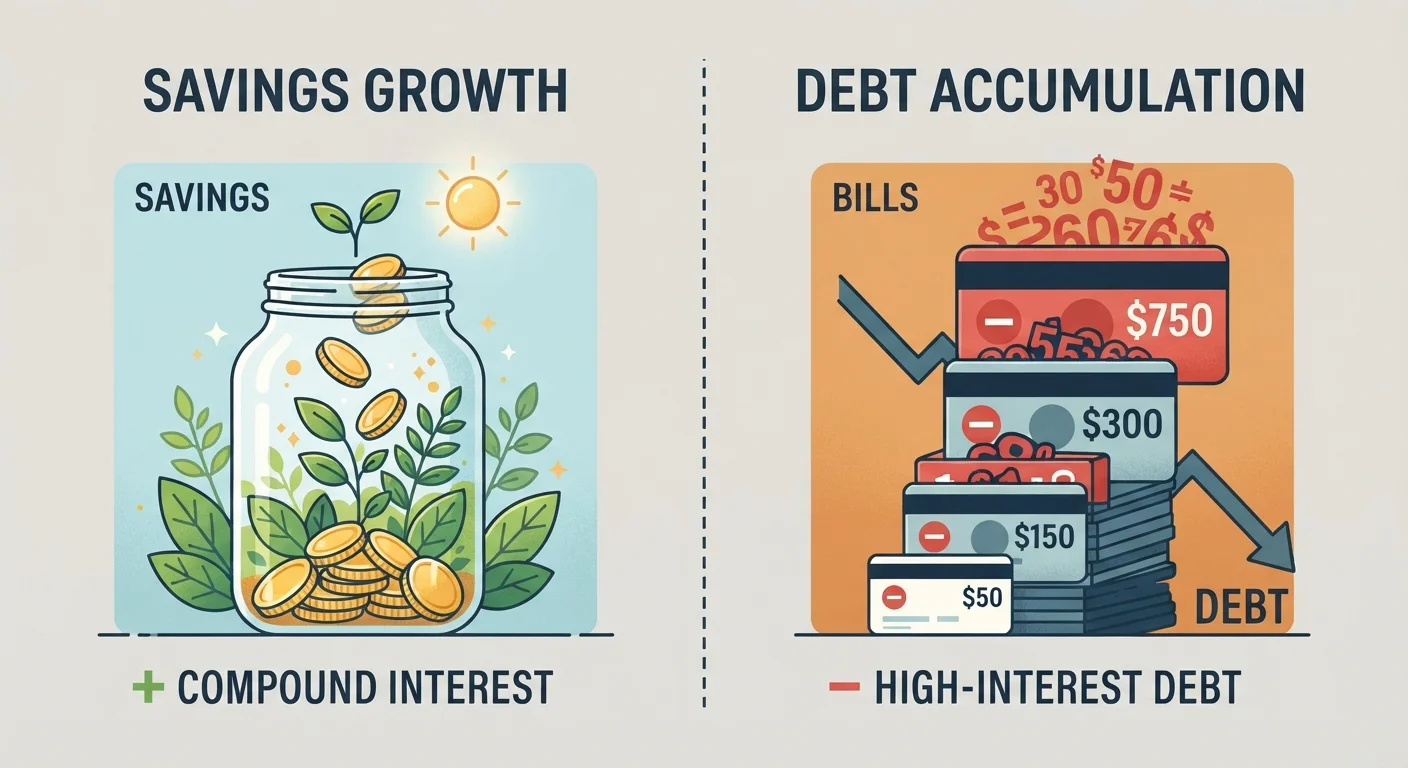
Compound interest is interest calculated not just on your original amount of money, but also on any interest that has already been added to it. Over time, this means your balance — whether savings or debt — grows faster and faster. The longer the time frame, the more dramatic the effect.
The standard compound interest formula is A = P(1 + r/n)^(nt), where P is the principal, r is the annual interest rate, n is the number of compounding periods per year, and t is time in years.
The Core Idea: Interest on Interest
Most people learn about interest as a simple concept: borrow money, pay a percentage back. But compound interest adds a twist that changes everything. Each time interest is calculated, it gets added to the balance — and the next calculation uses that larger number.
Think of it as a snowball rolling downhill. At first, the growth seems modest. But each rotation picks up more snow, and before long, a small ball has become something much larger. The same math applies whether you're growing savings or carrying debt.
For anyone trying to build a financial safety net or dig out of debt, understanding this mechanism is non-negotiable. It's one of the most powerful forces in personal finance — and it doesn't care which side of it you're on. See our plain-language glossary of key financial terms for definitions of related concepts like APR and APY.
22%+
Average credit card APR in the U.S.
According to Federal Reserve data, average credit card interest rates have reached historically high levels, making compounding on carried balances especially costly.
Daily
How often most credit cards compound interest
Most U.S. credit card issuers calculate interest daily using the daily periodic rate, meaning balances grow faster than monthly compounding would suggest.
10 years
Time to double money at 7% with compounding
Using the Rule of 72 — a common approximation — dividing 72 by the interest rate gives the approximate years to double a balance; at 7%, that's roughly a decade.
When Compounding Works For You: Savings and Investing
In a savings account or investment portfolio, compound interest is your ally. You deposit money, it earns interest, and that interest gets added to your balance. The next cycle, interest is calculated on the new, larger amount — and so on.
The critical variable is time. Someone who begins saving at 25 will, in general, accumulate more wealth by retirement than someone who starts at 35 — even if the later saver contributes more per month. This isn't magic; it's math. Early contributions simply have more compounding cycles to work through.
Automate to Let Compounding Do Its Job
Setting up automatic recurring transfers to a savings account removes the temptation to spend first and save later. Because compounding rewards consistency over time, even modest automated contributions can compound meaningfully over years. Start with whatever amount you can sustain — the habit matters more than the size.
Compounding frequency also matters. An account that compounds daily produces slightly more growth than one that compounds monthly at the same rate. This is why financial institutions report APY (Annual Percentage Yield) — it reflects the true annual return after compounding is included, making it easier to compare accounts accurately.
For a deeper look at how compounding applies to long-term investing, see how compound interest drives long-term wealth.
When Compounding Works Against You: Debt
The same engine that grows savings can quietly devastate a debt balance. Credit cards are the most common example. Most card issuers compound interest daily, then apply the accumulated charge to your statement each month.
Carry a $3,000 balance at 22% APR and make only minimum payments? You'll pay far more than $3,000 before that debt is cleared — and it can take years. The balance doesn't shrink steadily; interest keeps getting added on top of interest. Our related article explains exactly what minimum payments cost you over time.
The practical takeaway: every dollar of unpaid balance is a base for future interest charges. Paying only the minimum is rarely a path out of debt — it's often closer to treading water.
Putting It to Work: Practical Steps
Understanding compound interest is most useful when it changes behavior. A few principles apply broadly:
- On savings: Start as early as you can, even with small amounts. Time in the market or in a savings account matters more than the size of individual deposits in the long run.
- On debt: Pay more than the minimum whenever possible. Extra payments reduce the principal — the base amount interest is calculated on — which slows the compounding effect directly.
- On rate shopping: A higher APY on savings and a lower APR on debt both reduce the impact of compounding in the wrong direction. These numbers are worth comparing when choosing accounts or managing balances.
It's also worth questioning some common assumptions about saving. Separating savings myths from financial reality addresses why many people underestimate what's possible on a modest income.
Compounding Frequency Varies by Account
Not all accounts compound at the same rate. Some savings accounts compound monthly; others compound daily. The difference on small balances over short periods is minor, but it adds up over years. Always check your account's terms and compare APY — not just the stated interest rate — when evaluating savings options.
This article is for general informational purposes only and does not constitute personalized financial or investment advice. Consult a qualified financial professional for guidance specific to your situation.