

Key Takeaways
Option A
Fine Motor Skills
The precision powerhouse of small-scale movement.
Best for: Understanding how children develop hand-eye coordination, grip strength, and the dexterity needed for writing, drawing, and self-care tasks.
Option B
Gross Motor Skills
The foundation of big-body movement and physical confidence.
Best for: Tracking how children build strength, balance, and coordination for activities like walking, jumping, climbing, and playing.
If your child struggles with holding crayons, using utensils, or buttoning clothes
Fine Motor Skills
These tasks rely on fine motor precision. Targeted activities like threading beads or playing with playdough can help, alongside pediatric occupational therapy if concerns persist.
If your child seems unsteady, avoids physical play, or has trouble with running and climbing
Gross Motor Skills
Balance, coordination, and large-muscle strength are gross motor concerns. Active outdoor play and pediatric physical therapy evaluation can both be valuable.
If you want to support overall development proactively
Fine Motor Skills
Fine motor development is often underestimated. Incorporating hands-on play early builds the dexterity children need for school readiness and independence.
If you're tracking developmental milestones for an infant or toddler
Gross Motor Skills
In the earliest years, gross motor progress — rolling, sitting, standing, walking — is typically the most visible and frequently monitored set of milestones.
What Makes These Two Skill Types Different?
Motor development refers to how children gain control over their bodies through muscle use and coordination. But not all movement is the same — developmental specialists distinguish between fine motor skills and gross motor skills because they involve different muscle groups, serve different functions, and follow slightly different developmental timelines.
Fine motor skills involve the small muscles of the hands, fingers, wrists, and face. Think of the careful pinch a toddler uses to pick up a blueberry, or the grip a preschooler develops around a crayon. These skills are foundational for writing, self-feeding, dressing, and eventually, academic tasks like drawing or cutting with scissors.
Gross motor skills, by contrast, engage the large muscle groups of the legs, arms, torso, and core. Rolling over, sitting upright, crawling, walking, jumping, and throwing a ball all fall into this category. Gross motor development is often the more visible kind — parents notice it clearly in a baby's first steps or a toddler's first run across the yard.
Importantly, these two skill categories don't develop in isolation. Gross motor control generally lays the groundwork for fine motor precision. A child needs a stable, well-supported torso before those small hand muscles can do refined work. That's why pediatric occupational therapists often look at both together. See our overview of child development research for broader context on how physical and cognitive growth intertwine.
| Criterion | Fine Motor Skills | Gross Motor Skills |
|---|---|---|
| Muscle groups involved | Small muscles: hands, fingers, wrists | Large muscles: legs, arms, core |
| Early milestone example | Pincer grasp (~9 months) | Sitting without support (~6–8 months) |
| Preschool milestone example | Cutting with scissors, drawing shapes | Hopping on one foot, skipping |
| School readiness link | Writing, drawing, self-care tasks | PE participation, recess play |
| Typical specialist involved | Occupational therapist | Physical therapist |
| Key supporting activity | Playdough, puzzles, threading beads | Climbing, ball play, running games |
How Each Type of Skill Develops Across Early Childhood
Both fine and gross motor skills follow predictable sequences — though the pace at which children move through them varies considerably. Developmental ranges are wide for good reason: healthy children develop at their own tempo.
Birth to 12 Months
In the first year, gross motor development is front and center. Babies progress from lifting their heads during tummy time to rolling, sitting without support, and often pulling to stand by their first birthday. Fine motor development runs alongside: the early reflexive grasp gradually becomes an intentional reach, and by around 9 months many infants are mastering the pincer grasp — using thumb and forefinger to pick up small objects.
Ages 1–3
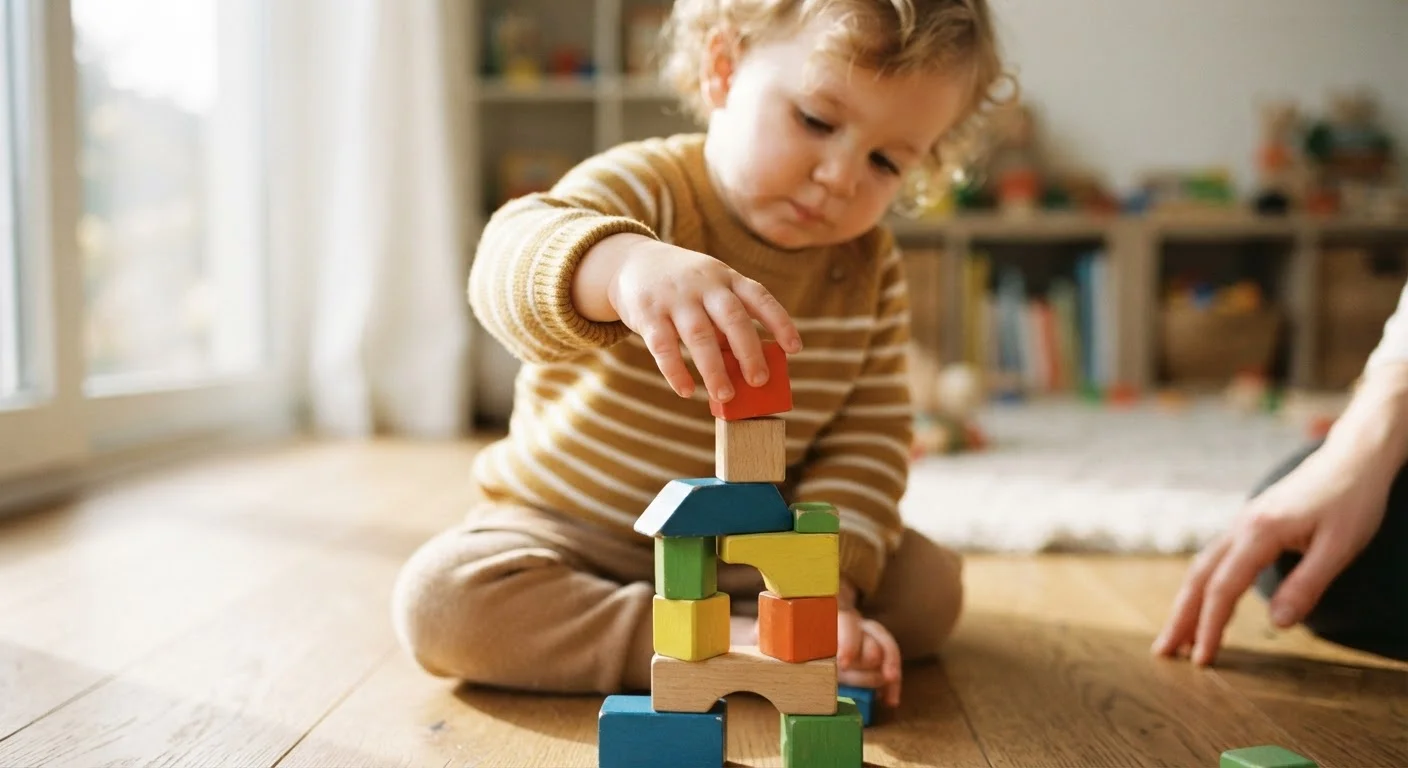
Toddlers become increasingly mobile, refining their walking gait and beginning to run, climb, and kick a ball. Fine motor skills accelerate too: stacking blocks, scribbling with crayons, and turning pages in a board book are hallmark achievements. Self-care tasks like holding a spoon begin in earnest during this window.
Ages 3–5
Preschoolers develop more sophisticated versions of both skill types. Gross motor milestones include hopping on one foot, skipping, and catching a bounced ball. Fine motor precision sharpens noticeably — children begin using scissors, drawing recognizable shapes, and forming early letters. These fine motor gains are closely tied to school readiness; pre-literacy skills like writing letters depend heavily on fine motor control.
1 in 20
Children with developmental coordination disorder
According to the American Academy of Pediatrics, developmental coordination disorder — affecting both fine and gross motor function — is estimated to affect approximately 5–6% of school-age children.
Age 3
Upper limit for free early intervention services in most US states
Under the federal Individuals with Disabilities Education Act (IDEA), children under age 3 with developmental delays may qualify for early intervention services; states manage eligibility criteria.
Parents sometimes misinterpret the range of typical development as a sign something is wrong. Our guide to commonly misread milestones explores this in depth.
What Delays Might Signal — and When to Seek Guidance
A delay in one area of motor development doesn't automatically mean something is wrong — but it's always worth discussing with your child's pediatrician. Early intervention, when needed, tends to produce better outcomes, so erring on the side of asking questions is never a mistake.
Signs worth raising with a pediatrician for gross motor concerns include: not sitting independently by 9 months, not walking by 18 months, persistent toe-walking past age 3, or significant difficulty with balance and coordination compared to same-age peers.
Fine motor red flags may include: persistent fisting of hands past 3 months, difficulty with a pincer grasp by 12 months, inability to stack two blocks by 18 months, or trouble holding a crayon or using utensils by age 3.
Keep in mind that motor development doesn't unfold in a vacuum — it connects to language, social-emotional growth, and cognition. Common ways parents misjudge development often involve comparing children to siblings or applying overly rigid timelines. Every child's profile is unique.
Play Is the Best Motor Workout
You don't need structured exercises or specialized equipment to support motor development. Everyday play — digging in sand, climbing at a playground, stringing pasta, or finger painting — naturally builds both fine and gross motor skills. The most effective "intervention" for most children is simply ample time for unstructured, active play across a variety of environments.
This article is for general informational purposes only and is not a substitute for professional medical advice. If you have concerns about your child's development, please consult your child's pediatrician or a qualified developmental specialist.